
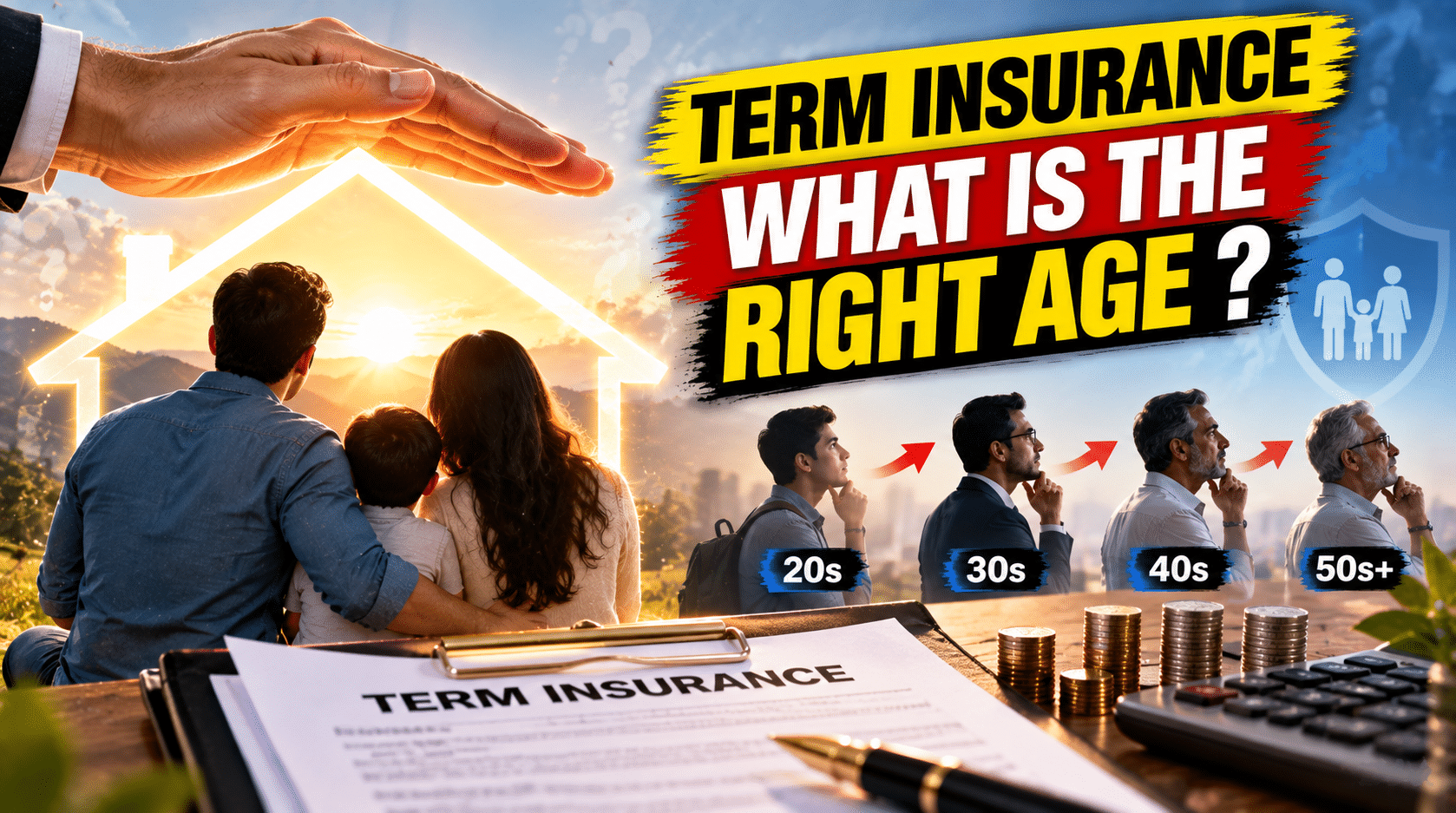
Term Insurance Age Limit: Buying term insurance is one of those financial decisions that many people keep postponing. Some think they should wait until marriage; others wait until they have children, while many only start considering it after taking a home loan.
But there is an important factor that can change the cost and availability of a term plan: your age when you buy it.
The earlier you enter a term insurance policy, the more likely you are to get access to longer policy terms and comparatively lower premiums, provided you meet the insurer’s underwriting requirements. At the same time, buying in your 40s or 50s does not automatically mean you are too late.
So, what is the term insurance age limit in India? Is there really a perfect age to buy a policy? And what changes if you wait until your 30s, 40s, or 50s?
Let’s break it down.
What Is the Term Insurance Age Limit?
The term insurance age limit refers to the minimum and maximum age at which an insurer allows someone to enter a particular term insurance plan.
In India, many insurers generally allow entry from around 18 years, while the maximum entry age is commonly in the 60–65-year range. However, this is not a universal rule. The actual eligibility depends on the insurer, product, policy term, health profile, and other underwriting conditions.
It is therefore important to check the specific policy’s eligibility criteria rather than assuming that every term plan has exactly the same age limit.
What Is the Right Age to Buy Term Insurance?
There is no single age that works for everyone.
Your financial responsibilities matter just as much as your age. If you have a spouse, children, dependent parents, loans, or other people relying on your income, life cover can become an important part of your financial protection plan.
From a pricing perspective, younger applicants generally have an advantage because age is one of the factors insurers consider when calculating risk and premiums.
In simple terms:
The question isn’t only “How old am I?” — it is also “Who depends on my income, and what financial obligations would remain if I were no longer around?”
Term Insurance in Your 20s
For many people, their 20s are the beginning of their earning years.
You may not have a home loan or children yet, but this is also the period when you can potentially lock in a long policy term at a comparatively lower premium, subject to the insurer’s underwriting.
Why people consider term insurance in their 20s:
- Premiums are generally lower at younger ages.
- Longer policy terms may be available.
- You can establish financial protection early.
- Future family responsibilities can be planned for.
- You may have fewer health-related underwriting complications.
However, someone in their early 20s without financial dependents may have a different level of insurance need than someone who is already supporting a family.
So buying early can be advantageous from a pricing perspective, but the amount of cover should still match the person’s actual financial situation.
Term Insurance in Your 30s
For many Indians, the 30s are when financial responsibilities increase rapidly.
Marriage, children, home loans, car loans, education planning, and support for parents can all become part of the financial picture.
This makes the 30s an important period for reviewing life insurance needs.
A person who bought a term plan earlier may already have protection in place. Someone who hasn’t purchased one yet can still apply, although the premium for comparable cover may be higher than it would have been at a younger age.
What changes in your 30s?
The focus generally shifts from simply getting affordable cover to ensuring that the cover is actually large enough for your responsibilities.
A policy should be considered in the context of:
- Outstanding loans
- Number of dependents
- Current income
- Future family expenses
- Children’s education goals
- Existing savings and investments
Term Insurance in Your 40s
Reaching your 40s does not mean you have missed your opportunity to buy term insurance.
In fact, this can be one of the stages when adequate life cover becomes particularly relevant because financial commitments may be at their highest.
You may have a large home loan, children’s education expenses, and several years of working income still supporting your household.
The trade-off is that premiums can be higher compared with buying a similar policy at a younger age.
Health underwriting may also become more important.
Should someone in their 40s still consider term insurance?
Yes, if there are financial dependents or significant liabilities that would create a problem for the family in the event of the policyholder’s death.
The important thing is not to assume that being older automatically makes term insurance irrelevant.
Term Insurance in Your 50s
The situation becomes more nuanced in your 50s.
Depending on the insurer and product, the available policy options may become more limited, while premiums can be significantly higher than those available to younger applicants.
Health checks and underwriting can also become more relevant.
But there are still situations where life cover can make financial sense.
For example, someone may still have:
- A substantial home loan
- Dependent family members
- Business liabilities
- Financial commitments towards children
- A spouse who depends on their income
The appropriate policy term and coverage amount should be considered carefully in such cases.
Can You Buy Term Insurance After 60?
It depends on the insurer and the specific product.
Some term insurance plans may accept applicants at older ages, but the choices can become more limited, and premiums may be higher.
The commonly seen maximum entry age for many term plans is around 60 to 65, although individual products can differ.
Therefore, if you are approaching 60 and are considering new life cover, it is important to compare actual policy eligibility rather than relying on a general age limit.
How Does Age Affect Term Insurance Premium?
Age is one of the factors used in determining the premium for term insurance.
For otherwise comparable coverage, a younger applicant will generally pay less than an older applicant because insurers assess mortality and health-related risks over the policy term.
This is one reason people often hear the advice to purchase term insurance early.
However, age isn’t the only factor.
The premium and eligibility can also depend on:
- Health history
- Smoking or tobacco use
- Lifestyle
- Occupation
- Sum assured
- Policy term
- Riders
- Medical examination
- Income and financial profile
- Underwriting assessment
So two people of exactly the same age can still receive different premium quotes.
Does the Premium Increase Every Year After Buying a Term Plan?
For a standard level-premium term policy, the premium structure is generally determined when the policy is purchased, subject to the specific policy terms.
That means delaying the purchase can matter because buying later can result in a higher starting premium for comparable cover.
It is therefore useful to distinguish between:
“Premium becoming higher because I bought later”
and
“Premium increasing every year after I bought the policy.”
These are not necessarily the same thing.
Always check the policy’s premium schedule and terms before purchasing.
How Much Term Insurance Cover Do You Need?
There is no universal number that works for every person.
A suitable amount of cover should be linked to the financial loss your family could face if your income suddenly disappeared.
You can consider:
Outstanding loans + future major expenses + family financial needs − existing financial resources
This isn’t a formal insurance formula, but it is a useful starting framework.
For example, someone with a large home loan, young children, and a dependent spouse may have a very different insurance requirement from a single person with no major liabilities.
The goal should be to choose coverage that is meaningful for the family’s actual financial situation rather than simply selecting a large round figure.
Why Policy Tenure Matters
Age doesn’t only influence premium.
It can also affect how long you can potentially keep the policy.
Someone purchasing term insurance in their 20s may have access to a much longer policy horizon than someone entering a new policy in their 50s or 60s.
This is another reason age should be considered alongside financial responsibilities.
The right policy term depends on factors such as:
- Current age
- Retirement plans
- Loan tenure
- Children’s age
- Expected earning years
- Financial dependents
What Happens If You Already Have a Term Plan?
If you already have a term insurance policy, don’t assume you need another one simply because your income or responsibilities have changed.
Instead, review whether your existing coverage is still adequate.
For example, your financial situation may have changed because you:
- Got married
- Had children
- Bought a house
- Took a large loan
- Started a business
- Experienced a major increase in income
Some insurers may allow additional coverage through specific product features or life-stage benefits, while buying another policy can also be possible, subject to underwriting and eligibility.
The important thing is to evaluate the total protection rather than focusing on one policy in isolation.
Can You Have More Than One Term Insurance Policy?
Yes, it can be possible to hold multiple term insurance policies.
However, insurers will consider factors such as income, existing insurance coverage, financial responsibilities, and underwriting requirements.
Having multiple policies does not automatically mean that you should buy more cover.
The combined amount should have a clear financial purpose.
Does Health Matter More as You Get Older?
Health becomes increasingly relevant during insurance underwriting as age rises.
An insurer may ask about existing illnesses, medical history, lifestyle habits, and other risk factors. Depending on the circumstances, medical examinations may also be required.
A health condition does not automatically mean that someone cannot obtain term insurance. However, it can affect eligibility, premium rates, coverage or policy terms depending on the insurer’s assessment.
That is why complete and accurate disclosure on the application is extremely important.
What About Tax Benefits?
Term insurance may have tax implications and benefits depending on the premium, policy structure, and prevailing income-tax rules.
The original syndicated report notes deductions under Section 80C and tax treatment of death benefits under Section 10(10D), subject to applicable conditions.
Because tax rules can change and treatment can depend on the policy and taxpayer’s circumstances, buyers should verify the current rules before relying on a tax benefit as the main reason for purchasing a policy.
So, What Is the Best Time to Buy Term Insurance?
There isn’t a magic birthday at which everyone should buy term insurance.
A better way to think about it is this:
Buy life cover when there is a genuine financial need for protection — and don’t unnecessarily delay once that need exists.
A younger age can offer the advantage of lower premiums and potentially longer policy terms. But someone in their 30s, 40s or even 50s may still have a significant need for financial protection.
The right decision depends on the combination of age, dependents, liabilities, income, health and desired policy term.
Final Takeaway
Term insurance is primarily about protecting the people who depend financially on you.
The age at which you purchase it can influence the premium, available policy options and potential policy duration. In general, buying earlier can make comparable coverage more affordable, but there is no universal age that is automatically right for every individual.
If you are already earning and have people or liabilities that depend on your income, it is worth assessing your life-cover requirement rather than simply waiting for a particular age or life event.
And if you’re already in your 40s or 50s, don’t assume the opportunity has passed. Depending on the insurer and your profile, term insurance may still be available.
Term Insurance Age Limit at a Glance
| Age Group | What to Consider |
|---|---|
| 20s | Generally lower premiums and potentially longer policy terms |
| 30s | Growing family responsibilities, loans, and income protection |
| 40s | Higher responsibilities may make adequate cover important |
| 50s | Higher premiums and potentially fewer options; assess liabilities carefully |
| 60+ | Eligibility becomes more insurer- and product-specific |
Frequently Asked Questions (FAQs)
1. What is the minimum age to buy term insurance in India?
Many term insurance plans allow entry from around 18 years, although eligibility varies by insurer and product.
2. What is the maximum age to buy term insurance?
For many plans, the maximum entry age is around 60 to 65 years, but the exact limit depends on the insurer and policy.
3. What is the best age to buy term insurance?
There is no universal best age. Younger applicants generally benefit from lower premiums, while the actual need for insurance depends on financial dependents, loans, income, and other responsibilities.
4. Is it too late to buy term insurance after 40?
No. People in their 40s can still consider term insurance, particularly when they have dependents or substantial financial liabilities. Premiums may be higher than for a younger applicant.
5. Can I buy term insurance after 50?
Some insurers offer term insurance to applicants in their 50s, subject to their eligibility and underwriting requirements. Options may be more limited, and premiums may be higher.
6. Can a 60-year-old buy term insurance?
It can be possible with certain insurers and products, but eligibility varies. At this age, applicants should carefully compare entry-age limits, premium costs, and available policy terms.
7. Does term insurance premium increase with age?
Generally, buying the same type of coverage at a later age can result in a higher premium because age is an important risk factor used in underwriting.
8. Does health affect term insurance eligibility?
Yes. Health history, existing medical conditions, lifestyle, and medical-test results can influence underwriting, premiums, and eligibility.
9. Can I have two term insurance policies?
Yes, holding multiple term policies can be possible, subject to insurer underwriting and eligibility requirements. The total cover should be appropriate for your income and financial responsibilities.
10. How much term insurance should I buy?
The amount depends on your income, dependents, outstanding loans, future financial obligations, and existing assets or insurance. There is no single coverage amount suitable for everyone.
11. Can term insurance cover last until age 99 or 100?
Some policies offer very long coverage periods, potentially extending to ages such as 99 or 100, but the available policy term depends on the specific insurer and product.
12. Is term insurance only useful for married people?
No. The need for life insurance depends primarily on financial responsibilities and people who would be financially affected by your death. A single person may also have dependents, loans, or other obligations that justify life cover.