
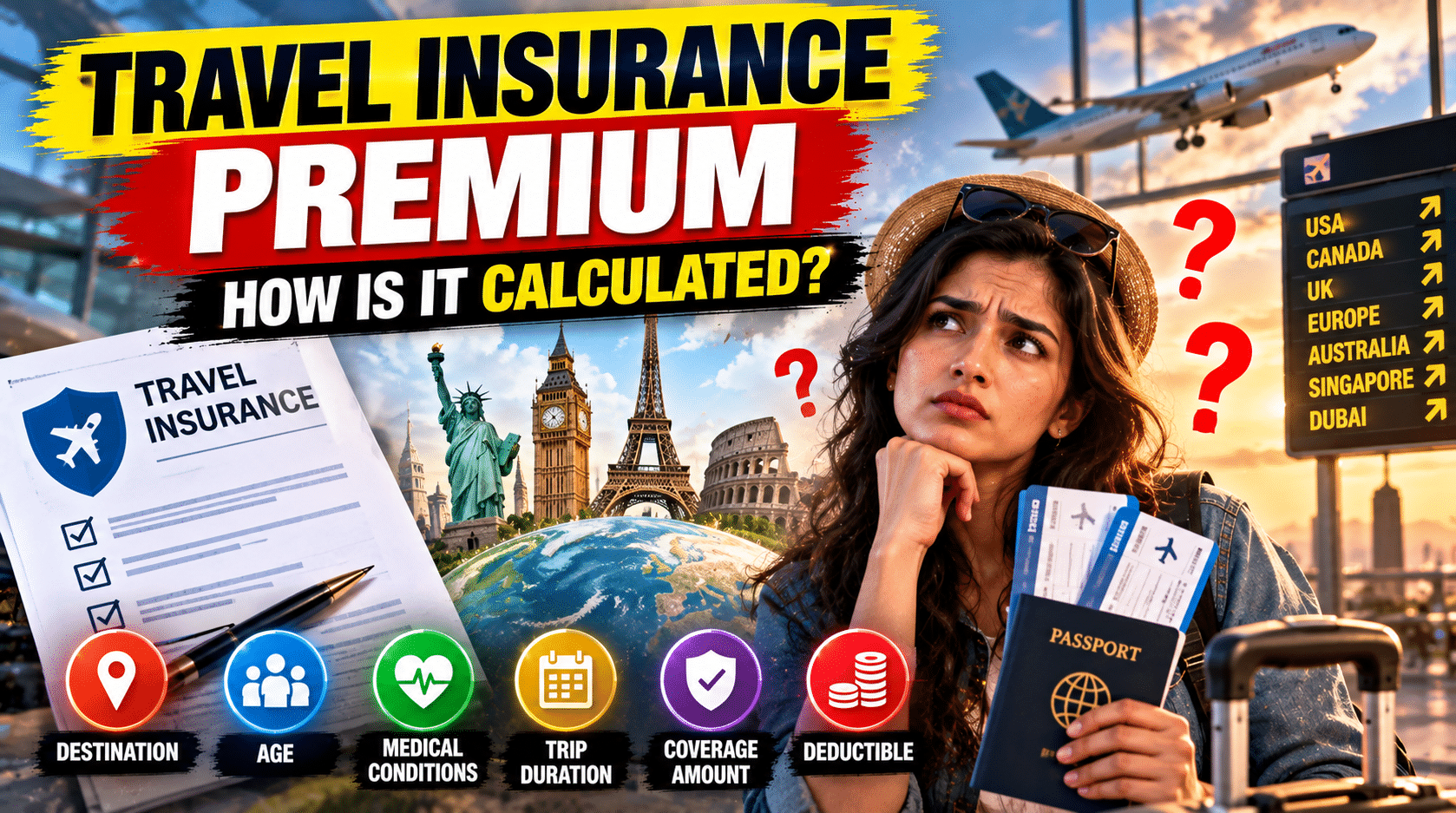
Travel Insurance Premium: Planning an international trip often means thinking about flights, hotels, visas, and sightseeing. But there is another expense that many travellers overlook until the last moment — travel insurance.
Two people travelling to different countries for the same number of days can end up paying very different insurance premiums. Even for the same destination, the premium can change depending on the traveller’s age, medical history, coverage amount, and other policy choices.
So, what exactly decides the price of travel insurance?
The answer is not simply the number of days you are travelling. Insurers look at several risk-related factors while calculating the premium. Destination, age, pre-existing medical conditions, trip duration, coverage amount, and deductible can all influence the final price.
Understanding these factors can help you compare policies more intelligently instead of choosing a plan simply because its premium looks cheap.
What Is Travel Insurance Premium?
A travel insurance premium is the amount you pay to an insurance company to obtain coverage for the risks included in your travel policy.
Depending on the plan, travel insurance may provide protection against expenses or losses associated with events such as:
- Emergency medical treatment
- Hospitalisation during the trip
- Accidental injury
- Trip cancellation or interruption
- Checked baggage loss or delay
- Passport loss
- Travel delays
- Personal liability
- Other benefits specified in the policy
The exact coverage differs from one policy to another, so the cheapest premium does not necessarily mean the policy provides the protection you actually need.
How Is Travel Insurance Premium Calculated?
There is no single flat rate that applies to every traveller.
Insurers generally consider the level of risk associated with the journey and the coverage being purchased. A trip to a country where medical treatment is extremely expensive can cost more to insure than a trip to a lower-cost destination.
Similarly, a longer trip creates a longer period during which an insured event could occur.
Here are the six major factors that can influence your travel insurance premium.
1. Destination Can Make a Big Difference
One of the first things insurers consider is where you are travelling.
This is important because the cost of medical treatment can vary dramatically between countries.
For example, medical treatment in countries such as the United States and Canada can be significantly more expensive than in many other destinations. As a result, travel insurance with substantial medical coverage for such destinations can cost more.
This does not mean that every trip to an expensive country will have the same premium. The final price still depends on other factors such as age, duration, and coverage.
Why does destination matter?
Imagine two travellers:
Traveller A:
Travelling to a relatively low-cost medical destination for one week.
Traveller B:
Travelling to the US for one week with high medical coverage.
Even though both trips last seven days, their insurance requirements and potential claim exposure can be very different.
That’s why travellers should not choose coverage only by looking at the minimum amount required for a visa. The actual medical expenses at the destination also matter.
2. Your Age Can Affect the Premium
Age is another important factor in travel insurance pricing.
As travellers get older, the likelihood of requiring medical assistance during a trip can increase. Consequently, premiums can be higher for older travellers, particularly in senior age groups.
This is particularly relevant for families travelling with senior citizens.
For example, a policy covering:
- A 25-year-old traveller
- A 40-year-old traveller
- A 68-year-old traveller
may not have the same premium even when the destination and trip duration are identical.
Some travel insurance products also have specific age eligibility conditions or different benefits for senior travellers. Therefore, it is important to check the policy wording rather than assuming that every plan covers every age group in exactly the same way.
3. Pre-Existing Medical Conditions Can Change the Cost
Your existing health conditions can also influence the premium and, more importantly, the scope of coverage.
Conditions such as diabetes, hypertension, or other ongoing medical issues may require additional underwriting or special terms depending on the insurer and policy.
Some plans may provide coverage for certain pre-existing conditions under specified circumstances, while others may exclude them or offer limited coverage.
This is why travellers should never hide a medical condition simply to obtain a lower premium.
Travel insurance policies define pre-existing conditions in their policy wording, and the exact definition can vary by product. For example, IRDAI-hosted travel policy documents contain specific definitions based on prior diagnosis, treatment, or medical advice.
A lower premium is of little use if a claim later becomes disputed because important medical information was not disclosed.
What should travellers do?
Before buying the policy:
- Disclose relevant medical conditions honestly.
- Check whether pre-existing diseases are covered.
- Read the exclusions carefully.
- Understand any additional premium or special conditions.
- Check whether medical treatment related to an existing condition is covered.
4. Trip Duration Directly Influences the Premium
The longer you stay abroad, the longer the period during which you are exposed to insured risks.
As a result, travel insurance premiums generally increase with the duration of the trip.
For example, insurance for:
7 days
will generally cost less than coverage for:
30 days
assuming other factors remain comparable.
This is especially important for travellers planning long vacations, business trips, study programmes or extended family visits.
Single-trip vs Multi-trip Insurance
If you travel several times internationally in a year, you may also come across annual multi-trip insurance.
Instead of purchasing separate insurance for every journey, an annual policy can cover multiple trips subject to the policy’s terms and maximum duration allowed for each trip.
Whether it works out cheaper depends on your travel frequency, destinations, and the specific plan.
5. Higher Coverage Can Increase the Premium
Another important factor is the sum insured or coverage amount.
Suppose one policy offers a relatively low level of emergency medical coverage while another provides substantially higher protection.
The second policy can have a higher premium because the insurer is potentially taking on a larger financial exposure.
However, choosing the lowest possible coverage simply to save money may not always be sensible.
This is particularly relevant when travelling to countries with expensive healthcare systems.
For example, a hospitalisation in the US can potentially involve very large medical expenses, so travellers should consider the cost of healthcare at their destination when deciding how much medical coverage they need.
The right question is therefore not:
“Which policy has the lowest premium?”
Instead, ask:
“Does the coverage provide reasonable protection for the destination I am visiting?”
6. Deductible Choice Can Change What You Pay
The deductible is another factor that can affect the premium.
A deductible is the portion of an eligible claim that the insured may have to bear according to the policy terms before the insurer pays the remaining eligible amount.
In some insurance products, choosing a deductible can result in a lower premium.
That may sound attractive, but there is an important trade-off.
A lower premium could mean that you agree to bear a larger portion of certain eligible expenses yourself.
Therefore, don’t compare travel insurance policies only by their headline premium.
Check:
- Deductible amount
- Medical coverage
- Claim limits
- Exclusions
- Sub-limits
- Coverage for baggage
- Trip cancellation benefits
- Emergency assistance
A policy costing slightly more may have materially different terms.
Why Two Travellers Can Get Different Travel Insurance Quotes
Consider these two hypothetical travellers:
| Factor | Traveller A | Traveller B |
|---|---|---|
| Age | 28 | 67 |
| Destination | Europe | USA |
| Trip duration | 7 days | 30 days |
| Medical history | No declared condition | Existing medical condition |
| Coverage | Moderate | Higher |
| Deductible | Selected | Lower/no deductible |
Even though both travellers are buying travel insurance, their risk profiles are very different.
Therefore, it would be normal for insurers to quote different premiums.
This is why copying another traveller’s policy or assuming that a friend’s premium will apply to you can be misleading.
Does a Cheap Travel Insurance Policy Mean It Is Better?
Not necessarily.
A low premium may be attractive, but you should first understand what you are actually getting.
A cheaper policy may have:
- Lower medical coverage
- Higher deductible
- More exclusions
- Lower baggage compensation
- Limited cancellation coverage
- Specific age restrictions
- Fewer add-on benefits
Instead of comparing only the price, compare the coverage-to-cost relationship.
What Should You Check Before Buying Travel Insurance?
Before paying for a travel policy, go through these points.
Check the Medical Cover
This can be one of the most important benefits for international travel.
Consider the healthcare costs in your destination and choose an appropriate coverage level.
Read the Exclusions
Do not assume that every medical emergency, activity, or travel disruption is covered.
Read the exclusions carefully.
Check Pre-Existing Disease Conditions
If you have any existing medical condition, understand exactly whether and under what circumstances it is covered.
Check the Deductible
A low premium can sometimes come with a deductible. Know how much you may have to pay yourself.
Look at Trip Cancellation and Interruption Benefits
If cancellation protection matters to you, check:
- What events are covered?
- What expenses are eligible?
- What are the limits?
- What exclusions apply?
Check Baggage Protection
Find out whether the policy covers:
- Lost baggage
- Delayed baggage
- Damaged baggage
and check the applicable limits and conditions.
5 Simple Ways to Avoid Paying More Than Necessary
You don’t necessarily need to choose the cheapest policy. Instead, focus on buying appropriate coverage without paying for benefits you don’t need.
1. Compare Multiple Policies
Premiums and coverage can vary between insurers, so compare the actual benefits rather than relying on one quote.
2. Buy According to Your Destination
Don’t choose coverage blindly. A trip to a high-cost healthcare destination may require more medical protection.
3. Don’t Hide Medical Information
Saving a little on the premium by withholding relevant information can create much bigger problems during a claim.
4. Review Add-Ons
Additional covers can increase the premium. Select them based on your actual trip rather than adding every optional benefit automatically.
5. Check the Deductible Before Buying
A policy with a lower premium may have a deductible. Make sure you understand the amount and circumstances in which it applies.
Is Travel Insurance Worth Buying?
For international travel, travel insurance can provide financial protection against unexpected events, particularly medical emergencies and travel disruptions.
Whether a particular policy is suitable depends on your destination, trip type, age, health situation, planned activities, and financial requirements.
The important thing is not simply to buy “travel insurance.”
It is to buy a policy whose coverage matches the risks of your particular trip.
Final Takeaway
Travel insurance premiums are not calculated randomly.
The price you see is influenced by several factors, with destination, age, pre-existing medical conditions, trip duration, coverage amount, and deductible being among the key considerations.
For travellers, the biggest mistake is to compare policies only on premium.
A policy that costs less may provide lower coverage or come with conditions that matter when you actually need to make a claim.
Before buying, look beyond the price tag. Check the medical coverage, exclusions, deductible, pre-existing disease conditions, trip duration, and destination-specific risks.
A few extra minutes spent reading the policy today can make a significant difference if an unexpected problem occurs during your journey.
Frequently Asked Questions (FAQs)
1. What factors affect travel insurance premiums?
The major factors include the destination, traveller’s age, trip duration, coverage amount, pre-existing medical conditions, and deductible.
2. Does age affect travel insurance costs?
Yes. Older travellers may generally pay higher premiums because insurers may consider them to have a higher medical risk.
3. Does the destination affect travel insurance premium?
Yes. Destinations with higher healthcare costs can result in higher premiums, particularly when substantial medical coverage is selected.
4. Does a longer trip cost more to insure?
Generally, yes. A longer trip means a longer period of exposure to insured risks, which can increase the premium.
5. Do pre-existing diseases affect travel insurance?
They can. Depending on the policy, pre-existing conditions may affect eligibility, coverage, or premium. Travellers should disclose relevant conditions and read the policy’s definition and exclusions carefully.
6. Does higher travel insurance coverage increase the premium?
It can. A higher sum insured generally means greater potential financial exposure for the insurer and may therefore result in a higher premium.
7. What is a deductible in travel insurance?
A deductible is the portion of an eligible claim that the insured is required to bear according to the policy terms. Some policies may offer lower premiums when a deductible is selected.
8. Is the cheapest travel insurance policy the best option?
Not necessarily. Premium should be compared alongside medical coverage, exclusions, deductibles, claim limits, and other benefits.
9. Should I buy extra coverage for travelling to the USA?
Travellers should consider the potentially high cost of medical treatment in the US when deciding their coverage amount. The appropriate level depends on the policy, trip, and individual circumstances.
10. How can I reduce my travel insurance premium?
Compare multiple plans, choose coverage based on your actual needs, review optional add-ons, and understand deductible choices. However, avoid reducing important medical coverage simply to obtain a lower premium.