
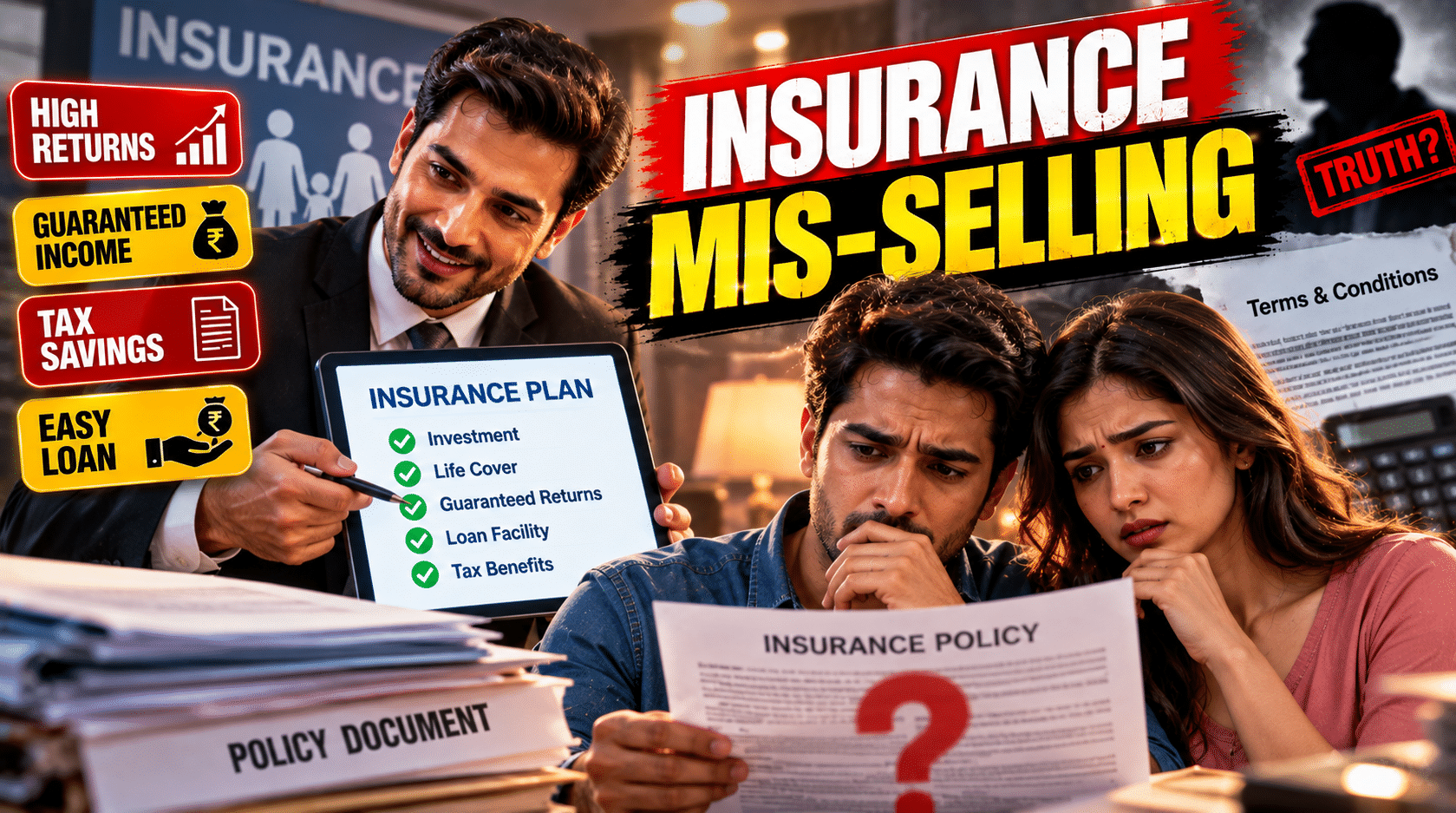
Insurance Mis-Selling: You buy an insurance policy believing it will protect your family, health, or finances when something goes wrong. But what if the policy you purchased is not actually the product you thought you were buying?
This is where insurance mis-selling becomes a serious concern.
Mis-selling can happen when an insurance product is presented in a way that does not properly match the customer’s needs, when important terms are not adequately explained, or when promises are made that are not supported by the actual policy document.
The problem is that the sales conversation can sound attractive at first. A policy may be presented as an investment, a guaranteed income source, a high-return product, or even a way to arrange a loan. Later, the policyholder may discover that the actual terms, charges, benefits or conditions are very different.
IRDAI’s consumer material has specifically documented complaints involving situations such as policies being presented as single-premium plans, promises of high bonuses or returns, policy terms being explained differently from the actual document, and promises of loans.
So, how does insurance mis-selling actually happen, and what can you do to avoid it?
What Is Insurance Mis-Selling?
Insurance mis-selling means selling an insurance product in a way that can mislead the customer about its features, benefits, costs, risks, suitability, or actual terms.
It does not necessarily mean that the insurance company or agent has intentionally committed fraud in every case. Sometimes the problem can arise because the product is poorly explained, important conditions are overlooked, or the sales pitch focuses heavily on benefits while giving little attention to exclusions, charges, or limitations.
The key issue is whether the customer has been given enough accurate information to understand what they are purchasing.
For example, imagine someone is told:
“You will get guaranteed high returns and insurance cover.”
The customer may assume the policy works like a fixed-return investment. But after reading the policy documents, the actual benefits may depend on specific conditions, policy duration, or bonuses.
That difference between what was communicated and what the policy actually provides can become a mis-selling concern.
Why Is Insurance Mis-Selling a Problem?
Insurance is a long-term financial commitment in many cases.
A customer may pay premiums for several years expecting a particular benefit. If the product was unsuitable or misunderstood at the time of purchase, exiting the policy later may not produce the outcome the customer expected.
IRDAI has also highlighted the need for insurers to curb mis-selling and misleading sales that can result in policy surrender or lapse and financial loss to policyholders.
That is why the most important document is not the sales pitch, WhatsApp message or verbal promise.
It is the actual policy document and its applicable terms.
7 Common Ways Insurance Can Be Mis-Sold
1. Presenting Insurance as a High-Return Investment
One common warning sign is when an insurance policy is marketed primarily as an investment opportunity rather than as an insurance product.
A salesperson may focus heavily on future maturity value, bonuses, or projected returns while giving comparatively little attention to the actual insurance coverage and policy conditions.
This can create unrealistic expectations.
Before purchasing, ask:
- What is the actual insurance benefit?
- Which returns are guaranteed and which are not?
- What is the policy term?
- How much premium will I pay in total?
- What happens if I stop paying premiums?
- What will I receive if I surrender the policy early?
Never judge an insurance product solely by a projected maturity amount.
2. Promising Benefits That Are Not Clearly Guaranteed
Words such as “guaranteed,” “fixed,” “assured,” and “confirmed” can sound reassuring.
But they should never be accepted at face value.
The important question is:
Where exactly is this benefit mentioned in the policy document or benefit illustration?
If a salesperson verbally promises a particular amount but the official documentation describes it differently, the written policy terms deserve careful attention.
IRDAI consumer material has identified complaints where customers said they were promised high bonuses or returns that did not match their understanding of the policy.
3. Selling an Insurance Policy as a Loan or Easy-Money Product
Another potential red flag is a promise that buying a particular insurance policy will automatically help you get a loan.
A salesperson may make statements such as:
- “Buy this policy, and you can get a loan.”
- “You will receive money against the policy very easily.”
- “This policy works like a fixed deposit and loan facility.”
However, a loan facility, if available, is subject to the actual product terms and applicable conditions.
A policy should not be purchased simply because someone verbally promises access to easy credit.
IRDAI’s consumer material has specifically listed the promise of a loan among the reported root causes of complaints relating to mis-selling.
4. Hiding or Downplaying Important Policy Conditions
Insurance products can contain several important details, including:
- Exclusions
- Waiting periods
- Lock-in or policy duration
- Premium payment requirements
- Surrender conditions
- Deductibles
- Charges
- Eligibility conditions
- Claim conditions
A sales discussion that focuses only on attractive benefits without properly explaining relevant limitations can leave the buyer with an incomplete understanding of the product.
That is why you should never buy a policy based only on a short presentation or verbal explanation.
5. Selling a Product Without Understanding the Customer’s Need
Not every insurance product is suitable for every customer.
For example, someone primarily looking for pure life protection may be shown a savings-oriented insurance product without a proper discussion of their financial goals, existing insurance coverage, and ability to pay premiums over the long term.
Similarly, a customer looking for health protection may purchase an unsuitable policy simply because the salesperson focuses on one attractive feature.
IRDAI’s consumer material has discussed need-based assessment and financial suitability as part of measures intended to prevent mis-selling.
Before buying, ask yourself:
“What financial problem am I actually trying to solve with this policy?”
That single question can prevent many poor decisions.
6. Giving a Different Explanation Than What the Policy Says
This is one of the most important things customers should watch for.
Suppose the salesperson explains:
“You only need to pay once.”
But the policy document actually requires premiums for several years.
Or you are told:
“You can withdraw the money whenever you want.”
But the actual policy has specific surrender conditions.
Such differences can create serious confusion.
IRDAI’s consumer material has documented complaints where customers said the product terms explained to them differed from the terms stated in the policy document.
The simple rule is:
If a benefit matters to you, make sure you can find it in the official documents.
7. Pressuring the Customer to Buy Immediately
High-pressure sales tactics can also lead to poor insurance decisions.
You may hear statements such as:
- “This offer is only available today.”
- “You have to complete it right now.”
- “Don’t worry about reading the documents.”
- “I’ll explain everything later.”
- “Just sign here.”
Insurance should not be purchased under unnecessary pressure.
A long-term financial commitment deserves time for comparison and document review.
If someone is uncomfortable with you asking questions or reading the policy before paying, treat that as a warning sign.
How to Identify Insurance Mis-Selling Before Buying
You don’t need to be an insurance expert to protect yourself.
A simple checklist can help.
Check the Policy Name
Understand whether you are buying:
- Term insurance
- Health insurance
- Endowment insurance
- ULIP
- Money-back policy
- Annuity
- Savings-oriented life insurance
- General insurance
Do not rely only on the product’s marketing name.
Check the Premium Payment Term
Do not confuse the policy term with the premium payment term.
You may have a policy that lasts for a certain period while premiums are payable for a different duration.
Check Guaranteed vs Non-Guaranteed Benefits
Ask which benefits are guaranteed and which depend on bonuses, market performance, or other conditions.
Read the Benefit Illustration
For eligible life insurance products, the benefit illustration can help you understand projected benefits and applicable values.
IRDAI’s life insurance product framework also requires policy information around surrender values and benefit illustrations, including year-wise values where applicable.
Check Surrender Value
If you stop the policy early, what happens?
Find out:
- Whether surrender is allowed
- When surrender value becomes applicable
- How much you may receive
- What benefits you lose after surrender
Never assume that the amount you paid in premiums will automatically come back if you exit early.
What Should You Do If You Think You Were Mis-Sold an Insurance Policy?
If you believe the product was not sold to you correctly, don’t ignore the problem.
Start by collecting all relevant evidence.
Keep:
- Policy document
- Proposal form
- Benefit illustration
- Premium receipts
- Emails
- SMS messages
- WhatsApp communication
- Sales brochures
- Written promises
- Relevant recordings, where lawfully available
- Any other communication with the agent or intermediary
Then compare what you were told with what the policy actually says.
Check the Free-Look Option
Depending on the policy and applicable regulations, a free-look period may provide an opportunity to review the policy after receiving the documents and return it if you disagree with the terms, subject to applicable conditions and deductions.
IRDAI’s consumer material has described a 15-day free-look period under the earlier policyholder-protection framework. Because regulatory rules and product-specific provisions can change, policyholders should check the current policy document and applicable IRDAI framework for the policy concerned.
This is particularly important if you realise soon after purchase that the policy is not what you believed you were buying.
What If the Insurer Does Not Resolve Your Complaint?
The first step is generally to approach the insurer’s Grievance Redressal Officer (GRO) with the complaint and supporting documents.
IRDAI’s Bima Bharosa FAQ says the complaint should be submitted in writing with necessary supporting documents and that the insurer should resolve the grievance within the prescribed timeline.
If you are dissatisfied with the response or the complaint is not resolved within the prescribed period, you can escalate the matter through Bima Bharosa, IRDAI’s grievance platform. A registered complaint receives a token number that can be used for tracking.
The official Bima Bharosa portal also warns policyholders that it does not ask complainants to make payments and cautions against scanning QR codes or using suspicious links claiming to provide insurance-claim disbursements.
8 Questions to Ask Before Buying Any Insurance Policy
Before making a payment, ask the salesperson these questions:
- What exactly does this policy cover?
- What is not covered?
- How long do I have to pay the premium?
- What is the total premium I will pay?
- Which benefits are guaranteed?
- What happens if I stop paying?
- What will I receive if I surrender the policy?
- Where is each important promise mentioned in the official policy documents?
If you don’t get a clear answer, take more time before purchasing.
Insurance Mis-Selling: Red Flags at a Glance
| Red Flag | Why You Should Check |
|---|---|
| “Guaranteed high returns” | Verify whether the benefit is actually guaranteed |
| “Easy loan with this policy” | Check actual loan provisions in policy documents |
| “Pay only once” | Verify premium payment term |
| “You can withdraw anytime” | Check surrender/withdrawal conditions |
| “Don’t read the documents” | Important terms may be overlooked |
| “Buy today or lose the offer” | Avoid unnecessary pressure |
| Returns discussed but insurance ignored | Understand the actual protection provided |
| Verbal promise differs from documents | Ask for written clarification |
Final Takeaway
Insurance is meant to provide financial protection, but choosing the wrong product or misunderstanding its terms can create problems later.
The best defence against mis-selling is surprisingly simple: slow down, ask questions, read the documents, and verify important promises in writing.
Do not make a long-term insurance decision solely because someone tells you that the policy offers “high returns,” “guaranteed income” or an “easy loan.”
Look at the actual coverage, premium commitment, exclusions, surrender conditions, and guaranteed benefits.
And if something goes wrong, remember that policyholders have formal grievance-redressal channels. Start with the insurer’s grievance mechanism and, where appropriate, escalate through IRDAI’s Bima Bharosa system.
Frequently Asked Questions (FAQs)
1. What is insurance mis-selling?
Insurance mis-selling occurs when an insurance product is sold in a manner that can mislead the customer about its benefits, costs, risks, coverage, conditions, or suitability.
2. What is the biggest sign of insurance mis-selling?
A major warning sign is when the salesperson’s promises do not match the official policy documents. Claims about guaranteed returns, easy loans, or benefits that cannot be found in the policy should be carefully verified.
3. Can an insurance agent promise guaranteed returns?
An agent should not make claims that are inconsistent with the actual product documentation. If a return is described as guaranteed, verify the precise benefit and conditions in the official policy documents.
4. Can insurance be sold as an investment?
Some life insurance products combine protection with savings or investment-related features, but customers should understand exactly what the product provides rather than treating every insurance policy like a conventional investment.
5. What should I do if I realise that my policy was mis-sold?
Review the policy documents, collect evidence of the sales communication and contact the insurer. If the policy is within an applicable free-look period, check whether cancellation under that provision is available.
6. Can I complain against an insurance agent?
Yes. If you believe an agent or intermediary has acted improperly, you can raise the matter with the insurer’s grievance-redressal mechanism and provide relevant evidence.
7. What is Bima Bharosa?
Bima Bharosa is IRDAI’s grievance-management platform for insurance policyholders. Complaints can be registered and tracked through the system.
8. Does Bima Bharosa charge money for filing a complaint?
The official Bima Bharosa portal states that it does not ask complainants or policyholders for payments. It also warns against suspicious QR codes or links claiming to facilitate insurance disbursements.
9. What is a free-look period in insurance?
A free-look period gives an eligible policyholder an opportunity to review the policy after receiving the policy documents and, subject to applicable rules and conditions, return the policy if they disagree with its terms.
10. How can I avoid insurance mis-selling?
Compare policies, understand the coverage and exclusions, check the premium-payment commitment, distinguish guaranteed from non-guaranteed benefits, read the policy documents and never rely solely on verbal promises.