
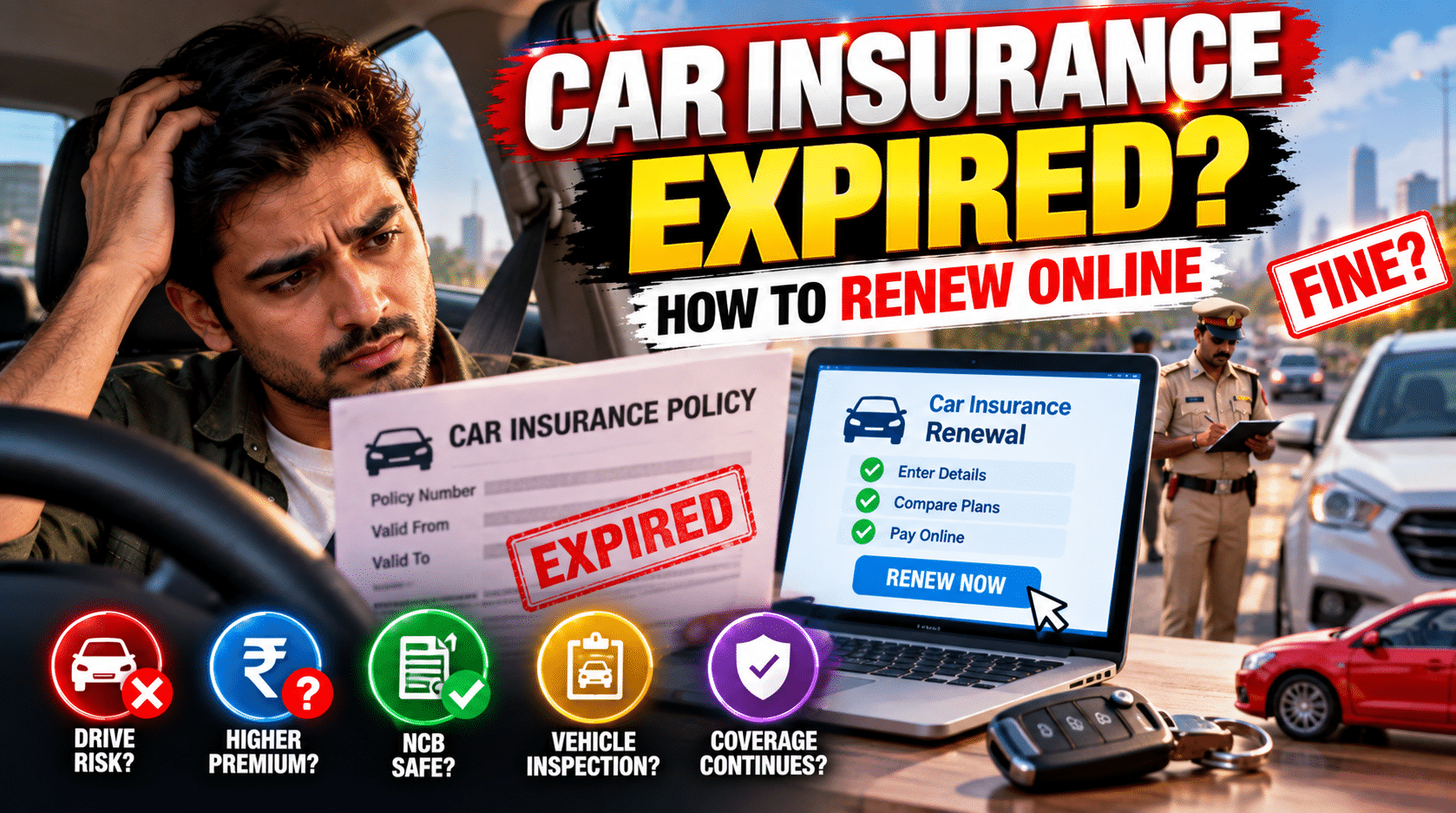
Car Insurance: You check your car documents and suddenly notice something important: your motor insurance policy has already expired.
For many car owners, the immediate question is, “Can I still renew it online, or do I need to buy a completely new policy?”
The good news is that an expired car insurance policy can generally be renewed, including through online channels offered by insurers. However, there is an important difference between renewing before expiry and renewing after a policy has already lapsed.
Once the policy has expired, you should not assume that your vehicle continues to have insurance protection simply because you intend to renew it soon. IRDAI states that there is no grace period for motor insurance premium payment, and a vehicle can require inspection when there is a break in insurance.
So, what should you do if your car insurance has expired?
Here’s a complete guide covering online renewal, inspection, documents, No Claim Bonus (NCB), coverage, premium, and the mistakes you should avoid.
Can You Renew an Expired Car Insurance Policy Online?
Yes, insurers can provide online renewal options even when a car insurance policy has already expired.
The exact process can vary between insurers, but it generally involves entering your vehicle and previous policy details, reviewing the available coverage, paying the applicable premium, and completing any additional requirements.
IFFCO Tokio’s online renewal guidance says customers can enter details such as the vehicle registration number and previous policy information, review coverage, calculate the premium, and make the payment online.
However, an important point is often missed:
Online renewal does not necessarily mean the policy becomes active instantly without any further verification.
If there has been a break in insurance, the insurer may require a vehicle inspection before issuing or activating certain coverage.
What Happens When Car Insurance Expires?
When your motor insurance policy reaches its expiry date, the protection provided under that policy ends according to its terms.
You should therefore avoid driving the uninsured vehicle on public roads.
Third-party liability insurance is mandatory for vehicles plying on public roads in India.
If you continue driving without the required insurance, you can expose yourself to legal and financial consequences.
More importantly, if an accident happens while there is a gap in your own-damage insurance, you may have to bear the relevant loss yourself, depending on the circumstances and coverage.
That’s why an expired policy should be treated as something to fix as soon as possible, rather than something to deal with later.
How to Renew an Expired Car Insurance Policy Online?
The exact buttons and screens differ between insurers, but the basic process is fairly straightforward.
Step 1: Visit the Insurer’s Official Website
Go to the official website of your existing insurer or another insurer if you are comparing policies.
Look for the Car Insurance / Motor Insurance / Renew Policy section.
Avoid using suspicious links received through random messages or social media.
Step 2: Enter Your Vehicle Details
You may be asked for information such as:
- Car registration number
- Previous policy number
- Mobile number
- Email address
- Vehicle details
IFFCO Tokio’s online renewal process specifically uses vehicle registration and previous policy details to retrieve the relevant insurance information.
Step 3: Check Your Existing Policy
Before simply clicking renew, review what your previous policy contained.
Look at:
- Third-party cover
- Own-damage cover
- Insured Declared Value (IDV)
- No Claim Bonus
- Deductible
- Add-ons
- Policy tenure
- Previous claims
This is particularly important if your policy has already expired because you may be given options to select or modify coverage.
Step 4: Choose the Required Coverage
Depending on the insurer and your vehicle, you may be able to choose between liability-only and broader protection that includes own damage.
If you’re renewing a comprehensive/package policy, don’t automatically remove useful coverage simply to reduce the premium.
IRDAI recommends comparing factors such as coverage, deductibles, and IDV, rather than choosing a policy solely because it has a lower premium.
Step 5: Select Add-Ons Carefully
You may also see optional add-ons such as:
- Zero depreciation
- Roadside assistance
- Engine protection
- Return to invoice
- No Claim Bonus protection
Availability depends on the insurer, vehicle, and policy.
Don’t select every add-on automatically. Choose them based on the type of protection you actually need.
Step 6: Complete the Premium Payment
Once the policy details and coverage are finalised, the insurer will calculate the applicable premium.
You can then complete the payment through the available online payment methods.
Step 7: Complete Vehicle Inspection If Required
This is the part that can surprise people after a policy has expired.
If there has been a break in insurance, the insurer may require an inspection of the vehicle before providing or restoring certain coverage.
IRDAI specifically states that in case of a break in insurance, vehicle inspection would be required and additional charges may apply.
The inspection process can differ between insurers. Some insurers may facilitate digital inspection or arrange another form of verification.
Step 8: Receive and Check Your Renewed Policy
After the applicable requirements are completed and the payment is confirmed, the renewed policy documents can be issued digitally.
IFFCO Tokio says renewed policy documents can be sent electronically after online renewal.
Don’t just save the PDF and forget about it.
Check:
- Your name
- Registration number
- Policy dates
- Coverage type
- IDV
- NCB
- Add-ons
- Deductibles
- Any other important details
If something is incorrect, contact the insurer promptly.
Does an Expired Car Insurance Policy Have a Grace Period?
This is one of the biggest misconceptions around motor insurance.
IRDAI’s consumer guidance states that motor insurance does not have a grace period for premium payment. Even a one-day lapse can result in a break in coverage and may require vehicle inspection.
So, if your policy expired yesterday, don’t assume that you’re still covered today simply because you plan to renew tomorrow.
The safest approach is to renew before the expiry date.
Can You Drive the Car While the Policy Is Expired?
You should not drive an uninsured vehicle on public roads.
Third-party liability insurance is mandatory for vehicles operating on public roads in India.
If your policy has expired, arrange the required renewal first and confirm that the appropriate coverage is active before using the vehicle on public roads.
Will You Lose Your No Claim Bonus After an Insurance Lapse?
The No Claim Bonus (NCB) is an important factor to check when renewing a car policy.
NCB is a benefit linked to a claim-free insurance history and applies to the own-damage premium rather than the third-party liability premium.
IRDAI’s consumer guidance states that NCB can range from 20% to 50% of the own-damage premium, depending on the applicable claim-free history. It also states that for a comprehensive policy allowed to lapse for more than 90 days, the accrued NCB can be lost.
This makes timely renewal especially important.
However, because NCB rules can depend on the applicable policy and current regulatory framework, always check the NCB shown in your renewal quotation and policy documents.
What Documents Are Needed to Renew Expired Car Insurance?
Online renewal is generally document-light, especially when the insurer already has your vehicle and previous policy information.
Still, keep the following information handy:
- Vehicle registration certificate (RC)
- Previous insurance policy
- Registration number
- Engine and chassis details, where required
- Owner’s details
- Contact number
- Email address
- Previous claim information
- Valid driving licence, where required
- Pollution Under Control (PUC) certificate, where applicable
IFFCO Tokio’s guidance also recommends keeping vehicle details such as manufacturer, model, first registration date, purchase date, and RTO information available when renewing an expired policy.
What If You Want to Change Your Insurance Company?
An expired policy does not necessarily mean that you have to renew with the same insurer.
You can compare available policies from different insurers and choose coverage based on your requirements.
IRDAI itself advises consumers to compare motor insurance quotes and look beyond premium, including deductibles, coverage, and IDV.
This is particularly useful when renewing because another insurer may offer a different combination of premium, IDV, add-ons, and coverage.
But don’t compare only the final price.
A policy that costs less may also have a different IDV, deductible, or coverage structure.
Can You Renew Only Third-Party Insurance?
Yes, motor insurance can be structured around third-party liability coverage, which is the mandatory component for vehicles on public roads.
However, third-party insurance does not protect your own vehicle from accidental damage.
If you want protection for your own car, you need appropriate own-damage or package/comprehensive coverage.
IRDAI recommends considering comprehensive/package or standalone own-damage protection in addition to the mandatory liability cover when appropriate for the vehicle owner’s needs.
What Happens to Own-Damage Cover After Expiry?
This is another important distinction.
Suppose your comprehensive policy expired on September 30 and you renew it on October 5.
The vehicle does not automatically have own-damage protection for the five-day gap.
If an accident occurs during that period, you cannot assume the new policy will cover an incident that happened before its coverage became effective.
This is why driving during a policy gap can create significant financial risk.
Why Can an Insurer Ask for Vehicle Inspection?
When a policy has expired, the insurer needs to assess the vehicle before providing certain own-damage coverage after the break.
Without an inspection, it could be difficult to distinguish between:
damage that occurred before the new policy began
and
damage that occurs after the new coverage becomes active.
That is one reason insurers can require a pre-policy inspection after a break in insurance.
IRDAI specifically notes that vehicle inspection can be required when there is a break in insurance.
Does an Expired Policy Increase Your Premium?
Not necessarily in every case, but a policy lapse can affect the renewal process and may lead to additional requirements.
The premium itself depends on several factors, particularly for own-damage coverage.
IRDAI notes that factors such as vehicle age, IDV, previous claim experience, and applicable discounts/loading can influence own-damage premiums.
If the policy has lapsed, you should compare the new quotation carefully rather than assuming the previous year’s premium will simply continue.
Common Mistakes to Avoid When Renewing an Expired Car Policy
1. Driving Before Renewal Is Active
Don’t assume that payment alone means your coverage has already started. Check the policy’s effective date and confirmation.
2. Ignoring Vehicle Inspection
If the insurer asks for an inspection after a lapse, complete it before expecting own-damage coverage to operate.
3. Choosing the Cheapest Policy Without Checking Coverage
A low premium isn’t automatically a better deal.
Check IDV, deductible, exclusions, and add-ons.
4. Forgetting About NCB
Check whether your accumulated NCB is correctly reflected in the renewal quote.
5. Providing Incorrect Information
Never enter incorrect vehicle details or hide relevant information just to reduce the premium.
6. Not Checking the New Policy Document
After renewal, verify the dates, registration number, coverage, and other details.
7. Waiting Until the Last Minute
Renewing before expiry is much simpler than dealing with a policy that has already lapsed.
Expired Car Insurance Renewal: Quick Checklist
Before completing your renewal, check these points:
| Check | What to Look For |
|---|---|
| Policy status | Has the policy expired? |
| Coverage | Third-party only or comprehensive/package? |
| Own damage | Is your car protected? |
| IDV | Is the value appropriate? |
| NCB | Is your applicable bonus reflected? |
| Deductible | How much will you bear during a claim? |
| Add-ons | Are they actually useful for you? |
| Inspection | Is it required because of the lapse? |
| Policy dates | When exactly does the renewed cover begin? |
| Documents | Have you received and checked the policy? |
How to Avoid Car Insurance Expiry in the Future
The easiest way to deal with an expired policy is to prevent the expiry in the first place.
Set a reminder two to three weeks before the policy’s expiry date.
IRDAI’s consumer guidance recommends approaching the insurer at least 15 days before expiry for renewal.
You can also:
- Keep the policy PDF saved on your phone
- Add the expiry date to your calendar
- Enable insurer reminders
- Compare renewal quotes before the last day
- Check your NCB before renewing
- Review your add-ons annually
A few minutes of preparation can prevent an unnecessary insurance gap.
Final Takeaway
An expired car insurance policy is not something to panic about, but it is something you should address quickly.
In many cases, you can initiate the renewal online by entering your vehicle and previous policy details, reviewing coverage, and completing the premium payment.
But remember that renewing an expired policy is different from renewing it before expiry.
A break in insurance can mean vehicle inspection and other requirements, and you should not assume that coverage continues during the gap. IRDAI states that motor insurance has no grace period for premium payment and that inspection can be required after a break in insurance.
Before paying, compare the premium, IDV, deductible, coverage, and add-ons. Once the policy is issued, check the documents carefully and confirm the effective dates.
Most importantly, don’t wait until the policy has already expired. Set a reminder well before the renewal date and keep your car continuously insured.
Frequently Asked Questions (FAQs)
1. Can I renew my car insurance after it expires?
Yes. Insurers can provide renewal options for expired policies, including online renewal. However, a break in insurance can lead to additional requirements such as a vehicle inspection.
2. Can I renew expired car insurance online?
Yes, many insurers offer online renewal. The process generally involves entering vehicle and previous policy details, reviewing coverage, and paying the applicable premium.
3. Is there a grace period after car insurance expires?
IRDAI’s consumer guidance states that there is no grace period for paying motor insurance premiums. A lapse can result in a break in coverage and may require vehicle inspection.
4. Can I drive my car after insurance expires?
You should not drive an uninsured vehicle on public roads. Third-party liability insurance is mandatory for vehicles plying on public roads in India.
5. Will my car be inspected if the insurance policy has expired?
An inspection can be required after a break in insurance, particularly when renewing coverage that includes own damage. IRDAI specifically notes vehicle inspection in cases of a break in insurance.
6. Will I lose my No Claim Bonus if my policy expires?
It depends on the length of the lapse and applicable rules. IRDAI’s consumer guidance states that if a comprehensive policy is allowed to lapse for more than 90 days, the accrued NCB can be lost.
7. Can I change my insurance company after my car policy expires?
You can compare policies from different insurers when arranging your new coverage. Compare not only premiums but also IDV, deductibles, coverage, and applicable add-ons.
8. Do I need my old insurance policy to renew the car insurance?
Having the previous policy information is useful and may be requested during renewal. Insurers can also ask for vehicle and registration details.
9. Does an expired policy cover an accident that happened during the gap?
No. You should not assume that a subsequently purchased policy will cover an incident that occurred while there was no active coverage. The effective dates and policy terms determine coverage.
10. What should I check before renewing expired car insurance?
Check the policy type, IDV, NCB, deductible, exclusions, add-ons, premium, and the effective date of the renewed policy. Also complete any inspection requested by the insurer.