
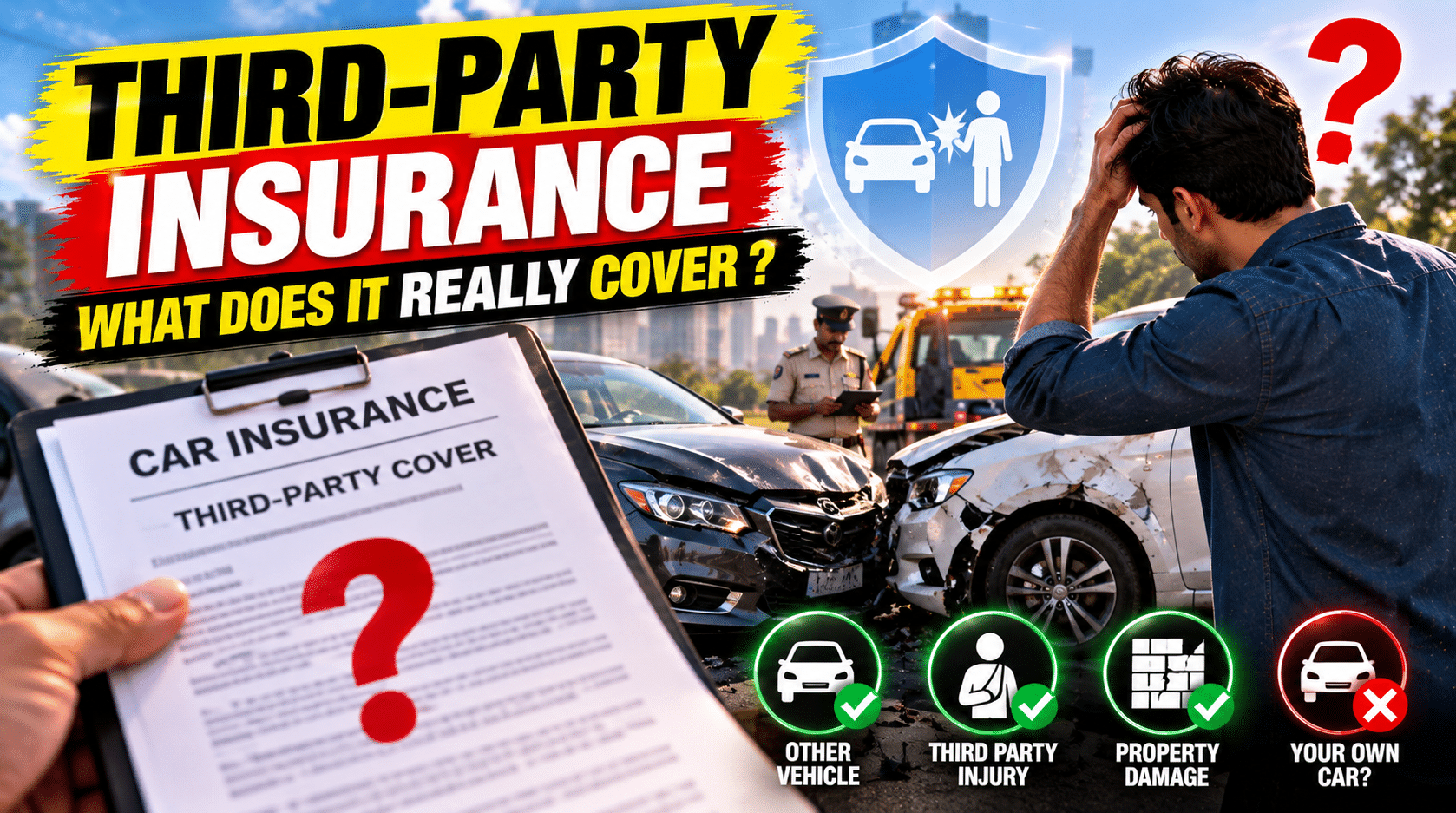
Third-Party Insurance: A road accident can turn into a major financial problem within minutes. Even when your own vehicle suffers only minor damage, the situation can become far more complicated if another person is injured or their vehicle or property is damaged.
This is where third-party motor insurance becomes important.
In India, third-party liability insurance is not simply an optional protection that vehicle owners can choose to skip. It is a mandatory requirement for vehicles plying on public roads. The cover is designed to protect the insured against certain legal liabilities arising from injury, death, or property damage caused to a third party.
But there is one important catch that many vehicle owners discover only after an accident:
Third-party insurance does not normally pay for damage to your own vehicle.
So, what exactly does third-party insurance cover? How does it work after an accident? What is the difference between third-party and comprehensive insurance? And what should you do if an accident happens?
Here is everything you need to know.
What Is Third-Party Insurance?
Third-party insurance, also called Third-Party Liability or Act Only insurance, is a motor insurance policy that covers the policyholder’s legal liability towards another person when an accident involving the insured vehicle causes covered injury, death, or property damage.
In simple terms, there are three parties involved:
- First party: The vehicle owner or insured
- Second party: The insurance company
- Third party: Another person who suffers injury, death or property damage because of the insured vehicle
For example, suppose you are driving your car and accidentally hit another vehicle.
If the other vehicle is damaged or the other person suffers an injury, a third-party liability policy is intended to respond to the liability arising from that accident, subject to the applicable law and policy terms.
However, if your own car is damaged in the same accident, third-party insurance does not cover that own damage.
IRDAI describes third-party liability insurance as mandatory for vehicles operating on public roads and distinguishes it from comprehensive/package or standalone own-damage protection.
Why Is Third-Party Insurance Mandatory in India?
The primary reason behind mandatory third-party insurance is financial protection for people who may suffer losses because of road accidents.
Imagine a situation where a vehicle causes serious injury to another person. The resulting liability could be much larger than what an ordinary vehicle owner can comfortably pay from their own pocket.
Third-party insurance provides a mechanism through which covered third-party liabilities can be addressed through insurance, subject to applicable legal provisions and policy conditions.
IRDAI specifically states that third-party liability insurance is mandatory for vehicles plying on public roads in India.
This means that simply having a vehicle registered does not remove the responsibility to maintain the required insurance cover.
What Does Third-Party Insurance Cover?
The central purpose of third-party insurance is liability towards others, rather than protection of your own vehicle.
Depending on the circumstances and applicable legal process, third-party cover can relate to:
Third-Party Injury
If your vehicle causes injury to another person, the policy can provide protection against the insured’s covered legal liability, subject to applicable law and policy conditions.
Third-Party Death
In the unfortunate event that an accident involving the insured vehicle results in the death of another person, third-party liability protection can apply to the resulting legal liability.
Third-Party Property Damage
Damage caused to another person’s vehicle or property can also fall under third-party liability coverage, subject to the applicable limits and terms.
IRDAI’s current motor-insurance guidance states that third-party injury/death liability has unlimited coverage, while third-party property damage is covered up to ₹7.5 lakh under the standard liability framework.
Because liability claims can involve legal proceedings and compensation determined through the applicable legal mechanism, policyholders should not assume that every accident will be settled simply by submitting a repair bill to the insurer.
What Is Not Covered by Third-Party Insurance?
This is perhaps the most important part to understand.
Third-party insurance does not cover damage to your own vehicle.
For example, if you accidentally hit a wall and damage your own car, there is no third-party liability involved.
Similarly, if you collide with another vehicle and your own car requires expensive repairs, a basic third-party policy does not provide own-damage protection for your vehicle.
Some situations may also be outside the scope of coverage or subject to legal and policy conditions.
The exact terms should always be checked in the policy wording.
Third-Party vs Comprehensive Insurance
Many vehicle owners confuse these two types of cover.
Here’s the basic difference:
| Feature | Third-Party Insurance | Comprehensive/Package Cover |
|---|---|---|
| Third-party injury/death liability | Yes | Yes |
| Third-party property damage | Yes, subject to applicable limits | Yes |
| Damage to your own vehicle | No | Generally covered, subject to terms |
| Theft of your vehicle | No | Generally covered |
| Own vehicle damage from accidents | No | Generally covered |
| Premium | Usually lower | Usually higher |
| Main purpose | Legal liability protection | Broader vehicle protection |
A comprehensive/package policy generally combines third-party liability with own-damage protection, subject to the policy’s terms, exclusions, and deductibles. IRDAI also notes that vehicle owners can consider comprehensive/package or standalone own-damage cover in addition to the mandatory liability cover.
How Does Third-Party Insurance Work After an Accident?
The process can vary depending on the nature of the accident and the claim.
If an accident occurs, the first priority should be safety and medical assistance.
After that, gather as much relevant information as possible.
This may include:
- Date and time of the accident
- Location
- Vehicle registration numbers
- Insurance details
- Driving licence details where appropriate
- Names and contact details of people involved
- Details of witnesses
- Photographs and videos of the accident scene
- Details of injuries or property damage
- Police/FIR information, where applicable
The insurer should also be informed promptly according to the policy’s claim procedure.
IFFCO Tokio’s guidance similarly recommends informing the insurer at the earliest and keeping accident-related information and evidence available.
Step-by-Step Third-Party Insurance Claim Process
Step 1: Make Sure Everyone Is Safe
After an accident, move to safety where possible and arrange emergency medical assistance if someone is injured.
Do not focus on insurance paperwork before addressing an emergency.
Step 2: Inform the Police Where Required
Depending on the nature and seriousness of the accident, police involvement may be required.
Keep the relevant police record or FIR details if an FIR is registered.
Step 3: Notify Your Insurance Company
Inform your insurer as soon as reasonably possible through its official claim channel.
Provide the basic details of the accident and policy.
Avoid making inaccurate statements about how the accident occurred.
Step 4: Collect Evidence
Photographs and videos can be useful in establishing what happened.
Where possible, document:
- Damage to vehicles
- Position of vehicles
- Road conditions
- Traffic signs
- Number plates
- Visible injuries
- Surrounding area
Also keep details of witnesses if available.
Step 5: Submit the Required Documents
The insurer may ask for documents relevant to the claim.
Depending on the circumstances, these may include:
- Policy details
- Claim form
- Vehicle registration certificate
- Driving licence
- Accident information
- Police/FIR documents
- Photographs
- Medical records
- Third-party details
- Other supporting documents
The exact requirements depend on the nature of the claim.
Step 6: Assessment and Legal Process
Third-party injury and death claims can involve a legal process, including proceedings before the Motor Accident Claims Tribunal (MACT).
The insurer’s role and the amount payable depend on the applicable law, facts of the accident, policy terms, and the compensation determined through the relevant process.
This is an important distinction from an own-damage claim, where the insurer may assess the insured vehicle’s repair loss directly.
Step 7: Settlement According to Applicable Rules
Once liability and compensation are determined through the applicable process, the claim is dealt with according to the law, policy, and relevant proceedings.
Therefore, third-party claims should not always be viewed as a simple “submit bill → insurer pays” process.
What Documents Should You Keep After an Accident?
Keeping proper documentation can make communication with the insurer and authorities easier.
Important records may include:
- Motor insurance policy
- Registration Certificate (RC)
- Driving licence
- Vehicle details
- Accident photographs
- Video footage, if available
- Police/FIR documents
- Medical reports
- Hospital bills
- Witness information
- Third-party details
- Claim/reference number
- Emails and correspondence with the insurer
Never submit fabricated documents or altered photographs.
Accurate information is essential when dealing with an insurance claim.
What Are the Major Benefits of Third-Party Insurance?
1. It Meets the Legal Requirement
The biggest advantage is that it provides the mandatory third-party liability protection required for vehicles on public roads.
2. It Protects Against Third-Party Liability
A serious accident can potentially create substantial financial liability. Third-party insurance is designed to address covered liability towards others.
3. It Is Generally More Affordable
Because it does not provide own-damage protection, third-party insurance is generally less expensive than broader motor insurance.
4. It Provides Financial Protection
Instead of handling covered third-party liability entirely from personal finances, the policy provides insurance protection subject to applicable law and policy conditions.
What Are the Limitations of Third-Party Insurance?
The biggest limitation is straightforward:
Your own vehicle is not protected against accidental damage under a basic third-party policy.
So if you own a new, expensive, or frequently used vehicle, relying only on third-party insurance means you remain exposed to the cost of repairing your own vehicle.
Other limitations can arise from the applicable law, policy conditions, and circumstances of the accident.
For example, certain conduct or circumstances can affect the insurer’s rights or the policyholder’s obligations.
Therefore, never assume that “insurance is active” automatically means every loss is covered.
Does Third-Party Insurance Cover Theft?
No.
A basic third-party liability policy is designed to cover liability towards other parties, not theft of your own vehicle.
If you want protection against vehicle theft, you generally need a policy that includes appropriate own-damage/comprehensive protection, subject to the terms of that policy.
Does Third-Party Insurance Cover Damage to My Car?
No.
This is one of the most common misunderstandings.
If your own car is damaged in an accident, the repair cost is not covered by a basic third-party liability policy.
For protection against your own vehicle’s accident damage, you need appropriate own-damage or comprehensive/package coverage.
Is Third-Party Insurance Enough for a Car?
Legally, third-party liability insurance is the mandatory component for vehicles used on public roads.
But whether it is financially sufficient for an individual depends on the vehicle and the owner’s circumstances.
Someone with an older vehicle may have different priorities from someone who owns a new, high-value car.
The important distinction is:
Third-party insurance protects you against covered liability towards others; own-damage cover protects your vehicle against specified risks.
What Is the Difference Between Liability and Own Damage?
The easiest way to understand it is:
Third-party liability = damage/injury caused to others
Own damage = damage to your insured vehicle
A comprehensive/package policy generally combines both forms of protection, while a liability-only policy focuses on third-party liability.
How Much Does Third-Party Insurance Cost?
The premium for third-party motor liability is not determined in exactly the same way as own-damage pricing.
IRDAI states that third-party liability premium rates are laid down by the regulator, while own-damage premiums can vary between insurers depending on factors such as the vehicle, IDV, age, and claims history.
This is why comparing motor policies solely by their total premium can sometimes be misleading.
When comparing broader policies, look at:
- Third-party cover
- Own-damage cover
- IDV
- Deductibles
- No Claim Bonus
- Add-ons
- Exclusions
- Claim service
What Should You Do Immediately After a Road Accident?
Keep this simple checklist in mind:
1. Prioritise safety
Move away from danger where possible and arrange medical assistance.
2. Call the police if required
Especially in serious accidents involving injury, death, or major disputes.
3. Exchange details
Collect vehicle, insurance, and contact information.
4. Take photographs
Document the accident scene and visible damage where safe.
5. Inform the insurer
Use the official claim channel and keep the claim/reference number.
6. Keep every document
Save police records, medical papers, photographs, and insurer communication.
7. Don’t make false statements
Give an accurate account of what happened.
Final Takeaway
Third-party insurance is one of the most important basics of motor insurance in India because it addresses the legal liability that can arise when your vehicle causes injury, death, or property damage to another person.
But it is equally important to understand what it doesn’t do.
A basic third-party policy does not protect your own vehicle against accident damage, theft, or other own-damage risks. For that, you need appropriate own-damage or comprehensive/package protection.
So, before buying or renewing your motor insurance, don’t just ask, “Is my vehicle insured?”
Ask the more useful question:
“What exactly is my policy protecting me against?”
That small distinction can make a significant difference when an unexpected accident happens.
Frequently Asked Questions (FAQs)
1. What is third-party insurance?
Third-party insurance is motor liability insurance that provides protection against covered legal liability towards another person arising from the use of the insured vehicle.
2. Is third-party insurance mandatory in India?
Yes. IRDAI states that third-party liability insurance is mandatory for vehicles plying on public roads in India.
3. Does third-party insurance cover my own car?
No. A basic third-party liability policy does not provide own-damage protection for your vehicle.
4. Does third-party insurance cover another person’s car?
Third-party property damage can be covered subject to the applicable limit and policy/legal conditions. IRDAI currently states a ₹7.5 lakh limit for third-party property damage under its motor-insurance guidance.
5. Does third-party insurance cover injuries?
Third-party liability cover can respond to covered liability arising from injuries caused to another person. The applicable compensation and legal process depend on the circumstances and law.
6. Does third-party insurance cover death?
Third-party liability insurance can apply when an accident involving the insured vehicle results in the death of another person, subject to applicable law and the relevant claim process.
7. Does third-party insurance cover theft?
No. A basic liability-only policy does not cover theft of the insured vehicle.
8. What is the difference between third-party and comprehensive insurance?
Third-party insurance focuses on liability towards others, while comprehensive/package insurance generally combines third-party liability with own-damage protection, subject to policy terms and exclusions.
9. What should I do after an accident?
Prioritise safety, arrange medical assistance if necessary, contact the police where required, collect accident evidence, exchange relevant details, and notify your insurer promptly.
10. Can I claim third-party insurance without informing the insurer?
You should follow the policy’s claim-notification requirements and inform the insurer promptly. Delaying notification can complicate the claim process.