
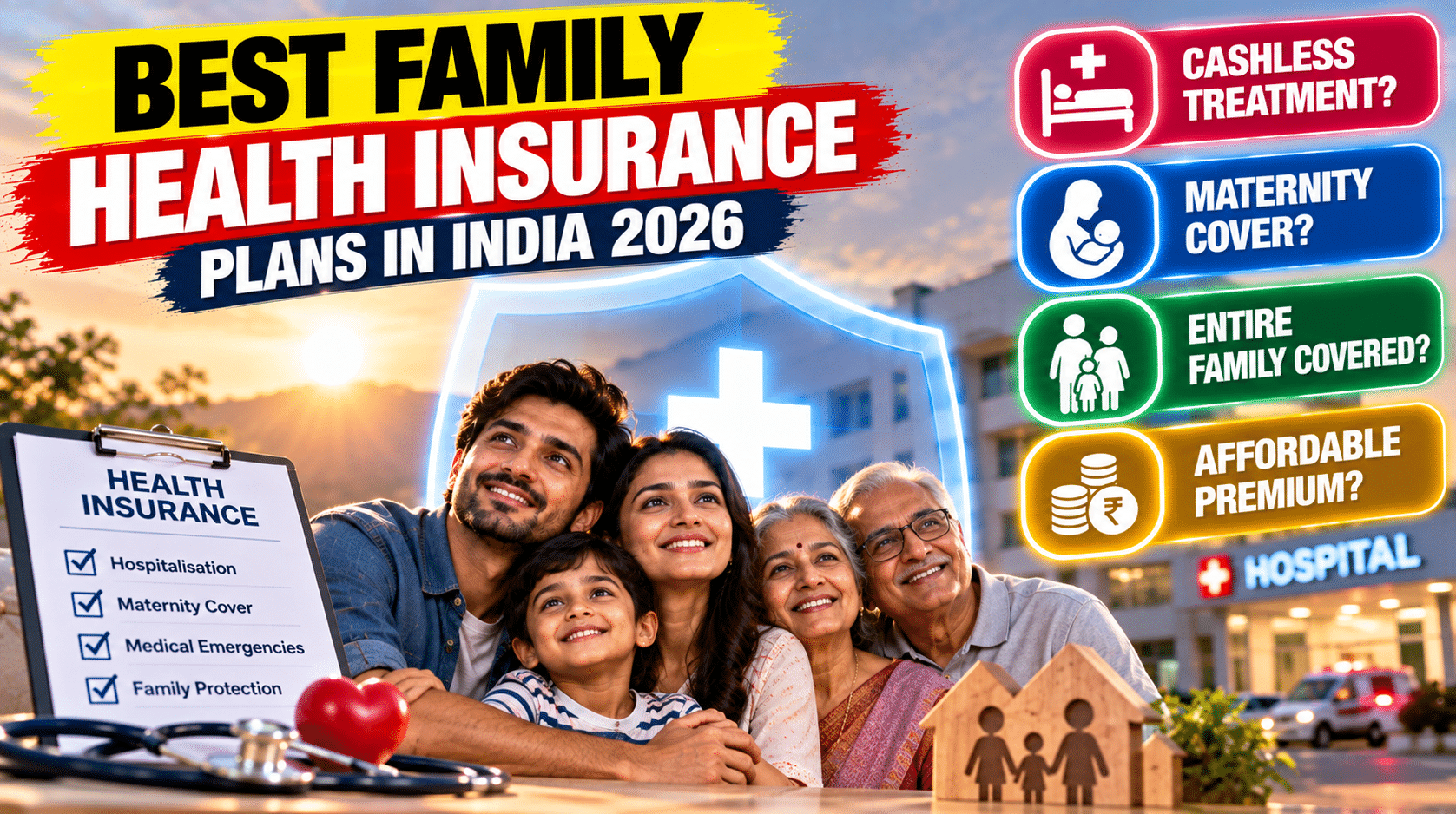
Best Family Health Insurance Plans in India: A single medical emergency can put years of family savings under pressure. Whether it is an unexpected hospital admission, a major surgery, or treatment for a long-term illness, healthcare expenses can rise quickly. For families managing household budgets, the right health insurance policy can make a significant difference when medical needs arise.
But choosing family health insurance in 2026 is not simply about finding the lowest premium or the biggest advertised coverage amount. A policy that looks attractive at first may have waiting periods, room-rent restrictions, treatment sub-limits, or co-payment conditions that affect how much the insurer actually pays.
This is why families should compare health insurance plans carefully before making a decision.
A suitable family health insurance policy should offer an adequate sum insured, access to preferred hospitals, useful hospitalisation benefits, transparent claim conditions, and protection that remains relevant as the family grows older. Some families may benefit from a family floater, while others may need separate policies for elderly parents or members with different healthcare requirements.
In this guide, we explore some family health insurance plans worth comparing in India in 2026, explain the features that matter most, and share practical steps to help you choose coverage that fits your family’s needs and budget.
Which Is the Best Family Health Insurance Plan in India in 2026?
There is no single health insurance plan that is best for every household. The right choice depends on your family size, members’ ages, medical history, preferred hospitals, financial situation, and the kind of treatment you want your policy to cover.
For a young couple with one child, a family floater may provide convenient and cost-effective coverage. A family with elderly parents or members who need frequent medical treatment may benefit from combining a family floater with separate individual policies.
When comparing plans, pay attention to these important factors:
- Sum insured: Is the coverage adequate for your family’s potential medical expenses?
- Hospital network: Can you access suitable hospitals near your home?
- Waiting periods: When do benefits become available for pre-existing diseases and specified treatments?
- Room-rent and treatment limits: Are there restrictions that could increase your out-of-pocket costs?
- Restoration benefits: Can the available sum insured be replenished after an eligible claim, and under what conditions?
- Claim experience: How clearly does the insurer explain cashless and reimbursement procedures?
- Premium affordability: Can you maintain the policy over the long term?
The goal is to find a plan that provides meaningful protection when your family needs it, rather than one that simply looks impressive in a comparison chart.
Top Family Health Insurance Plans to Compare in India
The following plans are examples worth researching when building a shortlist. They are not presented in a definitive order, and the best option will depend on the policy version, benefits selected, exclusions, and current terms.
1. HDFC ERGO Optima Secure
HDFC ERGO Optima Secure is worth evaluating for families looking for a comprehensive retail health insurance policy with additional coverage-related benefits.
When comparing this plan, pay attention to how its coverage enhancement features operate, how restoration benefits work, and which conditions apply to different types of claims.
What to check before buying:
- The base sum insured and how additional benefits are calculated.
- Conditions attached to restoration or other enhanced coverage features.
- Room-category restrictions, if applicable to the selected variant.
- Waiting periods, exclusions and optional benefits.
- Premiums for the required family composition.
Do not assume that an advertised increase in coverage means every benefit is available without conditions. Read the current policy wording to understand how the benefits apply.
2. Care Health Insurance – Ultimate Care
Care Health Insurance’s Ultimate Care is another option families can include in their comparison.
Rather than focusing on the product name alone, examine its hospitalisation coverage, treatment limits, optional benefits, and the conditions attached to additional features.
What to check before buying:
- The available sum-insured options.
- Coverage for hospitalisation and eligible day-care procedures.
- Waiting periods for pre-existing diseases and specified treatments.
- Co-payments, deductibles, and treatment-related restrictions.
- Cashless hospital availability in your preferred locations.
Compare the policy with other plans using the same coverage amount and family details to make the comparison more meaningful.
3. Niva Bupa ReAssure Product Range
Niva Bupa’s ReAssure product range may be worth considering for families interested in restoration or replenishment features and broader hospitalisation benefits.
The exact benefits depend on the particular product version and its terms. Families should understand whether restoration applies to subsequent claims, whether restrictions apply to claims for the same illness, and how the available coverage is calculated.
What to check before buying:
- The precise restoration conditions.
- Any restrictions on using restored cover.
- The policy’s sum-insured structure.
- Waiting periods and exclusions.
- Renewal terms and applicable premiums.
A restoration benefit can be useful, but it should not replace a careful assessment of the family’s overall coverage needs.
4. Star Health Family Health Optima
Star Health’s Family Health Optima is an example of a family-oriented policy that buyers may research when comparing floater coverage.
Families should examine the shared sum insured, the benefits available to each insured member, and the conditions under which claims can be made.
What to check before buying:
- The eligible family relationships and age requirements.
- The maximum available sum insured.
- Room-rent or treatment-related limits, where applicable.
- Restoration and other additional benefits.
- The insurer’s network hospitals in your area.
The most suitable choice will depend on whether the policy’s structure fits your family rather than on its popularity alone.
5. Tata AIG MediCare Product Range
Tata AIG’s MediCare product range is another option to investigate when comparing health insurance for families.
Different variants can have different benefits, limits, and eligibility conditions. Review the specific product rather than assuming all policies under the same product family provide identical protection.
What to check before buying:
- Hospitalisation and day-care benefits.
- Pre- and post-hospitalisation coverage.
- Applicable room-rent and treatment limits.
- Waiting periods and exclusions.
- Optional benefits and the additional premium they require.
Check the latest brochure and policy wording before making a decision.
6. ICICI Lombard Elevate
ICICI Lombard Elevate may be worth evaluating if your family wants to compare a health insurance product with a choice of coverage features and optional benefits.
The value of any optional feature depends on your family’s requirements and the conditions attached to it. More features do not automatically mean better protection.
What to check before buying:
- Which benefits are included in the base policy.
- Which features require an additional premium.
- Whether the policy covers the treatments your family may need.
- The waiting periods and applicable exclusions.
- The claim procedure and hospital network.
Compare the total premium after selecting the features you actually need.
7. Aditya Birla Health Insurance – Activ Product Range
Aditya Birla Health Insurance’s Activ product range is another area to explore when comparing family health insurance options.
Depending on the plan, customers may find different combinations of hospitalisation benefits, wellness-related features, and optional coverage. The exact details should be verified for the selected product.
What to check before buying:
- The base coverage and optional benefits.
- Conditions governing wellness or preventive health features.
- Waiting periods and treatment exclusions.
- Co-payments, deductibles, and sub-limits.
- The overall cost for your family.
A wellness feature can be a useful addition, but core medical coverage should remain the priority.
Important: Product features, premiums, and availability can change. This shortlist is intended as a starting point for research, not a guarantee that every listed plan will be suitable for your household. Always compare current policy documents before purchasing.
Family Floater vs Individual Health Insurance: Which Is Better?
One of the most important decisions is whether to cover everyone under a family floater or purchase separate individual policies.
A family floater provides one shared sum insured for all covered members. Individual health insurance provides a separate sum insured for each insured person.
| Factor | Family floater | Individual policies |
|---|---|---|
| Sum insured | Shared by covered family members | Separate for each insured person |
| Policy management | Usually simpler, with one family policy | Multiple policies may need to be managed |
| Premium structure | Based on family composition and insurer pricing | Based on each person’s policy and risk factors |
| Claims | One member’s claim can reduce the remaining shared cover | One person’s claim generally does not reduce another person’s separate sum insured |
| Elderly family members | Suitability needs careful assessment | May provide more dedicated coverage |
| Best use case | Families whose healthcare needs are reasonably compatible | Members who need different coverage levels or have different risk profiles |
When Is a Family Floater a Good Choice?
A family floater can be practical for a young couple and their children, particularly when the family wants one policy and a shared pool of coverage.
For example, a family with a ₹15 lakh floater has ₹15 lakh of total cover for all insured members collectively, subject to policy conditions. It does not provide ₹15 lakh separately to each person.
If one member makes a large claim, the remaining cover available to the rest of the family may decrease during that policy period.
When Should You Consider Separate Policies?
Separate policies may be worth considering when one family member is older, has different healthcare requirements, or needs a dedicated sum insured.
This is particularly relevant when deciding how to insure elderly parents. Adding parents to a younger family’s floater is not automatically the most cost-effective or suitable arrangement.
Compare the premiums, waiting periods, medical underwriting, coverage limits and claim conditions before deciding.
How Much Family Health Insurance Cover Is Enough in 2026?
There is no fixed sum insured that suits every family. The amount you need depends on where you live, how many people are covered, their ages, existing medical conditions, and the level of medical expenses your household could manage from savings.
Consider the following factors before choosing a coverage amount.
1. Family Size and Age
A young couple may have different healthcare needs from a household with children and elderly dependants. As family members age, the potential need for medical treatment can change.
2. Cost of Healthcare in Your City
Treatment costs can vary between cities and hospitals. If your preferred hospitals are in a major metropolitan area, compare coverage against the likely cost of treatment at those facilities.
3. Existing Employer Coverage
Employer-provided insurance can be helpful, but it may change when employment changes. Review the coverage available to your family and consider whether you need a separate personal policy.
4. Medical History
Existing conditions, previous treatment, and family medical history may influence the type of policy you need. Disclose medical information accurately and confirm the insurer’s terms for pre-existing diseases.
5. Out-of-Pocket Expenses
A large sum insured does not necessarily mean the insurer will pay every rupee of an eligible hospital bill. Co-payments, deductibles, room-rent restrictions, sub-limits and non-payable expenses can affect the final claim amount.
6. Ability to Pay Premiums Over Time
Choose a policy that fits your budget at purchase and remains manageable at renewal. A policy that lapses because the premium becomes unaffordable may not provide the continuity you intended.
Compare different coverage amounts and, where appropriate, investigate whether a super top-up policy can provide additional protection above a deductible.
Important Features That Make Family Health Insurance More Useful
When comparing policies, look beyond the headline sum insured. The following features can make a meaningful difference to how the policy works during a claim.
Restoration Benefit
A restoration benefit can replenish some or all of the sum insured after an eligible claim, depending on the policy.
However, conditions differ. Some policies may restrict when restoration can be used, whether it applies to the same illness or whether the benefit is available for the first claim.
Read the terms carefully instead of assuming that a restored amount is always available for every treatment.
Cashless Hospitalisation
Cashless treatment may allow eligible hospital bills to be settled directly between the insurer or its claims administrator and a network hospital, subject to approval and policy conditions.
Before buying, check whether suitable hospitals near your home are included in the network. Also understand the process to follow if your preferred hospital is not in the network.
Pre- and Post-Hospitalisation Expenses
Some policies cover eligible medical expenses incurred before and after hospitalisation for a specified period. The benefit may include certain consultations, diagnostic tests or medicines connected with the hospitalisation.
Check the time limits, eligible expense categories, and documentation requirements.
Day-Care Procedures
Some treatments can be completed without a full 24-hour hospital admission because of medical advances. A policy may cover eligible day-care procedures listed or defined in its terms.
Confirm that the treatment you are concerned about qualifies under the policy.
No-Claim Bonus
Some insurers increase the available sum insured or offer another benefit after a claim-free period. The structure varies between products.
Check whether the bonus increases coverage, reduces the premium, or operates in another way. Also understand how claims affect the accumulated benefit.
Preventive Health Check-Ups
Some plans include health check-ups at specified intervals or up to a defined amount. The conditions may differ by plan and variant.
Do not treat a health check-up benefit as a substitute for adequate hospitalisation coverage.
Waiting Periods and Exclusions: What Families Must Check
A policy may not cover every illness from the first day. Waiting periods and exclusions determine when particular conditions, treatments, or expenses become eligible for coverage.
Under IRDAI’s health insurance guidance, the maximum waiting period for pre-existing diseases and specified diseases or treatments is generally capped at 36 months, subject to the applicable regulatory framework and policy provisions.
Before buying, review:
- The waiting period for pre-existing diseases.
- Waiting periods for specified illnesses or procedures.
- Maternity waiting periods, if maternity benefits are included.
- Room-rent and ICU limits.
- Treatment-specific sub-limits.
- Co-payment and deductible requirements.
- Exclusions listed in the policy wording.
- The conditions governing cashless and reimbursement claims.
A plan with a low premium may have restrictions that increase the family’s share of medical expenses. Compare the policy’s overall value rather than judging it on price alone.
How to Compare Family Health Insurance Plans Correctly?
Follow a consistent process when comparing two or more policies.
- Step 1: List everyone who needs coverage. Record each family member’s age, healthcare needs, and existing insurance.
- Step 2: Decide between a floater and individual cover. Consider whether a shared sum insured is appropriate for the entire family or whether some members need separate protection.
- Step 3: Compare the same sum insured. Comparing a ₹10 lakh policy with a ₹25 lakh policy only by premium will not provide a fair assessment.
- Step 4: Review the policy’s limits. Check room-rent conditions, co-payments, deductibles, sub-limits and exclusions.
- Step 5: Check waiting periods. Pay special attention to pre-existing diseases and any treatment your family may reasonably need.
- Step 6: Verify nearby hospitals. Check the current cashless network and understand the claim procedure.
- Step 7: Review the claims process. Understand the documents required, timelines specified in the policy and how to raise a grievance.
- Step 8: Compare the total cost. Include optional benefits you actually need, rather than adding features simply because they are available.
- Step 9: Read the Customer Information Sheet and full policy wording. Ask the insurer to explain any clause you do not understand.
- Step 10: Renew on time. Keeping the policy active helps preserve continuity benefits according to the policy and applicable rules.
IRDAI also advises policyholders to disclose pre-existing health conditions, understand exclusions and limits, check eligible hospitals, and maintain timely renewals. <Cite refs={[“turn918056search0”]}/>
Common Mistakes to Avoid When Buying Family Health Insurance
Choosing Only by Premium
A lower premium is attractive, but it may come with lower coverage or restrictions. Compare the benefits and conditions before deciding.
Assuming the Entire Sum Insured Is Available to Every Member
A family floater has a shared sum insured. It is not a separate full coverage amount for each insured person.
Ignoring Elderly Parents’ Needs
Older members may need a different coverage structure, depending on their age, medical history, eligibility, and premiums. Compare separate policies as well as floater options.
Overlooking Co-Payments
A co-payment means the policyholder pays a specified share of eligible expenses. Understand how much you might need to pay during a major hospitalisation.
Assuming Every Hospital Is Cashless
Cashless treatment depends on the insurer’s network, the hospital’s participation, and the claim authorisation process. Verify current details before treatment whenever possible.
Hiding Medical Information
Providing incomplete or inaccurate information about health conditions can create problems during underwriting or claims. Answer the insurer’s questions truthfully and completely.
Buying More Add-Ons Than Necessary
Optional benefits can increase the premium. Choose them based on your family’s actual requirements and the protection they provide.
How Can You Keep Family Health Insurance Useful in the Years Ahead?
Your family will not necessarily have the same healthcare needs five or ten years from now. Children may be added to the policy, parents may need different coverage, and employer-provided insurance may change.
Review your policy when major life events occur and at renewal. Check whether the sum insured remains appropriate, whether your preferred hospitals are still in the network, and whether the policy’s exclusions and conditions meet your current needs.
If you consider moving to another insurer, ask about portability and the transfer of eligible continuity credits. Apply within the prescribed renewal window and confirm the conditions with the new insurer before making a switch.
The aim is to maintain coverage that fits your family over time, not simply to purchase a policy once and forget about it.
Final Verdict: Which Family Health Insurance Plan Should You Choose?
The best family health insurance plan in India for 2026 is the one that provides suitable coverage for your household, has clear terms, and fits your long-term budget.
HDFC ERGO Optima Secure, Care Health Insurance Ultimate Care, Niva Bupa’s ReAssure range, Star Health Family Health Optima, Tata AIG’s MediCare range, ICICI Lombard Elevate, and Aditya Birla Health Insurance’s Activ range are examples you can research when building a shortlist.
However, a plan’s suitability depends on its current version, the coverage selected, and your family’s specific needs. No brand name or single benefit can guarantee the best outcome for every household.
Compare the sum insured, hospital network, restoration conditions, waiting periods, exclusions, co-payments, and claim process. If you have elderly parents or members with different healthcare needs, consider whether separate policies may provide more appropriate protection.
Finally, read the policy documents and disclose medical information accurately. The right policy is not necessarily the cheapest or the one with the longest list of features. It is the one whose coverage and conditions you understand before you need to make a claim.
Frequently Asked Questions (FAQs)
1. Which is the best family health insurance plan in India in 2026?
There is no single best plan for every family. Compare products such as HDFC ERGO Optima Secure, Care Ultimate Care, Niva Bupa ReAssure, Star Health Family Health Optima, and other suitable options based on coverage, exclusions, hospital access, and premium.
2. What is a family floater health insurance policy?
A family floater covers eligible family members under one shared sum insured. Any covered member can use the available cover according to the policy terms, so one large claim may reduce the remaining amount available to others.
3. How much health insurance does a family need?
The required sum insured depends on family size, ages, location, healthcare needs, and existing coverage. Compare realistic hospital costs and out-of-pocket expenses before selecting an amount.
4. Is a family floater better than individual health insurance?
A floater can be convenient for a small family with broadly similar coverage needs. Separate policies may be worth considering for elderly parents or members who need dedicated coverage. Compare both options before deciding.
5. Should I include my parents in my family floater?
It depends on their age, health, eligibility, and the premium quoted. Compare the cost and conditions of adding them to the floater with the cost and benefits of separate policies.
6. What is a restoration benefit in health insurance?
A restoration benefit can replenish the sum insured after an eligible claim, subject to the policy’s conditions. Check when restoration becomes available and whether restrictions apply to the same illness or subsequent claims.
7. What is the maximum waiting period for pre-existing diseases in health insurance?
Under the applicable IRDAI framework, the maximum waiting period for pre-existing diseases and specified diseases or treatments is generally 36 months. Always confirm the waiting period in the specific policy you are considering.
8. Does family health insurance cover pre-existing diseases immediately?
Not necessarily. Coverage may begin only after the applicable waiting period and subject to the policy’s terms. Disclose all relevant medical information when applying.
9. What is a co-payment in health insurance?
A co-payment is the portion of an eligible claim that the policyholder must pay under the policy. A plan with a co-payment may have a different premium, but it can increase out-of-pocket expenses during treatment.
10. Does a higher sum insured always mean better health insurance?
Not automatically. A higher sum insured can provide more financial protection, but exclusions, room-rent limits, waiting periods, co-payments, and treatment restrictions also affect the policy’s value.
11. What is the difference between cashless and reimbursement claims?
With cashless treatment, eligible expenses may be settled directly with a participating hospital, subject to approval and policy conditions. Under reimbursement, the policyholder pays first and submits the required documents for assessment under the policy.
12. Can I switch my family health insurance to another company?
Health insurance portability may allow eligible continuity credits to be transferred when moving to another insurer at renewal, subject to applicable rules and the insurer’s process. Confirm the procedure and apply within the prescribed time window.
13. Are maternity and newborn benefits included in family health insurance?
Some policies include maternity and newborn benefits, while others do not. Where offered, these benefits may have waiting periods, sub-limits and eligibility conditions. Review the policy wording carefully.
14. What documents should I read before buying health insurance?
Read the latest policy brochure, Customer Information Sheet and full policy wording. Pay particular attention to the sum insured, waiting periods, exclusions, room-rent limits, co-payments, sub-limits and claims procedure.
Disclaimer: This article is for general educational purposes and does not constitute personalised insurance advice. Product features, premiums, eligibility and coverage limits may change. Verify current details with the insurer and read the full policy wording before purchasing.