
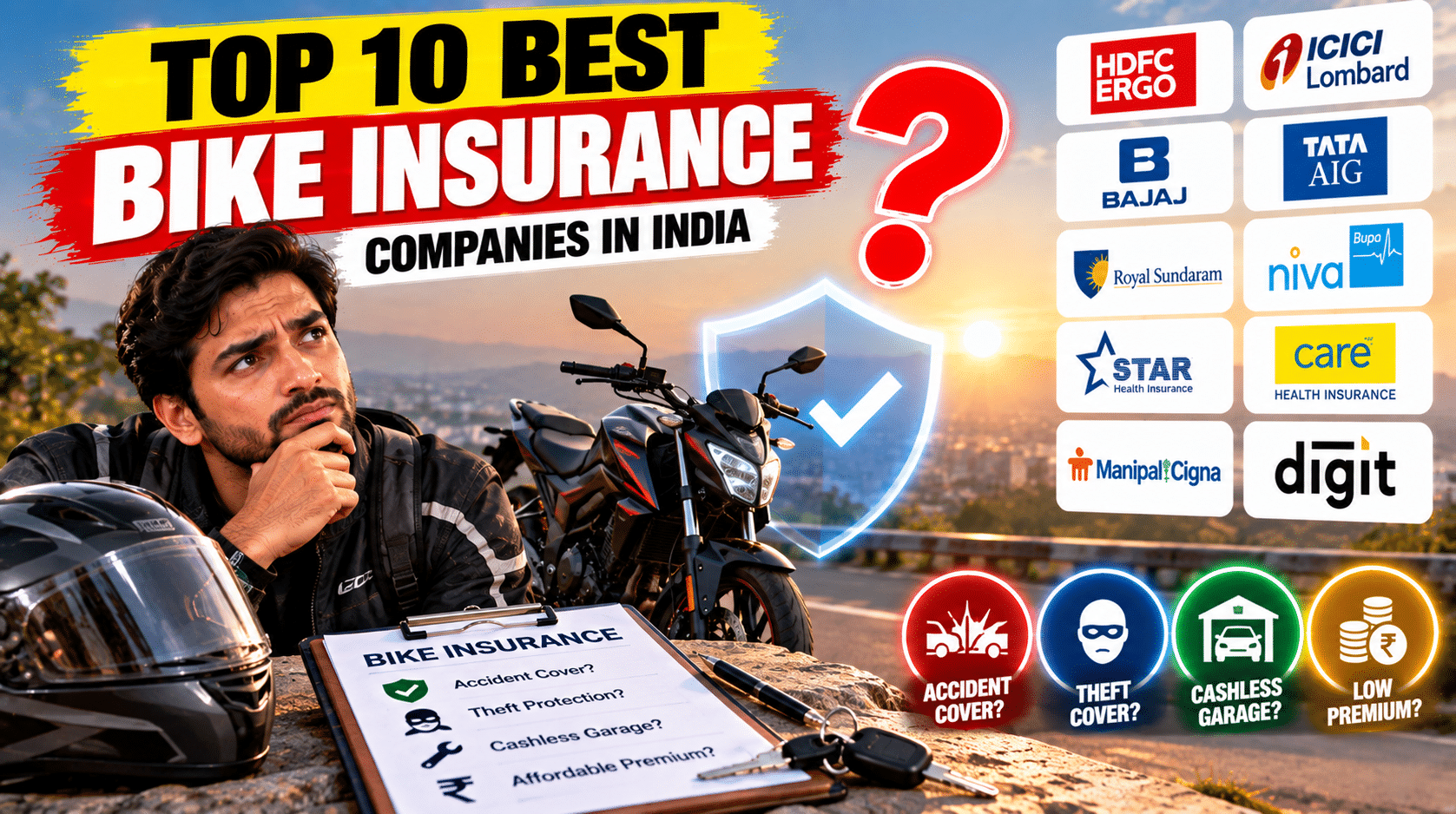
Best Bike Insurance Company in India: Buying a bike gives you freedom on the road, but even a minor accident can lead to unexpected repair bills. Add third-party damage, theft, or severe weather to the picture, and the financial impact can be much greater than many riders expect.
That is why choosing the right two-wheeler insurance policy matters. But with so many insurance companies advertising affordable premiums and attractive benefits, how do you decide which one deserves your money?
The answer isn’t simply to choose the company offering the lowest quote. The right bike insurance policy should provide suitable coverage, clear terms, a convenient claims process, and a premium that fits your budget.
Royal Sundaram is one insurer worth including in your comparison. However, before choosing it—or any other company—you should evaluate the policy benefits, exclusions, claim support, cashless garage availability, and overall cost. Royal Sundaram provides online bike insurance and digital claim-related services for policyholders.
This guide explains what makes a bike insurance company worth considering, the different types of policies available, how to compare insurers, and what riders should check before purchasing or renewing coverage.
What Is Bike Insurance?
Bike insurance is a motor insurance policy designed to cover specified financial liabilities arising from the use of a motorcycle or scooter.
Depending on the type of policy, it may cover legal liability towards third parties, damage to your own vehicle, theft, and certain other insured events.
In India, third-party liability insurance is mandatory for vehicles used on public roads. Riders who also want protection for their own bike can consider a comprehensive or standalone own-damage policy alongside the required third-party cover.
A suitable policy can help reduce the financial burden of covered incidents, but the amount payable depends on the policy wording, applicable limits, deductibles, exclusions, and claim assessment.
Best Bike Insurance Companies in India: Options to Compare
There is no single insurer that is automatically best for every rider. Your ideal choice may depend on your bike’s age and value, your location, the premium you can afford, and the type of protection you need.
The following insurers are examples of providers you can include in your research. This is a comparison shortlist, not an independently verified ranking of claim performance.
1. Royal Sundaram General Insurance
Royal Sundaram offers two-wheeler insurance with options for third-party liability and broader protection, depending on the product selected.
Its online claim services allow customers to initiate claims, follow the process, and submit documents digitally. The insurer also advertises a network of cashless garages, although riders should verify garage availability in their own area before purchasing.
What to compare: Premium, own-damage coverage, claim requirements, add-ons, nearby cashless garages, and exclusions.
Potentially suitable for: Riders who want to evaluate online policy management and claim services alongside coverage options.
2. ICICI Lombard General Insurance
ICICI Lombard is another insurer worth considering when comparing two-wheeler policies.
Check the available policy variants, own-damage protection, optional add-ons, and claim process. The actual value of the policy depends on the coverage and conditions offered in your quotation.
What to compare: Premium, IDV, deductibles, add-ons, and garage access.
3. HDFC ERGO General Insurance
HDFC ERGO can also be included in a bike insurance comparison.
Before buying, review the policy’s protection against covered accidents, theft, fire, and other insured events. Confirm whether the chosen policy offers the benefits you need rather than relying only on the product name.
What to compare: Coverage limits, claim documentation, exclusions, and available cashless repair facilities.
4. Bajaj General Insurance
Bajaj General Insurance is another provider riders can consider while comparing two-wheeler coverage.
Review the available policies for your motorcycle or scooter and compare their premium, insured value, deductibles, and optional benefits with competing offers.
What to compare: Policy type, IDV, add-ons, claim support, and renewal terms.
5. Tata AIG General Insurance
Tata AIG is another insurer worth researching when comparing bike insurance options.
Read the current policy wording to understand which events are covered, how claims are assessed, and whether the optional benefits match your needs.
What to compare: Premium, own-damage protection, exclusions, and cashless garage availability.
6. SBI General Insurance
SBI General is another provider to include in your comparison.
As with other insurers, review the specific two-wheeler policy rather than assuming that every product provides identical coverage.
What to compare: Available cover, deductibles, claim requirements, IDV, and premium.
7. Go Digit General Insurance
Go Digit can be considered by riders who want to compare digital policy purchase and servicing options.
Check the current product documents to understand the claim procedure, available coverage, and whether the insurer’s service network is convenient for your location.
What to compare: Online servicing, policy conditions, add-ons, and repair-network access.
8. ACKO General Insurance
ACKO is another provider to include when researching online bike insurance.
Compare the actual policy quotation and coverage terms instead of judging a plan solely by the advertised starting price.
What to compare: Premium, coverage limits, deductibles, claim process and exclusions.
9. New India Assurance
New India Assurance is another insurer riders may investigate when comparing motor insurance.
Review the applicable two-wheeler policy wording, service channels, and available coverage before deciding whether it meets your requirements.
What to compare: Policy benefits, claims process, premium, and local servicing options.
10. Reliance General Insurance
Reliance General Insurance can also be included in your research shortlist.
Check the currently available two-wheeler products and compare their benefits against the specific risks you want to insure.
What to compare: Third-party and own-damage options, IDV, deductibles, add-ons, and renewal conditions.
Editorial note: The list above identifies insurers to research; it does not establish a current performance ranking. Product availability and company branding may change. Verify the insurer’s current legal name, product documents, and policy terms before purchasing.
Quick Comparison: What Should You Evaluate?
Instead of choosing a policy based on a brand name alone, compare each quotation using the same criteria.
| Comparison factor | What to look for |
|---|---|
| Premium | Total cost for the selected coverage |
| Policy type | Third-party, comprehensive, or standalone own damage |
| IDV | Insured value of your bike |
| Deductible | Amount you may have to pay towards an eligible claim |
| Cashless garages | Availability of convenient repair facilities |
| Add-ons | Optional protection relevant to your bike |
| Claim process | How to report, document, and track a claim |
| Exclusions | Situations and expenses not covered |
| Renewal | Process, deadline and applicable conditions |
| Customer support | Availability of help when a problem arises |
IRDAI recommends comparing multiple quotations and checking the coverage, deductibles, and IDV rather than choosing the cheapest policy automatically.
Types of Bike Insurance Policies in India
Before comparing insurance companies, understand which type of policy you actually need.
1. Third-Party Bike Insurance
Third-party insurance covers specified legal liabilities arising when your bike causes injury, death, or property damage to another party.
It is the minimum mandatory motor insurance cover for riding on public roads in India. However, it does not ordinarily cover damage to your own motorcycle or scooter.
This policy may cost less than broader coverage, but it leaves you responsible for repairing or replacing your own bike after an uninsured loss.
2. Comprehensive Bike Insurance
A comprehensive policy generally combines third-party liability with own-damage protection.
Depending on the policy terms, own-damage coverage may include insured events such as:
- Accidental damage
- Fire-related damage
- Theft
- Certain natural disasters
- Specified man-made events
Exclusions and conditions apply, so always check the policy wording.
Who should consider it? Riders who want protection for their own vehicle as well as third-party liability.
3. Standalone Own-Damage Insurance
A standalone own-damage policy covers specified damage to your own insured vehicle but does not replace the mandatory third-party cover.
It is generally relevant when a rider already has a separate valid third-party policy and wants additional protection for their own bike. The two policies’ validity periods and terms should be checked carefully.
How to Choose the Right Bike Insurance Company
The following factors can help you narrow your options.
1. Compare the Claim Settlement Process
An insurer’s claim process becomes especially important after an accident or theft.
Check how claims are reported, which documents are required, whether inspections are necessary, and how you can track progress.
Don’t judge an insurer only by a headline claim settlement ratio. Make sure you understand what the published figure measures, which financial year it covers, and whether it relates specifically to motor own-damage claims.
2. Check the Cashless Garage Network
Cashless repairs can simplify the payment process when your claim is approved, and the repair is handled under the applicable arrangements.
However, a large nationwide network does not guarantee that your preferred local garage is included.
Check the current network in your city or nearby area before purchasing.
Royal Sundaram, for example, advertises a network of more than 8,000 garages, but local availability and the applicable repair arrangements should still be verified.
3. Understand Insured Declared Value (IDV)
IDV represents the insured value used for own-damage coverage and is an important factor when assessing a bike insurance quotation.
A lower IDV can reduce the premium, but it may also reduce the amount payable in certain total-loss or theft situations, subject to the policy terms.
IRDAI advises policyholders to ensure that the IDV reasonably reflects the vehicle’s market value.
Compare IDV alongside premium rather than selecting whichever quote appears cheapest.
4. Check the Deductible
A deductible is the portion of an eligible claim that you must bear under the policy.
A higher deductible may lower the premium in some circumstances, but it can increase your out-of-pocket expense when you make a claim.
Choose a deductible you could realistically afford after an accident.
5. Compare Useful Add-ons
Add-ons extend the base policy for an additional premium.
Depending on the insurer and product, options may include:
- Zero depreciation cover
- Roadside assistance
- Return-to-invoice protection
- No-claim bonus protection
Not every add-on is available for every bike or policy.
For example, zero depreciation cover can reduce the effect of depreciation on eligible parts when a claim is assessed, subject to its terms. It does not mean every repair expense will automatically be paid in full.
Choose add-ons based on the bike’s age, value, usage, and the risks you want to address.
6. Review Exclusions
Even a comprehensive policy has exclusions.
Common examples may include ordinary wear and tear, certain consequential losses, or damage arising from activities excluded by the policy. Riding under the influence of alcohol or drugs can also affect claim eligibility.
The exact exclusions depend on the policy wording. Read the document rather than assuming every accident will be covered.
7. Consider Your Bike’s Age and Value
A new or expensive motorcycle may justify broader own-damage protection because repairs or replacement can be costly.
For an older bike with a lower market value, you may want to compare the premium against the maximum potential benefit.
The right decision depends on your financial circumstances and risk tolerance.
What Is No-Claim Bonus (NCB) in Bike Insurance?
No-Claim Bonus is a benefit associated with a claim-free policy history. Under the applicable motor own-damage framework, it can increase with successive claim-free years, subject to policy terms and eligibility.
IRDAI describes NCB as a discount on the own-damage premium, commonly ranging from 20% up to 50% under the relevant rules. It is associated with the insured person rather than simply being attached to the vehicle.
A few things to remember:
- NCB generally applies to the own-damage premium, not the third-party premium.
- Making a claim can affect the bonus at renewal.
- NCB may be transferable when you change insurers, subject to the required proof and applicable conditions.
- It should not be confused with a discount on every part of the premium.
Before renewing, verify your NCB entitlement and make sure it is correctly reflected in the quotation.
How to Buy Bike Insurance Online?
Buying or renewing a policy online can make it easier to compare available options.
Step 1: Keep Your Bike Details Ready
You may need the registration number, make, model, registration year, and other information from the registration certificate.
Step 2: Compare Policy Types
Decide whether you need third-party cover alone or broader protection that includes own damage.
Step 3: Review the Quotation
Check the premium, IDV, deductible, add-ons, and policy duration.
Step 4: Compare More Than One Insurer
Get multiple quotations with comparable coverage. A lower premium may come with a lower IDV, a higher deductible, or fewer benefits.
Step 5: Verify Your Details
Check the vehicle information, policyholder details, previous policy information, and NCB declaration before payment.
Step 6: Read the Policy Documents
Review the exclusions, conditions, and claim procedure before finalising the purchase.
Step 7: Save Your Policy
Once the insurer issues the policy, save a digital copy and note the renewal date.
How to Renew an Expired Bike Insurance Policy?
If your bike insurance has expired, don’t assume that you can continue riding until you get around to renewing it.
IRDAI states that motor insurance policies do not have a premium-payment grace period; a break in coverage can require vehicle inspection. A lapse can also affect NCB eligibility under the applicable conditions.
A sensible approach is to:
- Avoid riding the uninsured vehicle on public roads.
- Contact an insurer or use its official renewal facility.
- Provide the requested vehicle and previous-policy details.
- Complete any inspection required.
- Review the quotation and coverage.
- Pay the premium and confirm issuance before riding again.
Do not assume that paying the premium automatically means coverage has started. Check the policy’s actual commencement date.
Common Mistakes to Avoid When Buying Bike Insurance
- Choosing a policy only because it is cheap.
- Ignoring the difference between third-party and comprehensive cover.
- Selecting a low IDV without considering the consequences.
- Buying add-ons without understanding their conditions.
- Failing to check nearby cashless garages.
- Providing incorrect vehicle or previous-policy details.
- Assuming every accident or repair will be covered.
- Forgetting to renew before expiry.
- Failing to check NCB and deductibles.
- Treating a claim settlement ratio as a guarantee of an individual claim outcome.
Final Verdict
Choosing the best bike insurance company in India requires more than comparing advertisements or premiums.
Royal Sundaram, ICICI Lombard, HDFC ERGO, Bajaj General, Tata AIG, SBI General, Go Digit, ACKO, New India Assurance and Reliance General are examples of insurers you can research when building a shortlist. Their suitability depends on the policy currently available to you, the terms offered, and your own requirements.
Before making a decision, compare the coverage type, IDV, deductibles, add-ons, claim process, cashless garage access, exclusions, and total premium.
For some riders, third-party insurance may meet the minimum legal requirement. Others may prefer comprehensive protection because they also want cover for their own vehicle. Neither choice should be made without understanding what the policy actually pays for.
The smartest purchase is not necessarily the cheapest or the most heavily advertised. It is the policy whose benefits and conditions make sense for your bike, your budget, and the risks you want to cover.
Frequently Asked Questions (FAQs)
1. Which is the best bike insurance company in India?
There is no single insurer that is best for every rider. Compare policy coverage, premium, IDV, deductibles, claim procedures, exclusions, and local cashless garage availability before deciding.
2. Is bike insurance mandatory in India?
Yes. Third-party liability insurance is mandatory for motor vehicles used on public roads in India. Riders can consider additional own-damage coverage for broader protection.
3. What is the difference between third-party and comprehensive bike insurance?
Third-party insurance covers specified legal liabilities towards others. Comprehensive insurance generally combines third-party liability with own-damage protection, subject to the policy terms.
4. Does comprehensive bike insurance cover theft?
Own-damage coverage under a comprehensive policy generally includes theft, subject to the policy conditions, exclusions, and claim requirements. Check the actual policy wording.
5. How can I compare bike insurance companies?
Compare at least a few quotations with similar coverage. Review IDV, deductibles, add-ons, claim process, exclusions, garage network, and total premium. IRDAI recommends comparing coverage and deductibles alongside price.
6. What is IDV in bike insurance?
IDV stands for Insured Declared Value. It is an important valuation used for own-damage cover and can influence both the premium and the amount payable in certain total-loss or theft situations.
7. What is No-Claim Bonus in bike insurance?
NCB is a benefit for eligible claim-free policy periods. It generally reduces the own-damage premium, subject to the applicable rules and policy conditions.
8. Can I transfer my NCB when switching insurers?
NCB may be carried forward when you change insurers at renewal, provided you meet the applicable conditions and supply the required proof. Confirm the process with your new insurer.
9. What is zero depreciation bike insurance?
Zero depreciation is an add-on that can reduce depreciation deductions on eligible parts during claim assessment, subject to the policy terms. It usually costs extra and does not eliminate every possible deduction or exclusion.
10. Can I buy bike insurance online?
Yes. Many insurers provide online purchase and renewal facilities. Enter accurate vehicle details, compare coverage, review the policy wording, and save the issued policy document.
11. What happens if my bike insurance expires?
You may no longer have valid coverage for the expired period. A break in insurance can require inspection, and NCB can be affected under applicable conditions. Renew through an official channel and confirm the commencement date before riding.
12. Does a lower bike insurance premium mean a better deal?
Not necessarily. A cheaper quote may have a lower IDV, higher deductible, or less extensive coverage. Compare the policy terms and likely out-of-pocket expenses as well as the price.
13. Does bike insurance cover engine damage?
Coverage depends on the cause of the damage and the policy terms. Certain types of consequential or mechanical damage may be excluded unless specifically covered by an applicable add-on. Read the wording carefully.
14. Can I claim for every accident under comprehensive insurance?
No. Claims remain subject to coverage, exclusions, deductibles, documentation, and the insurer’s assessment. Comprehensive insurance does not mean every loss is automatically payable.
15. When should I renew my bike insurance?
Renew before the current policy expires. IRDAI advises approaching the insurer at least 15 days before expiry to allow time for renewal arrangements.