
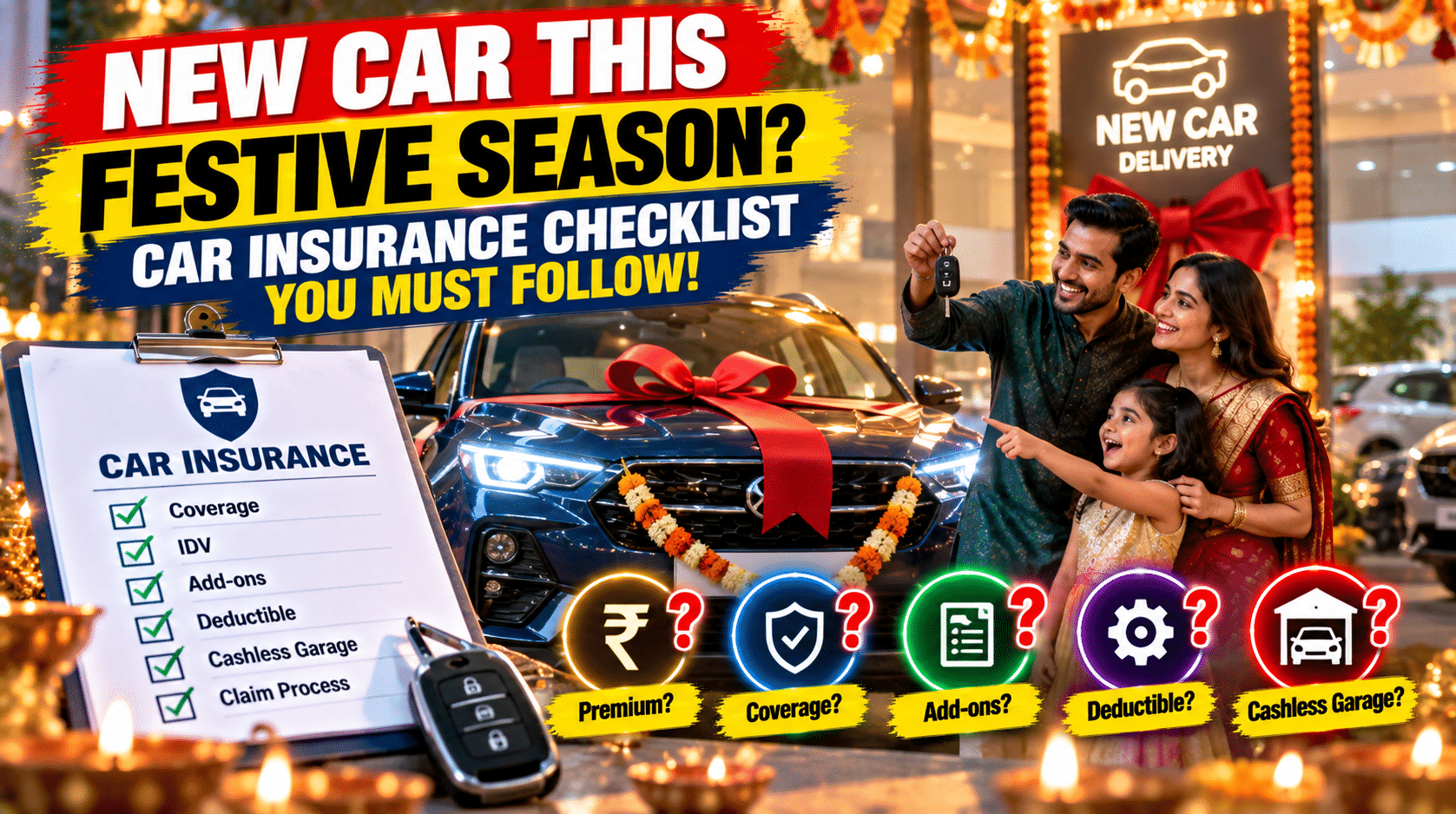
Festive Season Car Insurance Checklist: The festive season is one of the busiest times of the year for car dealerships. Attractive discounts, exchange offers, financing deals, and special packages often make a new car look even more tempting.
But there is one part of the purchase that buyers should not treat as just another formality: car insurance.
When a new car is delivered, many buyers focus on the ex-showroom price, EMI, accessories, and registration charges while accepting the insurance package offered at the dealership without comparing what it actually includes.
That can be a mistake.
The final insurance premium is only one part of the equation. IDV, coverage, deductibles, add-ons, NCB eligibility, cashless garages, and policy exclusions can all affect the value of your insurance.
IRDAI advises vehicle owners to compare multiple own-damage quotes and specifically recommends checking premium alongside deductibles, coverage, and IDV.
So, if you’re planning to bring home a new car this festive season, use this checklist before signing the final insurance documents.
Why Car Insurance Deserves Attention When Buying a New Car
Buying a new car is a significant financial commitment. Insurance is designed to protect part of that investment against specified risks.
Third-party liability insurance is mandatory for vehicles being driven on public roads in India. For broader protection against damage to your own car, buyers can consider a comprehensive/package policy or appropriate standalone own-damage cover, depending on their requirements.
The important point is that not all insurance policies are identical.
Two policies may appear similar but have different:
- IDV
- Deductibles
- Add-ons
- Coverage limits
- Exclusions
- Claim procedures
- Cashless garage networks
That is why buyers should compare the actual policy rather than simply accepting the first insurance quotation.
1. Check What Type of Car Insurance You Are Buying
Before looking at the premium, understand the type of policy being offered.
Third-Party Insurance
Third-party liability insurance protects you against covered legal liabilities arising from injury, death, or property damage caused to third parties.
It is mandatory for vehicles used on public roads in India. However, it does not generally cover damage to your own car.
Comprehensive or Package Insurance
A comprehensive/package policy generally combines third-party liability protection with own-damage cover, subject to the policy terms.
Depending on the policy, own-damage protection can cover specified risks such as:
- Accidents
- Theft
- Fire
- Natural calamities
- Certain man-made events
Optional add-ons can provide additional protection.
For a new car, buyers often prefer broader protection because the vehicle has a relatively high value and repair costs can be substantial.
2. Don’t Judge the Policy Only by Its Premium
This is probably the most important point on the entire checklist.
Suppose the dealer gives you two insurance options:
Policy A: ₹42,000
Policy B: ₹47,000
At first glance, Policy A appears cheaper and therefore better.
But what if Policy A has a lower IDV, higher deductible, and fewer useful add-ons?
The ₹5,000 difference may suddenly look very different.
IRDAI specifically cautions that a lower premium can sometimes be associated with a higher deductible, lower coverage, or lower IDV.
So the right question isn’t:
“Which policy is cheapest?”
It is:
“What protection am I getting for the premium I am paying?”
3. Check the IDV Before You Buy
IDV stands for Insured Declared Value.
It represents the insured value of the vehicle for own-damage purposes and should broadly reflect the car’s current market value.
IDV becomes particularly important in situations such as:
- Total loss
- Constructive total loss
- Theft
A lower IDV may make the premium look attractive, but it can also affect the amount payable in an applicable total-loss or theft claim.
IRDAI specifically recommends comparing IDVs while shopping for motor insurance.
Don’t Simply Choose the Lowest IDV
A lower insured value isn’t automatically a better deal.
When comparing policies, look at the IDV alongside the premium and coverage.
The objective should be a reasonable insured value rather than simply the cheapest possible quotation.
4. Understand the Deductible
A deductible, also called an excess, is the portion of an eligible claim that you may have to bear according to the policy terms.
This is another reason why two apparently similar policies can have different premiums.
For example, a policy offering a lower premium may require you to bear a larger amount yourself when making an eligible claim.
Before buying, check:
- Compulsory deductible
- Voluntary deductible
- Any additional excess
- Whether the deductible varies by circumstances
- How it affects claim settlement
IRDAI advises buyers to compare deductibles along with premium, coverage, and IDV.
5. Check Which Add-Ons Are Actually Included
Add-ons can extend the protection provided by the base policy, but they also increase the premium.
Common options can include:
- Zero Depreciation
- Return to Invoice
- Engine Protection
- Roadside Assistance
- NCB Protection
- Key Protection
- Consumables Cover
- Tyre Protection
However, buying every available add-on isn’t necessarily a smart financial decision.
The Department of Consumer Affairs also advises vehicle owners to select add-ons according to their requirements because unnecessary add-ons can substantially increase the premium.
For a New Car, Pay Special Attention to These Add-Ons
Depending on the vehicle and your circumstances, you may want to investigate:
Zero Depreciation: Can reduce the impact of depreciation on eligible parts during a covered claim, subject to policy terms.
Return to Invoice: May provide additional protection in specified total-loss or theft situations, subject to eligibility and policy conditions.
Engine Protection: Can provide additional cover for specified engine-related risks not covered under the basic policy.
Roadside Assistance: Can help with specified roadside emergencies such as breakdowns, towing, or other assistance.
Don’t buy an add-on simply because the dealer says it is “recommended.” First, understand what it covers and whether you actually need it.
6. Check the No Claim Bonus Rules
NCB stands for No Claim Bonus.
It is a benefit for eligible policyholders who do not make claims during the preceding policy period.
According to current IRDAI information, NCB applies to the own-damage premium and can progressively increase from 20% to a maximum of 50% based on consecutive claim-free years.
For someone buying their first car, there may not be an existing NCB to carry forward.
But if you’re replacing an old vehicle, don’t forget to ask how your existing NCB can be carried forward to the new vehicle, subject to applicable rules.
IRDAI also states that NCB belongs to the insured rather than the vehicle and can be carried to a new insurer on renewal when appropriate proof is provided.
7. Check the Cashless Garage Network
Imagine your car gets damaged and you need repairs.
At that point, the number of cashless garages available near you can become much more important than a small difference in premium.
Before purchasing, check whether the insurer has suitable network garages:
- Near your home
- Near your workplace
- In your city
- Along your regular travel routes
- At locations you frequently visit
Don’t judge the insurer only by a large nationwide garage count.
What matters is whether useful and reliable garages are actually accessible to you.
8. Read the Policy Exclusions
Insurance buyers often spend more time looking at what a policy covers than what it does not cover.
That’s backwards.
Exclusions can be extremely important when a claim is filed.
Depending on the policy, exclusions or limitations can relate to situations such as:
- Driving without a valid licence
- Use outside the permitted purpose
- Certain consequential losses
- Wear and tear
- Mechanical breakdown not covered by the policy
- Driving under specified prohibited conditions
- Unauthorised modifications
- Other policy-specific circumstances
Always read the policy wording and understand the applicable exclusions.
9. Check the Claim Process Before Buying
A policy is tested when something goes wrong.
Before finalising the insurer, understand:
- How to register a claim
- Which documents are required
- How survey/inspection works
- Whether cashless repair is available
- How the insurer communicates claim status
- What happens if the claim is rejected
- How customer support can be contacted
Also save the insurer’s claim helpline and policy number on your phone.
During an accident, searching through old emails for basic policy information is the last thing you want to do.
10. Don’t Forget the Policy Duration
New car buyers should pay particular attention to the structure of the policy.
For new private cars, IRDAI’s guidance provides for a bundled policy structure where third-party liability cover is provided for three years while the own-damage portion is valid for one year. Buyers should check the exact policy schedule to understand when each component expires.
This matters because you don’t want to assume that every component of your new-car insurance expires on the same date.
Set a reminder well before the own-damage renewal date.
IRDAI advises approaching the insurer for renewal at least 15 days before the existing policy expires.
11. Compare the Dealer’s Insurance Quote With Outside Options
Many buyers assume they have to purchase insurance from the dealership.
That’s not necessarily the best way to compare value.
Before finalising the policy, obtain quotes from multiple insurers or authorised channels and compare them on a like-for-like basis.
IRDAI recommends getting multiple comparison quotes for own-damage insurance.
But remember: don’t compare only the final premium.
Compare the same:
- IDV
- Coverage
- Deductible
- Add-ons
- Policy term
- NCB
- Applicable conditions
Only then does the comparison become meaningful.
12. Ask for a Clear Break-Up of the Insurance Cost
Don’t hesitate to ask the dealer or insurer for a detailed premium breakdown.
You should be able to understand what you’re paying for.
The quotation may include components such as:
- Third-party premium
- Own-damage premium
- Add-ons
- Discounts
- NCB, where applicable
- Taxes
- Other applicable charges
A clear break-up makes it easier to compare one quotation with another.
Recent new-car insurance guidance also recommends asking for the overall cost of third-party cover, own-damage cover and add-ons separately rather than comparing only one final figure.
13. Check Whether the Add-Ons Match Your Car
Not every car needs the same insurance configuration.
For example, a new luxury vehicle may have different repair-cost considerations from an older compact car.
Similarly, someone who drives mostly in a city may have different needs from someone who frequently travels long distances.
Consider:
- Car’s age
- Car’s value
- Repair costs
- Daily driving distance
- City or highway usage
- Parking conditions
- Weather and flood exposure
- Frequency of long-distance travel
Your insurance should reflect your actual risk rather than a generic package.
14. Don’t Ignore the Car’s Registration Details
When purchasing insurance, make sure the information supplied to the insurer is accurate.
Check details such as:
- Registration number
- Engine number
- Chassis number
- Variant
- Fuel type
- Vehicle use
- Owner details
IRDAI lists vehicle registration information, engine and chassis details, vehicle class, cubic capacity, and other relevant information among the details commonly used in motor insurance underwriting and premium calculation.
An incorrect detail can create unnecessary problems during policy servicing or claims.
What Should New Car Buyers Carry After Delivery?
Once your car is delivered, keep the following information safely accessible:
- Insurance policy document
- Registration certificate
- Driving licence
- Pollution Under Control certificate, when applicable
- Insurer’s customer care number
- Claim helpline
- Policy number
- Emergency assistance details
- Purchase invoice
Keep digital copies on your phone as well.
New Car Insurance Checklist at a Glance
| What to Check | Why It Matters |
|---|---|
| Policy type | Determines the basic level of protection |
| IDV | Important for applicable theft/total-loss claims |
| Premium | Determines your insurance cost |
| Deductible | Determines your out-of-pocket contribution |
| NCB | Can reduce eligible own-damage premium |
| Add-ons | Extend coverage for specific risks |
| Exclusions | Tell you what isn’t covered |
| Cashless garages | Can make repairs more convenient |
| Claim process | Important during an actual loss |
| Policy duration | Prevents accidental coverage gaps |
| Vehicle details | Helps keep policy information accurate |
| Renewal date | Prevents policy lapse |
Should You Buy All the Add-Ons Offered by the Dealer?
No.
A long list of add-ons can make a policy look more comprehensive, but every additional cover can increase the premium.
The right approach is to identify the risks that are genuinely relevant to your vehicle.
For example, if an add-on provides protection against a risk you are unlikely to face and costs significantly more, it may not be necessary.
On the other hand, an add-on that protects against an expensive risk relevant to your vehicle could be worth considering.
The Department of Consumer Affairs specifically recommends choosing add-ons according to your requirements rather than automatically selecting all of them.
What Happens If Car Insurance Is Allowed to Lapse?
Don’t let the policy expire accidentally.
IRDAI states that motor insurers do not provide a conventional grace period for premium payment. If there is a break in insurance, vehicle inspection may be required. A comprehensive policy lapse exceeding 90 days can also result in loss of accrued NCB.
That makes it important to compare renewal options before the policy expires.
The Smartest Way to Compare Two New-Car Insurance Quotes
Suppose a dealer gives you Quote A and an online insurer gives you Quote B.
Don’t immediately choose the cheaper one.
Create a simple comparison:
| Feature | Quote A | Quote B |
|---|---|---|
| Premium | Check | Check |
| IDV | Check | Check |
| Third-party cover | Check | Check |
| Own-damage cover | Check | Check |
| Deductible | Check | Check |
| NCB | Check | Check |
| Zero Depreciation | Check | Check |
| Engine Protection | Check | Check |
| Roadside Assistance | Check | Check |
| Cashless Garages | Check | Check |
| Exclusions | Check | Check |
| Claim Process | Check | Check |
This makes it much easier to see whether the cheaper quotation is actually offering comparable protection.
Final Verdict
Buying a new car during the festive season is exciting, but insurance should not become an automatic checkbox in the dealership paperwork.
Before accepting the first quotation, take a few minutes to compare the policy type, IDV, deductible, NCB, add-ons, exclusions, cashless garages, claim process, and policy duration.
Most importantly, don’t compare policies purely on premium.
A lower price can sometimes hide a lower IDV, higher deductible, or narrower coverage. IRDAI explicitly recommends comparing these factors when shopping for motor insurance.
The smartest festive-season purchase isn’t necessarily the insurance policy with the biggest list of features or the lowest price.
It is the policy that gives your new car appropriate protection at a premium you can comfortably afford.
Frequently Asked Questions (FAQs)
Is car insurance mandatory when buying a new car?
Third-party liability insurance is mandatory for vehicles being driven on public roads in India. Buyers can also choose broader own-damage or comprehensive protection depending on their requirements.
Should I buy the car dealer’s insurance policy?
You can compare the dealer’s quotation with other authorised insurance options. The important thing is to compare like-for-like coverage, IDV, deductibles, add-ons, and other terms before deciding.
Is the cheapest car insurance policy the best?
No. A lower premium can sometimes come with a lower IDV, higher deductible, or different coverage. Compare the complete policy rather than just the price.
What is IDV in car insurance?
IDV means Insured Declared Value. It represents the insured value of the vehicle for own-damage coverage and should broadly reflect the vehicle’s current market value.
What is NCB?
NCB stands for No Claim Bonus. It is a benefit for eligible policyholders who do not make claims during the preceding policy period. Under current IRDAI information, it can progressively reach up to 50% of the own-damage premium.
Is NCB available on a new car?
If you are buying your first car and have no previous eligible insurance history, you generally won’t have an accumulated NCB. However, an existing NCB may be relevant if you are replacing a vehicle and meet the applicable conditions.
What are car insurance add-ons?
Add-ons are optional covers that extend the protection of the base policy for specific risks. Examples include zero depreciation, engine protection, roadside assistance, and return-to-invoice cover.
Should I buy zero depreciation cover for a new car?
It can be worth considering for a new vehicle, but the decision depends on the policy cost, vehicle, expected usage and the exact terms of the add-on.
What is a deductible?
A deductible is the amount of an eligible claim that you are required to bear according to the policy terms before the insurer pays the admissible amount.
Why should I check the cashless garage network?
A nearby network garage can make the repair and claim process more convenient when cashless service is available under the policy terms.
Can I buy car insurance from an insurer other than the dealer’s recommended company?
Yes, you can compare available options rather than automatically accepting the dealership’s recommended insurer. Always make sure the policy meets your required coverage and the vehicle details are correctly recorded.
Can I switch my insurer when renewing?
Yes. You can compare other insurers when your policy comes up for renewal. Eligible NCB can generally be carried forward when switching insurers, subject to the required proof and applicable rules.
How many insurance quotes should I compare?
There is no fixed number that guarantees the best result, but IRDAI recommends obtaining three or more comparison quotes for own-damage coverage.
When should I renew my car insurance?
You should renew before the existing policy expires. IRDAI advises approaching the insurer at least 15 days before expiry.
What happens if my car insurance expires?
A lapse can lead to inspection requirements, and a comprehensive policy lapse of more than 90 days can result in loss of accumulated NCB.
Is comprehensive insurance mandatory?
No. Third-party liability insurance is mandatory. Comprehensive/package insurance provides broader protection but is not itself the mandatory minimum.
Does comprehensive insurance cover everything?
No. Comprehensive insurance still has exclusions, deductibles, conditions, and limits. Always read the policy wording.
What should I check before signing the new-car insurance paperwork?
At minimum, check the policy type, IDV, premium, deductible, NCB, add-ons, exclusions, cashless garages, claim process, and policy duration.
Can I remove unnecessary add-ons to reduce the premium?
Depending on the insurer and policy, you may be able to choose which optional add-ons to include. Avoid selecting covers you don’t need simply to make the policy look more comprehensive.