
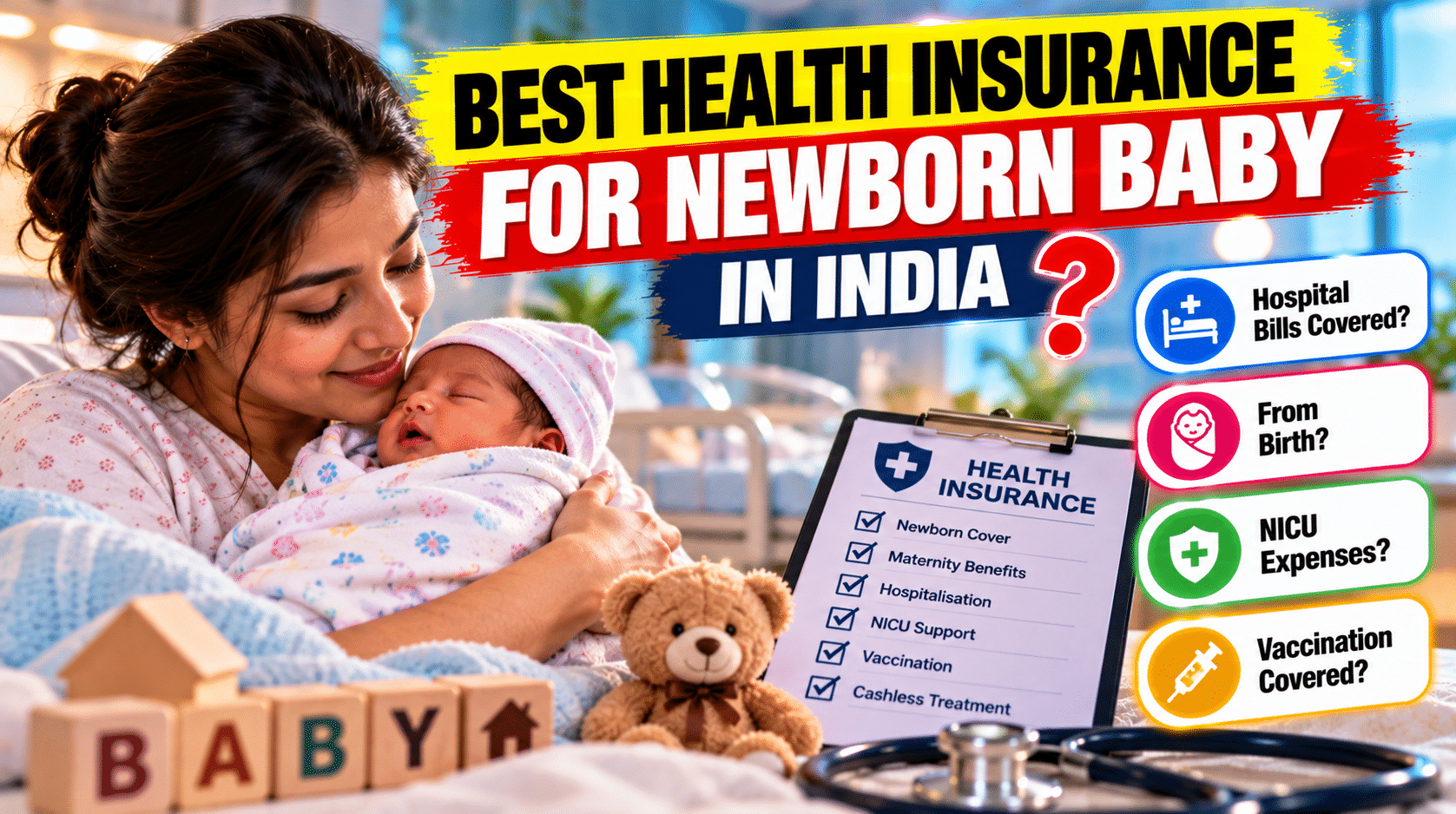
Best Health Insurance Policy for Newborn Babies in India: The arrival of a newborn brings happiness, new responsibilities, and a long list of financial decisions. While parents naturally focus on their baby’s health, nutrition, and early development, one important question can easily be overlooked: Will your health insurance cover your baby if medical treatment is needed soon after birth?
Many parents assume that their existing family health insurance policy automatically protects a newborn from the first day. Unfortunately, that is not always the case. Some policies provide newborn benefits from birth, while others allow parents to add a baby only after a specified age or at the next policy renewal.
This difference can become particularly important if a newborn requires hospitalisation, specialised treatment or neonatal intensive care. Without suitable coverage, families may have to pay a significant portion of the medical bill themselves.
The good news is that parents have several ways to arrange health insurance for a newborn in India. The right choice depends on the existing policy, maternity benefits, the baby’s eligible entry age, coverage limits, and the insurer’s conditions.
In this guide, we explain how newborn health insurance works, which features parents should prioritise, how to compare policies, and what to check before adding a baby to an existing health plan.
What Is Health Insurance for a Newborn Baby?
Health insurance for a newborn is medical coverage that can help pay eligible healthcare expenses for a baby, subject to the policy’s terms and limits.
Depending on the plan, the benefits may include:
- Hospitalisation due to an eligible illness or injury.
- Treatment for certain medical complications after birth.
- Neonatal intensive care unit (NICU) expenses, where covered.
- Treatment for specified congenital conditions, subject to policy wording.
- First-year vaccinations, if the plan includes this benefit.
- Other newborn-related medical expenses specifically listed in the policy.
Not every policy includes all these benefits. Some plans provide limited newborn coverage through a maternity benefit, while others allow the baby to be added to a family floater after meeting the minimum entry-age requirement.
Parents should therefore distinguish between a policy that covers maternity expenses and one that explicitly covers the newborn’s medical treatment.
Important: Maternity coverage does not automatically mean that every medical expense of the newborn will be paid. The policy’s newborn benefit, applicable limits, waiting periods, and exclusions determine the actual protection available.
When Can a Newborn Baby Be Added to Health Insurance?
The eligible age for newborn coverage varies between insurers and products. Some policies offer a newborn benefit from the day of birth, while many standard retail health insurance plans permit a dependent child to be added only after the baby reaches approximately 90 or 91 days of age.
Here are the common arrangements parents may encounter.
1. Coverage From the Day of Birth
Certain maternity-inclusive health insurance plans offer newborn benefits from birth. These benefits may cover eligible hospitalisation or medical complications during the initial period of life.
However, the phrase “covered from day one” should not be interpreted as unlimited protection. The benefit may have a separate sum insured, a maternity-related sub-limit, exclusions, or other conditions.
Before purchasing such a policy, confirm exactly which newborn expenses are covered and whether any initial waiting period or special restriction applies.
2. Coverage After 90 or 91 Days
Many regular family health insurance policies allow a dependent child to be added after the baby reaches the plan’s minimum entry age, commonly around 90 or 91 days.
This means parents may need another arrangement for medical expenses incurred before the child becomes eligible under that policy.
Check whether the insurer requires a formal endorsement, additional premium, medical information, or other documents before the baby is added.
3. Coverage Through Policy Renewal
Some insurers allow newborn inclusion only when the existing health insurance policy is renewed. Others may permit inclusion during the policy term by charging an additional premium.
The process depends on the product and its terms. Parents should not assume that a phone call to customer support or the baby’s birth automatically activates coverage.
Ask the insurer to confirm the baby’s inclusion date in writing.
What Is the Best Health Insurance Policy for a Newborn Baby?
There is no single policy that is best for every family. The most suitable option is the one that provides the required newborn benefits, fits your budget, and offers clear conditions for hospitalisation and treatment.
Parents can begin by comparing these three routes.
Option 1: Add the Baby to an Existing Family Floater
A family floater health insurance policy covers eligible family members under a shared sum insured. If the insurer permits newborn inclusion, parents may be able to add their baby to the existing plan.
Potential advantages:
- One policy can cover multiple eligible family members.
- Policy administration may be simpler than maintaining separate plans.
- The family may be able to continue using its existing insurer and hospital network.
What to check:
- The minimum age at which the baby can be included.
- Whether mid-term inclusion is permitted.
- The additional premium, if any.
- The date from which the baby’s coverage becomes effective.
- Whether adding the baby changes the overall sum insured or other policy conditions.
Remember that a shared family floater sum insured may be used by any covered family member, subject to the policy. A claim for one member can reduce the remaining available cover for others during the same policy year.
Option 2: Choose a Health Plan With Maternity and Newborn Benefits
If you are planning to have a child, consider a health insurance policy that specifically includes maternity and newborn benefits.
Such policies may cover eligible delivery expenses and provide certain medical benefits for the baby. The scope of protection differs significantly between products.
Some policies include newborn cover as a built-in feature, while others offer it through an optional benefit or add-on.
Potential advantages:
- The policy may provide newborn benefits from birth.
- Some plans include maternity-related expenses.
- Specific benefits may be available for eligible newborn hospitalisation or complications.
What to check:
- The maternity waiting period.
- The newborn coverage period.
- Whether the newborn benefit has a separate limit.
- Whether NICU treatment and congenital conditions are included.
- Whether the maternity and newborn benefits share the same limit.
- Whether the policy requires the child to be formally added.
A maternity plan purchased after pregnancy has already begun may not cover the current pregnancy or delivery. Waiting periods and eligibility conditions make advance planning important.
Option 3: Explore Separate Child Health Insurance Later
A standalone health insurance policy may become an option once the child reaches the insurer’s minimum entry age.
However, many retail policies do not accept a newborn as an independent insured member. Some products also require a parent to be insured or to act as the proposer.
For most families, the immediate priority is to understand how the baby can be covered under the parents’ existing plan or a suitable maternity-inclusive policy. Separate child coverage can be evaluated later, depending on eligibility and the family’s needs.
Seven Features to Compare Before Choosing Newborn Health Insurance
A policy’s headline sum insured or premium does not reveal the full extent of newborn protection. These seven factors deserve careful attention.
1. Newborn Coverage From Birth
If you are planning a family, prioritise policies that clearly state when newborn coverage begins.
Do not rely only on a sales brochure that mentions “day-one cover.” Read the policy wording to understand whether the benefit applies from birth, how the child is enrolled, and which expenses qualify.
Also check whether any waiting period or initial restriction affects specific treatments.
2. Hospitalisation and NICU Coverage
Newborns may require specialised treatment because of premature birth, respiratory difficulties, infections or other medical complications.
Review whether the policy covers eligible hospitalisation and NICU expenses. Look for room-category restrictions, daily limits, co-payments, exclusions and any separate caps on newborn treatment.
A high overall family sum insured does not necessarily mean the same amount is available for every newborn-related expense.
3. Congenital Conditions and Birth Defects
Some policies cover specified congenital conditions or birth defects, while others exclude certain conditions or apply special restrictions.
Parents should carefully read the relevant definitions and exclusions. Ask the insurer to clarify how internal congenital conditions and external birth defects are treated under the policy.
Do not assume that all congenital conditions are automatically covered simply because newborn benefits are advertised.
4. Vaccination Benefits
Some health insurance plans provide a limited vaccination benefit during the baby’s first year. Others may exclude routine vaccinations unless a specific benefit is included.
If this feature matters to your family, confirm:
- Which vaccinations qualify.
- The maximum amount payable.
- The age or time period during which the benefit is available.
- Whether the benefit is part of the newborn limit or a separate allowance.
- Whether reimbursement or a cashless process is available.
Compare the actual benefit limit rather than relying on a general statement that vaccinations are covered.
5. Premium and Additional Charges
Adding a newborn to a family floater may increase the premium. A maternity-inclusive plan may also cost more than a policy without maternity benefits.
Compare the extra premium with the benefits actually offered. A plan with a slightly higher premium may provide more useful protection, but only if its coverage conditions suit your needs.
Review the premium payable at renewal and whether the policy’s structure or pricing changes as family members are added.
6. Child’s Coverage Age and Continuity
Check how long the child can remain covered as a dependent under the family floater. The age limit varies by policy.
Also understand what happens when the child reaches that limit. Can the child transition to an individual policy? What eligibility rules apply? Will continuity benefits be preserved under the insurer’s terms?
Planning ahead can help avoid confusion when the child eventually needs separate coverage.
7. Cashless Hospital Network
A good hospital network can make treatment administration easier, especially when families need access to a nearby hospital.
Check whether the insurer has network hospitals in your city and whether the hospital you prefer participates in the insurer’s cashless network.
Cashless treatment is subject to the insurer’s rules, hospital participation, and claim authorisation. It should not be treated as an unconditional guarantee that every bill will be settled directly.
Newborn Health Insurance Comparison Checklist
Use this checklist when comparing plans from different insurers.
| Feature | What parents should verify |
|---|---|
| Eligible entry age | From birth, 90/91 days or another specified age |
| Inclusion process | Mid-term addition or renewal only |
| Newborn sum insured | Overall limit and any separate newborn sub-limit |
| NICU treatment | Whether eligible NICU expenses are covered |
| Congenital conditions | Covered conditions, exclusions and restrictions |
| Vaccinations | Eligibility, amount and time limit |
| Premium | Additional premium and renewal cost |
| Hospital network | Nearby cashless hospitals and claim procedure |
| Child’s coverage age | Maximum age for dependent coverage |
| Waiting periods | Any initial or benefit-specific waiting periods |
Practical tip: Ask each insurer the same questions and request written answers. This makes it easier to compare policies fairly and reduces the risk of relying on assumptions.
How to Add Your Newborn Baby to an Existing Health Insurance Policy?
If you already have health insurance, follow these steps to understand the newborn inclusion process.
Step 1: Review your policy documents. Look for the dependent-child entry age, newborn benefits, maternity provisions, and rules for adding family members.
Step 2: Contact your insurer or insurance adviser. Ask whether newborn inclusion is permitted immediately, during the policy term, or only at renewal.
Step 3: Submit the required details. The insurer may request information such as the baby’s date of birth, a birth certificate or other documents specified by the company.
Step 4: Confirm the additional premium. Ask whether any extra amount is payable and how it will be calculated.
Step 5: Obtain written confirmation. Check the endorsement or updated policy schedule to ensure the baby’s details and effective coverage date are correct.
Step 6: Understand the claim process. Keep the insurer’s contact details and the required documentation accessible in case medical treatment is needed.
Do not assume the baby is covered until the insurer confirms that the policy’s requirements have been met.
Common Mistakes Parents Should Avoid
Assuming the Baby Is Automatically Insured
The parents’ policy may not cover a newborn automatically. The insurer may require formal inclusion, or the baby may need to reach the minimum eligible age.
Confusing Maternity Cover With Newborn Cover
Maternity benefits generally relate to eligible pregnancy and childbirth expenses. Newborn coverage is a separate issue and must be confirmed in the policy.
Ignoring Sub-Limits
A plan may advertise a large overall sum insured while restricting newborn treatment, maternity expenses or vaccinations to a much smaller amount.
Overlooking Waiting Periods
A waiting period may affect maternity benefits or particular treatments. Confirm which waiting periods apply and when the benefits become available.
Focusing Only on the Lowest Premium
A cheaper plan may have narrower coverage, lower newborn limits or fewer suitable hospitals. Compare benefits and restrictions alongside the cost.
Delaying the Inclusion Process
If your insurer requires formal inclusion, delaying the paperwork could create uncertainty about the coverage start date. Ask about the process in advance and retain written confirmation.
Final Verdict: How Should Parents Choose the Right Newborn Health Insurance?
The best health insurance policy for a newborn baby is not necessarily the one with the largest advertised sum insured or the lowest premium. It is the plan that provides suitable medical protection, clearly explains when the baby becomes eligible, and offers benefits that match the family’s needs.
If you already have a family floater, start by checking its newborn inclusion rules. If you are planning a family, compare maternity-inclusive plans and examine their newborn benefits before purchasing. Pay particular attention to coverage from birth, NICU expenses, congenital conditions, vaccination limits, waiting periods, and cashless hospital access.
Most importantly, obtain written confirmation of the baby’s coverage and effective date. A little preparation can help parents make a more confident decision and reduce uncertainty during an already demanding stage of family life.
Frequently Asked Questions (FAQs)
1. Can a newborn baby get health insurance in India?
Yes, but eligibility depends on the insurer and policy. Some plans offer newborn benefits from birth, while many standard health insurance policies allow dependent-child inclusion only after the baby reaches a specified age.
2. Which is the best health insurance policy for a newborn baby?
There is no single best plan for every family. Compare newborn eligibility, hospitalisation and NICU coverage, maternity benefits, congenital-condition exclusions, vaccination limits, premiums and the insurer’s hospital network.
3. Is a newborn automatically covered under a parent’s health insurance?
Not always. The policy may require the baby to be formally added, an additional premium to be paid, or the child to reach the minimum entry age. Check the policy wording and obtain written confirmation from the insurer.
4. Can I add my newborn to an existing family floater policy?
Many insurers permit newborn inclusion, but the rules vary. Some allow mid-term additions, while others require inclusion at renewal or after the child reaches the eligible age.
5. Does health insurance cover a newborn from the first day of birth?
Some policies provide newborn coverage from birth. However, the exact benefits, limits, exclusions, and waiting periods differ. Confirm that the policy explicitly covers the expenses you are concerned about.
6. Does maternity insurance cover newborn hospitalisation?
Some maternity-inclusive plans include newborn hospitalisation benefits, but not all policies do. The amount payable may be subject to a separate newborn limit or a shared maternity benefit limit.
7. Are NICU expenses covered under newborn health insurance?
NICU expenses may be covered when the policy includes eligible newborn hospitalisation or neonatal treatment. Check the benefit wording, applicable limits, exclusions and claim requirements before assuming the full cost will be paid.
8. Does newborn health insurance cover congenital diseases?
Coverage depends on the policy. Certain congenital conditions may be covered, while others may be excluded or subject to specific conditions. Review the definitions and exclusions carefully.
9. Are a baby’s vaccinations covered by health insurance?
Some plans offer limited vaccination benefits, while others exclude routine vaccinations. Check which vaccinations qualify, the benefit limit and the period during which the claim can be made.
10. What documents may be required to add a newborn to health insurance?
The insurer may request the baby’s birth certificate, date-of-birth details, a policyholder’s identification or other documents. Requirements vary, so obtain the exact list directly from the insurer.
11. Can I buy maternity insurance after becoming pregnant?
You may be able to purchase a policy, but it generally will not cover the current pregnancy or delivery if the applicable waiting period and eligibility conditions have not been met. Check the terms before buying.
12. How long can a child remain covered under a family floater policy?
The maximum dependent-child age varies by policy. Review the policy’s age limit and the options available when the child becomes ineligible to remain covered as a dependent.
Disclaimer: This article is for general educational purposes and does not constitute personalised insurance advice. Coverage varies by insurer and product. Always review the latest policy wording, benefit limits, waiting periods and exclusions before purchasing or relying on a health insurance policy.