
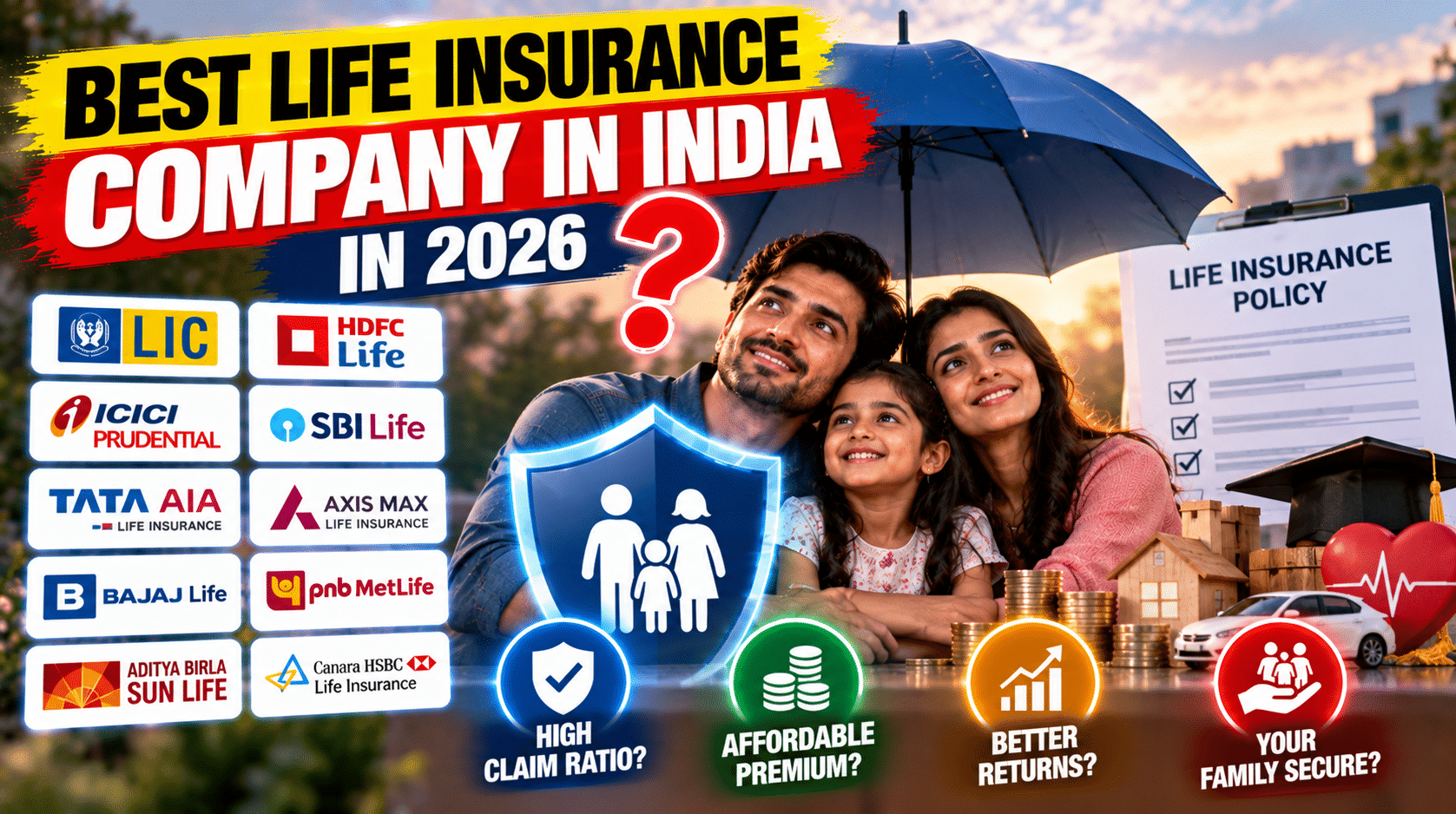
Best Life Insurance Company in India: Choosing a life insurance company is one of those financial decisions that may not seem urgent today but can become extremely important for your family in the future.
You may compare premiums, explore online offers, and look at advertisements promising financial security. But the real value of a life insurance policy becomes clear when a family needs financial support after the policyholder’s death.
That raises an important question: Which is the best life insurance company in India in 2026?
There is no single answer that suits every buyer. Some people want affordable term insurance with a large life cover. Others prefer a company with a long-established service network, while families planning for savings, children’s education, or retirement may need a different type of policy.
The smarter approach is to compare insurers using measurable factors such as claim settlement performance, solvency, customer complaints, product suitability, and service quality.
This guide explores how to identify a suitable life insurance company in India, which insurers deserve consideration, and what you should check before purchasing a policy.
What Makes a Life Insurance Company the Best?
A life insurance company should not be judged by its advertising budget or the number of products it sells.
For a policyholder, the more important question is whether the insurer can provide the promised benefits under the policy terms and deliver an acceptable customer experience throughout the policy’s lifetime.
Here are five factors worth examining.
1. Claim Settlement Ratio
The claim settlement ratio, or CSR, indicates the proportion of claims settled during a specified period under the particular measure being reported.
A higher ratio can be a useful indicator, but it should not be interpreted as a guarantee that every individual claim will be approved. Claim disclosures may also use different definitions, such as individual death claims received, claims settled by number or claims settled by benefit amount.
Always check what the published figure actually measures and which financial year it covers.
For example, published FY 2025–26 individual death-claim figures reported by insurers include 99.81% for PNB MetLife, 99.80% for Axis Max Life and 99.72% for HDFC Life. These are reported figures, not a guarantee of future claim outcomes. (Policybazaar)
2. Solvency Ratio
The solvency ratio provides an indication of an insurer’s financial capacity to meet its obligations.
A stronger solvency position can provide additional reassurance, but it should be assessed alongside the insurer’s regulatory disclosures, business performance and other relevant information.
IRDAI’s regulatory framework sets a minimum solvency requirement for insurers. Buyers should consult current disclosures rather than assume that one financial metric alone establishes an insurer’s overall strength. (IRDAI)
3. Customer Complaints and Service Quality
An insurer’s service experience matters at several stages, including policy issuance, premium payments, corrections, surrender requests, nominee updates and claim processing.
A company may report a high claim settlement ratio while customers still experience difficulties with documentation or customer support.
Look at complaints in relation to the insurer’s business size, the nature of the complaints, and how they are resolved.
4. Product Suitability
The best insurer for a person seeking pure life protection may not be the best choice for someone looking for a savings-oriented or retirement product.
Before choosing a company, decide what you actually need:
- Term insurance for financial protection
- Whole-life coverage, where suitable
- Savings-oriented life insurance
- Unit-linked insurance plans (ULIPs)
- Child-focused financial planning
- Pension or annuity products
A policy should fit your financial objective rather than forcing you to change your objective to match the product.
5. Consistency Over Time
A single year’s performance can be affected by several factors.
Comparing disclosures over multiple years can help you understand whether an insurer’s performance is relatively consistent or whether its latest result is an outlier.
This is especially important when evaluating claim data, complaints, and solvency.
Best Life Insurance Companies in India: Expert Shortlist
The following companies are worth considering when comparing life insurance in India. This is a research shortlist organised around different buyer needs, not an official ranking or a claim that one company is best for everyone.
1. Life Insurance Corporation of India (LIC)
LIC is a major public-sector life insurer with a long-established presence and an extensive agent network.
Its reach may appeal to customers who prefer in-person assistance, access to local agents, and a broad selection of life insurance products.
Worth considering if: You value a traditional distribution network and want to compare protection, savings, and retirement-oriented policies.
What to check: Premiums, policy conditions, surrender value, benefit structure, and whether the product matches your financial goals.
2. HDFC Life Insurance
HDFC Life is a large private-sector insurer offering products across protection, savings, investment-linked, and retirement categories.
Its digital channels may appeal to customers who prefer researching and managing policies online.
Worth considering if: You want to compare term insurance alongside other long-term life insurance products.
What to check: Actual premium quotations, policy exclusions, payout options, claim disclosures and servicing facilities.
3. Axis Max Life Insurance
Axis Max Life is another insurer to include in a comparison of term insurance and broader life insurance products.
Its reported FY 2025–26 individual death-claim settlement ratio was 99.80% in the cited comparison. This is a historical disclosure and should be read alongside the insurer’s other financial and service information. (Policybazaar)
Worth considering if: Your priority is comparing life protection options and examining published claim performance.
What to check: Eligibility, medical underwriting, coverage amount, premium payment conditions, and exclusions.
4. PNB MetLife India Insurance
PNB MetLife offers life insurance products for different protection and long-term planning needs.
The company’s reported FY 2025–26 individual death-claim settlement ratio was 99.81% in the cited comparison. That figure should not be treated as a promise of approval for any particular claim. (Policybazaar)
Worth considering if: You want to compare term insurance, savings-oriented policies and other long-term protection options.
What to check: Product suitability, service channels, policy conditions and the insurer’s latest official disclosures.
5. Aditya Birla Sun Life Insurance
Aditya Birla Sun Life Insurance offers a range of protection, savings, investment-linked, and retirement products.
Its reported FY 2025–26 individual death-claim settlement ratio was 98.86% in the cited source. Compare that number with other indicators rather than treating it as a standalone verdict on the insurer. (Policybazaar)
Worth considering if: You want to compare different life insurance product categories from one provider.
What to check: Charges, exclusions, surrender conditions, payout structure, and the actual benefits of the selected plan.
6. ICICI Prudential Life Insurance
ICICI Prudential Life offers term insurance, savings, investment-linked, and retirement-oriented products.
Worth considering if: You want to compare a broad range of life insurance options and digital servicing facilities.
What to check: Premium, policy term, exclusions, payout options, and the latest claim and solvency disclosures.
7. Tata AIA Life Insurance
Tata AIA offers life insurance products covering protection and longer-term financial planning.
Worth considering if: You want to compare term plans as well as products designed for savings or long-term goals.
What to check: Guaranteed versus non-guaranteed benefits, charges, policy duration, and conditions for receiving benefits.
8. SBI Life Insurance
SBI Life is another major insurer to research, with products covering life protection, savings, and retirement planning.
Worth considering if: You prefer comparing insurers with a substantial distribution presence and multiple product categories.
What to check: Premium affordability, product features, payout conditions, service access, and current regulatory disclosures.
9. Canara HSBC Life Insurance
Canara HSBC Life offers life insurance products across protection and other financial planning categories.
Worth considering if: You want to compare term insurance and other life insurance products through its digital and distribution channels.
What to check: The exact product’s benefits, medical requirements, exclusions, premium, and claim-related disclosures.
10. Bajaj Life Insurance
Bajaj Life is another insurer worth including in your research.
Worth considering if: You want to compare protection-oriented and longer-term financial planning products from multiple providers.
What to check: Product terms, premium, policy duration, riders, exclusions, and the insurer’s latest official disclosures.
Note: Company product ranges, branding, and reported performance can change. Verify current details through the insurer’s official website and IRDAI disclosures before making a purchase.
Quick Comparison of Life Insurance Companies
| Company | Main reason to compare | Key consideration |
|---|---|---|
| LIC | Established public-sector insurer and agent network | Product terms and servicing preferences |
| HDFC Life | Protection and broad product range | Premium and policy conditions |
| Axis Max Life | Protection-focused comparisons | Claim disclosures and underwriting |
| PNB MetLife | Protection and long-term planning | Service and current disclosures |
| Aditya Birla Sun Life | Multiple product categories | Charges and benefit structure |
| ICICI Prudential Life | Broad life insurance range | Suitability and payout terms |
| Tata AIA Life | Protection and savings options | Guaranteed versus market-linked benefits |
| SBI Life | Protection and retirement products | Policy conditions and servicing |
| Canara HSBC Life | Protection and financial planning | Eligibility and product terms |
| Bajaj Life | Protection and longer-term planning | Current features and premium |
This table is a starting point for research, not a performance ranking. A meaningful comparison requires quotations and policy terms suited to the same applicant and financial objective.
Which Life Insurance Company Is Best for Your Needs?
Instead of asking which company is best overall, begin with your primary goal.
If You Want Pure Life Protection
Start by comparing term insurance plans.
Look at the life cover, policy term, premium, exclusions, medical underwriting, and claim-related disclosures. Make sure the coverage lasts through the period when your family depends on your income.
If You Prefer In-Person Assistance
An insurer with a convenient agent or branch network may be useful if you prefer face-to-face support.
However, check the quality and accessibility of servicing in your own area rather than assuming a large national network guarantees a good individual experience.
If You Want Savings Alongside Insurance
Compare the product’s guaranteed benefits, non-guaranteed projections, charges, surrender value and maturity conditions.
Do not confuse an illustration with a guaranteed return. The policy document determines which benefits are guaranteed.
If You Are Planning for Retirement
Compare pension and annuity products based on the income they may provide, the options available to your spouse or nominee, and the terms applicable at purchase.
Annuity rates and terms can vary, so obtain current quotations before deciding.
If You Prefer Digital Policy Management
Check whether the insurer provides convenient online services for policy documents, premium payments, nominee updates, service requests, and claim tracking.
Digital convenience is useful, but it should not replace careful review of policy terms and financial disclosures.
How to Read a Life Insurance Claim Settlement Ratio
The claim settlement ratio is one of the most frequently discussed metrics in life insurance comparisons. But it is easy to misinterpret.
Suppose an insurer reports a 99% claim settlement ratio for a particular period. That does not mean that every claim will be paid automatically or that 99% of all future claims will necessarily be approved.
The ratio reflects a defined set of claims over a specified period. Different disclosures may use different calculation methods.
When checking a claim ratio, ask:
- Does it relate to individual death claims?
- Which financial year does it cover?
- Is it measured by the number of claims or their benefit amount?
- How does it compare with the insurer’s previous years?
- What do the insurer’s complaint and solvency disclosures show?
For example, the cited FY 2025–26 comparison reports individual death-claim ratios of 99.81% for PNB MetLife, 99.80% for Axis Max Life, and 99.72% for HDFC Life. Those figures are useful for research, but they do not replace an assessment of policy suitability or the insurer’s full disclosures. (Policybazaar)
What Is the Solvency Ratio, and Why Does It Matter?
The solvency ratio indicates an insurer’s ability to meet its financial obligations relative to the risks it has taken on.
Life insurance is often a long-term commitment, so financial strength matters beyond the first premium payment.
When comparing insurers, review the latest solvency disclosures and confirm that the company meets the applicable regulatory requirements. Consider the ratio alongside other indicators rather than treating a single number as a complete assessment of financial strength. (IRDAI)
Term Insurance vs Savings-Oriented Life Insurance
These products serve different purposes, so they should not be compared only by premium.
| Feature | Term Insurance | Savings-Oriented Life Insurance |
|---|---|---|
| Main purpose | Financial protection | Protection combined with savings or other benefits |
| Premium for a given death cover | Often lower than savings-oriented alternatives | Can be higher because of additional benefits |
| Maturity benefit | Usually none under a standard term plan | Depends on the product |
| Investment risk | Primarily protection-focused | Depends on the product; ULIPs are market-linked |
| Best comparison criteria | Cover, term, exclusions and affordability | Benefits, charges, guarantees and surrender conditions |
The appropriate choice depends on your needs. If your main goal is to provide a large life cover at an affordable cost, term insurance is a natural starting point. If you need a product with savings or other benefits, examine the policy’s structure carefully.
How to Calculate the Right Life Insurance Cover?
Before comparing insurers, estimate how much protection your family may need.
Consider:
- Your annual income
- Outstanding loans
- Household expenses
- Children’s education
- Financially dependent family members
- Existing life insurance
- Savings and investments
- The number of years your family may depend on your income
A useful starting framework is:
Income replacement + outstanding liabilities + future financial goals − existing financial resources
This is not a universal formula, but it encourages you to consider more than your current salary.
For example, a person with a home loan and two dependent children may need a different amount of cover from someone with the same income but no dependents or outstanding debt.
Once you have an estimate, compare policies with similar coverage and policy terms.
Common Mistakes to Avoid When Choosing a Life Insurance Company
Choosing Only by Claim Settlement Ratio
Claim data matters, but it cannot tell you everything about an insurer’s service quality, financial strength, or the suitability of a particular policy.
Buying the Cheapest Policy Without Comparing Coverage
A lower premium is useful only if the policy provides the protection you need.
Confusing Guaranteed and Non-Guaranteed Returns
Savings and investment-linked policies can have different benefit structures. Read the policy document to understand which benefits are guaranteed and which depend on future performance.
Ignoring Exclusions
Always check the conditions under which benefits may not be payable or may be restricted.
Giving Inaccurate Information
Provide complete and accurate information about your health, lifestyle, occupation, and other details requested in the application. Incorrect or withheld information can create problems during underwriting and claim assessment.
Buying a Policy Without Reviewing Affordability
Life insurance is a long-term commitment. Choose a premium you can realistically maintain over the policy’s required payment period.
Final Verdict
There is no single life insurance company that is automatically the best choice for every Indian buyer in 2026.
LIC may appeal to people who value a traditional agent network. HDFC Life, Axis Max Life, PNB MetLife, Aditya Birla Sun Life, ICICI Prudential, Tata AIA, SBI Life, Canara HSBC Life and Bajaj Life are other insurers worth comparing based on your financial goals.
The most useful decision comes from looking beyond advertisements and checking measurable disclosures, policy terms, premiums, claim-related information, and service facilities.
Before purchasing, compare at least a few suitable policies, verify the latest official disclosures, and read the complete policy wording. The objective is not merely to buy insurance from a popular company. It is to select coverage that your family can depend on, subject to the policy’s terms.
Frequently Asked Questions (FAQs)
1. Which is the best life insurance company in India in 2026?
There is no universal winner. The right company depends on your need for term protection, savings, retirement planning, service access, affordability, and the policy terms available to you.
2. Which life insurance companies should I compare?
You can compare LIC, HDFC Life, Axis Max Life, PNB MetLife, Aditya Birla Sun Life, ICICI Prudential Life, Tata AIA Life, SBI Life, Canara HSBC Life and Bajaj Life, among others.
3. Is claim settlement ratio the most important factor?
It is an important factor, but not the only one. Check how the ratio is calculated, the period covered, complaint information, solvency disclosures, and the actual policy conditions.
4. What is a good claim settlement ratio?
A higher ratio can be a positive indicator when the figures are comparable, but there is no single ratio that guarantees a satisfactory claim experience. Review multiple years and other disclosures as well.
5. What is the difference between a claim settlement ratio and solvency ratio?
The claim settlement ratio measures claims settled under a specified definition and period. The solvency ratio indicates the insurer’s financial capacity relative to its obligations and risks.
6. Is LIC better than private life insurance companies?
Not automatically. LIC’s distribution network may suit some buyers, while private insurers may offer different digital services or product options. Compare the actual policy, price, and servicing requirements.
7. Should I choose a life insurance company with the lowest premium?
Not based on price alone. Compare the sum assured, policy term, exclusions, payout conditions, and affordability over the long term.
8. Is term insurance better than savings-oriented life insurance?
They serve different purposes. Term insurance focuses primarily on life protection, while savings-oriented products may combine protection with savings or other benefits. Choose based on your objective.
9. Can I buy life insurance online?
Yes. Many insurers offer online applications. Provide accurate information, review the policy terms, and confirm that the issued policy reflects the coverage you selected.
10. Why should I check solvency before buying life insurance?
Solvency disclosures provide information about an insurer’s financial position and ability to meet obligations. They are useful alongside claim data, complaints, and other relevant information.
11. Does a high claim settlement ratio guarantee my family’s claim will be approved?
No. Each claim is assessed according to the policy terms, application information, documentation and applicable requirements. A high historical ratio does not guarantee an individual outcome.
12. How much life insurance cover should I buy?
Estimate your family’s income-replacement needs, outstanding liabilities and future financial goals, then account for existing insurance and other financial resources. Your personal circumstances determine the appropriate amount.
13. Should I buy all my insurance policies from one company?
Not necessarily. Convenience may be useful, but each policy should be evaluated on its own merits. Choose suitable products rather than concentrating everything with one insurer simply for convenience.
14. How often should I review my life insurance?
Review your cover after major life changes such as marriage, having children, taking a home loan, changing income, or reaching retirement. Also verify that your nominee and contact details remain accurate.
15. Where can I verify an insurer’s official status?
Check IRDAI’s official life-insurer listings and review the insurer’s own regulatory disclosures and current policy documents. (IRDAI)