
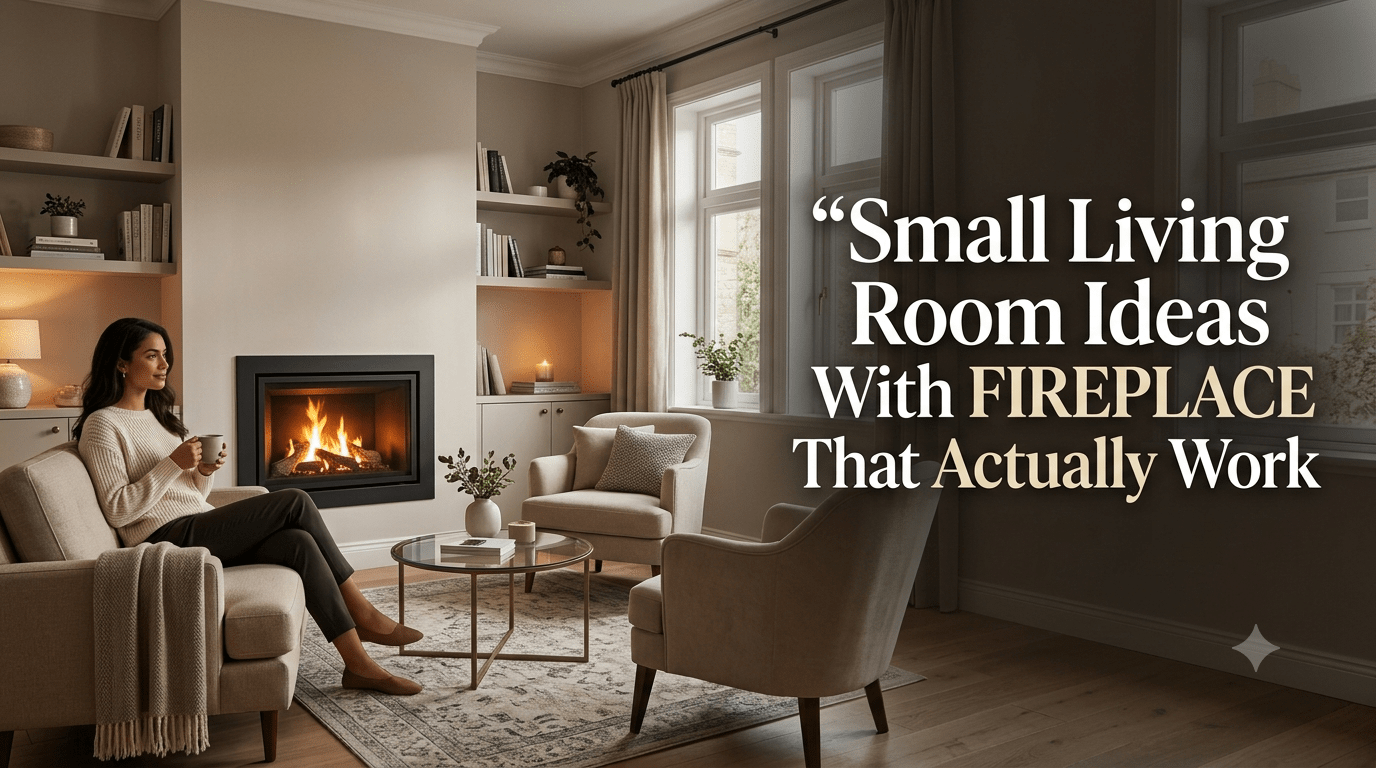
Small Living Room Ideas With Fireplace: You walk into your living room, and there it is: a sofa pushed awkwardly to one side, a fireplace nobody quite knows how to work around, and just enough floor space to remind you how small the room really is. If that sounds familiar, you’re not alone. A fireplace is one of the best features a living room can have, but in a small space, it can also feel like the one thing standing between you and a layout that actually works.
The good news is that small living room ideas with a fireplace don’t have to mean cramped, cluttered, or compromised. A fireplace can anchor a small room instead of fighting it, once you understand how to work with its scale, its sightlines, and the flow of the space around it. In this guide, you’ll find practical, real-world ideas for furniture placement, sofa sizing, color, lighting, storage, and styling — the kind of decisions that actually change how a room feels to live in, not just how it looks in a photo.
The biggest mistake people make with a small living room and a fireplace is treating the fireplace like an obstacle. It’s not. It’s already doing half the design work for you — you just need to build around it instead of around it.
Small Living Room Ideas With Fireplace
1. Make the Fireplace the Focal Point
Every room benefits from having one clear focal point, and in a room with a fireplace, that decision is already made for you. Trying to compete with it — with a big media wall, a gallery of art, or a second “statement” piece across the room — usually just splits the eye and makes a small space feel busier than it is.
Instead, arrange your furniture so that everything visually points toward the fireplace. Sofas and chairs angled slightly inward, rather than lined up flat against the walls, do more to create a sense of a real “room” than almost any other single change you can make. It also helps sightlines: when you walk in, your eye should land on the fireplace first, not on the back of a couch.
Scale matters here too. A fireplace with a tall, heavy mantel or a large stone surround can visually overpower a small room if the furniture around it is too low or too small. On the flip side, a modest fireplace can get lost if the surrounding furniture is bulky. The goal is proportion — furniture that feels like it belongs in conversation with the fireplace, not furniture that’s just filling space near it.
2. Choose a Sofa That Fits the Room
This is where most small living rooms go wrong before anything else is even decided. People buy the sofa they love in the showroom, then bring it home and realize it eats every inch of walking space. An oversized sofa is probably the single most common reason a small living room with a fireplace feels tight.
Look for what’s often labeled an apartment-size sofa or apartment sofa — typically 70 to 84 inches wide, compared to a standard sofa that can run 90 inches or more. That difference of a foot or two doesn’t sound like much until you see how much breathing room it gives back to the room.
A loveseat is another smart option if your space is genuinely tight, especially when paired with one or two chairs for flexible seating. It keeps the main seating piece from dominating the room while still giving you a comfortable spot to relax in front of the fire. Before you buy anything, measure the actual path you’ll walk between the sofa, the fireplace, and the room’s main entry point — that walkway is non-negotiable, and it should stay at least 30 inches wide.
3. Try a Small Sectional in an L-Shaped Layout
A compact sectional can work beautifully in a small living room with a fireplace, but only under the right conditions. It works when the room is roughly square rather than long and narrow, when there’s a corner available that isn’t directly in the walking path, and when the sectional itself is scaled down — think apartment-size sectionals in the 80 to 100 inch range, not the oversized versions built for great rooms.
Where a sectional goes wrong is when it’s forced into a room that’s too narrow or too rectangular. In that layout, an L-shaped piece often blocks the natural path to the fireplace or kitchen, and it can make the far end of the room feel unreachable. If your living room is long and skinny, a sofa and a couple of chairs will almost always create a better flow than a sectional will.
A helpful rule of thumb: if you can’t walk a clear line from your main entry to the fireplace without squeezing past furniture, the sectional is too big for the room, no matter how nice it looks in the catalog.
4. Use a Pair of Small Accent Chairs
Two small accent chairs, positioned across from the sofa or angled on either side of the fireplace, do something a single large chair can’t — they create balance without adding visual weight. Because they’re lighter in scale, often with exposed legs and slim arms, they read as “furniture” rather than “mass,” which matters a lot in a room where every square foot counts.
Chairs also give you flexibility a fixed sectional doesn’t. Need extra seating for guests? Pull a chair closer to the fireplace. Want the room to feel more open on a regular evening? Push them back slightly. That kind of adaptability is genuinely useful in a small space, where the furniture often has to do more than one job.
If you’re choosing between a bulky armchair and two slim accent chairs for the same footprint, the pair will almost always make the room feel more open, simply because there’s more visible floor between the pieces.
5. Arrange the Furniture Around the Fireplace
Once you’ve settled on your sofa and chairs, the actual arrangement comes down to a few consistent principles. First, keep the fireplace visible from the main seating — that’s the whole point of having it. Second, create a conversation area where people can actually talk without raising their voices, which usually means keeping seating pieces within about 8 feet of each other.
Walkways matter more in a small room than almost anything else. A room can be beautifully decorated and still feel cramped if you have to turn sideways to get past the coffee table. Keep at least 30 to 36 inches clear for main walking paths, and don’t let furniture legs creep into that zone even if the piece itself “technically” fits.
If your room is narrow, consider a layout where the sofa sits perpendicular to the fireplace rather than directly facing it, with a chair or two completing the seating area. This can open up a walking path along one side of the room that a straight-on arrangement simply doesn’t allow.
6. What If the TV Is Above the Fireplace?
Mounting the TV above the fireplace is popular for a reason — it’s often the only wall in the room that makes sense for both, and it consolidates your two focal points into one instead of splitting attention across the room. In a small space, that consolidation is genuinely useful; it frees up an entire wall that would otherwise be taken up by a media console or a competing feature.
That said, it’s not automatically the right call for every room. The main downside is viewing angle: TVs mounted above a fireplace tend to sit higher than ideal for comfortable seated viewing, especially on a low sofa, which can strain your neck over time. If your mantel is unusually tall, or your seating is very close to the fireplace, this becomes a bigger issue.
If mounting above the fireplace doesn’t work for your setup, look at an adjacent wall, a corner mount, or even a swivel TV stand that can be angled toward the seating area. In smaller rooms, a TV that isn’t directly over the fire also lets the fireplace stay the more prominent visual feature — some homeowners actually prefer this, especially in rooms with a traditional or farmhouse fireplace they want to keep front and center.
7. Use a Round Coffee Table to Improve Flow
Rectangular coffee tables are the default, but in a tight layout, their sharp corners are exactly what people bump into and walk around awkwardly. A round or oval coffee table softens the traffic pattern through the room — there’s no corner to catch a hip on, and you can walk closer to it without feeling like you need to detour.
Round tables also tend to look more proportional next to a small sectional or a pair of chairs angled toward each other, because they don’t force a strict rectangular seating arrangement. A nesting table set is worth considering too — you get a full-size surface when you need it, and the option to pull the smaller tables apart for extra side-table space when guests are over.
Scale still matters here. A coffee table should generally be about two-thirds the length of your sofa and low enough that it doesn’t compete visually with the fireplace across from it.
8. Add a Rug to Define the Seating Area
A rug that’s too small is one of the quiet culprits behind a small living room that still feels disjointed, even when the furniture itself is well chosen. If the rug only fits under the coffee table, with the sofa and chairs sitting entirely off of it, the seating area reads as separate pieces rather than one cohesive space.
The better approach, even in a small room, is to size the rug so at least the front legs of your sofa and chairs rest on it. This visually ties the furniture together and defines the conversation area as its own zone within the room, which matters more in an open or combined living space where the living room isn’t fully separated from a dining or entry area.
Lighter rug colors and simpler patterns tend to keep a small room feeling calm, while a busy, dark rug can visually shrink the floor space even if the actual square footage hasn’t changed.
9. Use Vertical Space Around the Fireplace
When floor space is limited, the walls around your fireplace become some of the most valuable real estate in the room. Floating shelves on either side of the fireplace add storage and display space without eating into your walkways, and they draw the eye upward, which makes the ceiling feel higher than it is.
Artwork above the fireplace is a classic choice for good reason — it fills the vertical space above the mantel in a way that feels intentional rather than empty, without adding any bulk to the room. Just be mindful of scale: a piece that’s too small will look lost above a mantel, while something appropriately sized (roughly two-thirds the width of the mantel) will feel balanced.
The key with vertical storage and decor is restraint. A wall of shelves packed floor to ceiling with books and objects can actually make a small room feel more cluttered, not less, even though technically you’re saving floor space. Leave some visual breathing room between items.
10. Try Built-In Shelving or Cabinets
If you have the ability to add built-ins — whether you own your home or your landlord allows modifications — flanking the fireplace with built-in shelving or cabinets is one of the most effective small living room storage ideas available. Built-ins use the awkward, narrow spaces on either side of a fireplace that standard furniture usually can’t fill well, turning dead space into genuinely useful storage.
Closed cabinets on the lower portion are particularly useful for hiding the things that create visual clutter — cables, remotes, board games, extra blankets — while open shelving above keeps the display personal without hiding everything away. This combination gives you both function and a finished, custom look that makes a small room feel more considered rather than just furnished.
If built-ins aren’t an option, freestanding bookcases in a similar scale can achieve much of the same effect, as long as they’re sized to fit the alcove rather than overwhelming it.
11. Keep the Fireplace Mantel Simple
A mantel is one of those spots that’s easy to overdecorate, especially around the holidays, and in a small room the effect is more noticeable than it would be in a larger space. A cluttered mantel competes with the fireplace itself for attention, which undercuts the whole point of making the fireplace your focal point in the first place.
A simple, well-edited approach works better: one larger piece — a mirror, art, or a substantial object — paired with one or two smaller items, rather than a long row of frames, candles, and knickknacks all fighting for space. Odd numbers of objects, grouped with a little varied height, tend to look more intentional than a perfectly even, matched set.
Leave some open mantel surface visible. That negative space is doing real work — it’s what keeps the styling from reading as busy, even in a room where everything else has to be a little more compact than usual.
12. Use Mirrors to Make the Room Feel Larger
A mirror placed above the fireplace, or on a nearby wall, is one of the most reliable small living room decorating tricks there is, and it earns its reputation. Mirrors reflect both light and the room itself, which creates a sense of depth that a flat wall simply can’t offer.
Placement matters more than people expect. A mirror positioned to reflect a window will bounce natural light back into the room, brightening spaces that might otherwise feel dim, especially in the evening when the fireplace is the main light source. A mirror that reflects a blank wall doesn’t do nearly as much work.
Size helps too — a larger mirror tends to read as a design feature, while a small one can look like an afterthought. Above a fireplace, a mirror sized close to the width of the mantel usually looks the most balanced.
13. Choose Light, Warm Colors
Light, warm colors are a genuine tool for making a small living room feel bigger, not just a design trend. Whites, creams, soft beige, and warm gray reflect more light than deep, saturated colors do, which keeps the room feeling open rather than closed in — particularly useful in a room where a fireplace can already read as visually heavy.
That doesn’t mean every small room has to be white. A warm taupe or a soft greige can feel just as light and airy while adding more warmth and personality than stark white, especially paired with wood tones from a mantel or floor. The goal is a palette with enough contrast to feel intentional, not flat, while staying light enough overall that the walls recede rather than close in.
If you love a bolder color, consider using it on the fireplace surround or an accent wall rather than across the whole room. That way you get the personality without sacrificing the sense of openness that light walls provide elsewhere.
14. Create a Cozy Small Living Room With Layered Lighting
A single overhead light fixture is rarely enough to make a small living room with a fireplace feel genuinely cozy, especially once the sun goes down and the fireplace becomes the main source of warmth in the room. Layered lighting — combining ceiling light, floor lamps, table lamps, and sometimes sconces — gives you more control over the mood than any single source can.
A floor lamp beside a chair, a table lamp on a side table, and dimmable overhead lighting together let you shift from bright and functional during the day to warm and low-lit in the evening, which is exactly when a fireplace does its best work. Wall sconces flanking the fireplace are another option, especially useful in a small room where floor space for lamps is limited.
The fireplace itself is a light source too, and it’s worth actually using it that way — dim the other lights slightly on a fire-lit evening and let the flicker do some of the visual work. It’s a simple change, but it’s one of the fastest ways to make a small room feel intentionally cozy rather than just dim.
15. Use Multifunctional Furniture
In a small living room, furniture that only does one job is a luxury you often can’t afford. A storage ottoman can serve as a coffee table, extra seating, and a place to stash blankets or magazines, all in one piece — which is a meaningful upgrade over a coffee table that just sits there taking up floor space.
Nesting tables solve a similar problem for side tables: you get the surface area when you need it, and a smaller footprint the rest of the time. A storage bench near the fireplace can double as extra seating for guests and a spot to keep firewood, throws, or games out of sight but within reach.
The common thread with all of these pieces is that they reduce the total number of items you need in the room without reducing function. Fewer individual pieces, doing more work each, is one of the most reliable small living room storage ideas — and it tends to make a room look calmer, too.
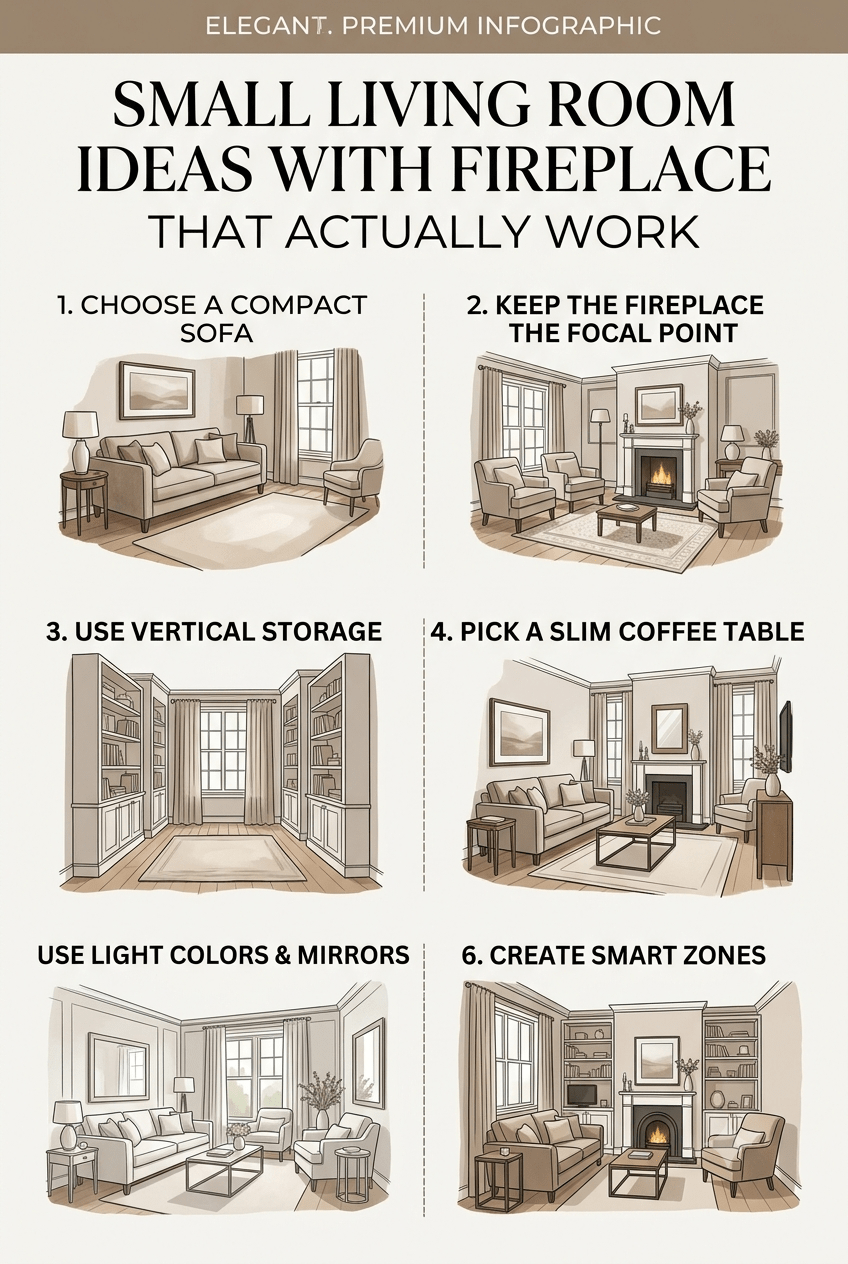
Small Apartment Living Room With Fireplace
Apartments, condos, and rentals come with their own set of constraints, and a small apartment living room with a fireplace often means working around things you can’t change — a gas insert you can’t modify, a mantel you didn’t choose, or walls you’re not allowed to paint or drill into.
For rentals, look for furniture and decor solutions that don’t require permanent changes: leaning shelves instead of built-ins, removable wallpaper for an accent wall, and freestanding bookcases sized to flank the fireplace the way built-ins would. Command hooks and adhesive strips can hang art and mirrors without leaving damage, which matters if you want to use vertical space without losing your security deposit.
Apartment living rooms are also more likely to be open-plan, blending into a dining area or entry hall. In that case, a rug and a consistent furniture arrangement around the fireplace become even more important — they’re what visually separates “the living room” from the rest of the open space, even without walls to do it for you.
Small Living Room Fireplace Ideas by Design Style
- Modern. Keep the fireplace surround clean and simple — a smooth painted finish or minimal tile — and let one or two statement pieces, like a sculptural lamp or a bold piece of art, do the visual work instead of a cluttered mantel.
- Minimalist. Lean into negative space deliberately. A nearly bare mantel, a neutral palette, and furniture with visible legs (which let light pass underneath and make the floor feel less crowded) all support this look.
- Farmhouse. A whitewashed or shiplap surround pairs well with warm wood floating shelves and a mantel styled with a mix of woven textures and greenery, without tipping into overly rustic clutter.
- Traditional. A more detailed mantel — crown molding, a marble or wood surround — can carry more decor than other styles, but keep the rest of the room’s furniture a bit more restrained so the fireplace still reads as the star.
- Scandinavian. Light wood tones, a mostly white or soft gray palette, and simple, functional furniture keep the room feeling open. A single cozy throw and a well-chosen lamp do more here than a room full of accessories.
- Rustic. Stone or brick surrounds are often already part of the room; balance that texture with softer, simpler furniture and warm lighting rather than adding more heavy, textured pieces on top of it.
- Contemporary. Clean lines, a neutral base palette, and one or two current accent colors — often introduced through pillows or art rather than large furniture — keep a contemporary living room feeling current without requiring a full remodel.
Common Small Living Room Fireplace Mistakes to Avoid
- Buying an oversized sofa that technically fits the wall but eliminates your walkway
- Blocking the natural path between the entry, the fireplace, and the rest of the room
- Overfurnishing — trying to fit a sofa, sectional, and multiple chairs into a room that only has space for two or three seating pieces
- Overdecorating the mantel to the point that it competes with the fireplace itself
- Mounting the TV too high above the fireplace without considering actual seated viewing angle
- Using a rug that’s too small, leaving furniture floating off its edges
- Skipping layered lighting and relying on a single overhead fixture
- Creating two competing focal points — a large media wall and a fireplace that fight for attention instead of working together
- Letting clutter build up around the fireplace — mail, remotes, and odds and ends tend to collect right where they’re most visible
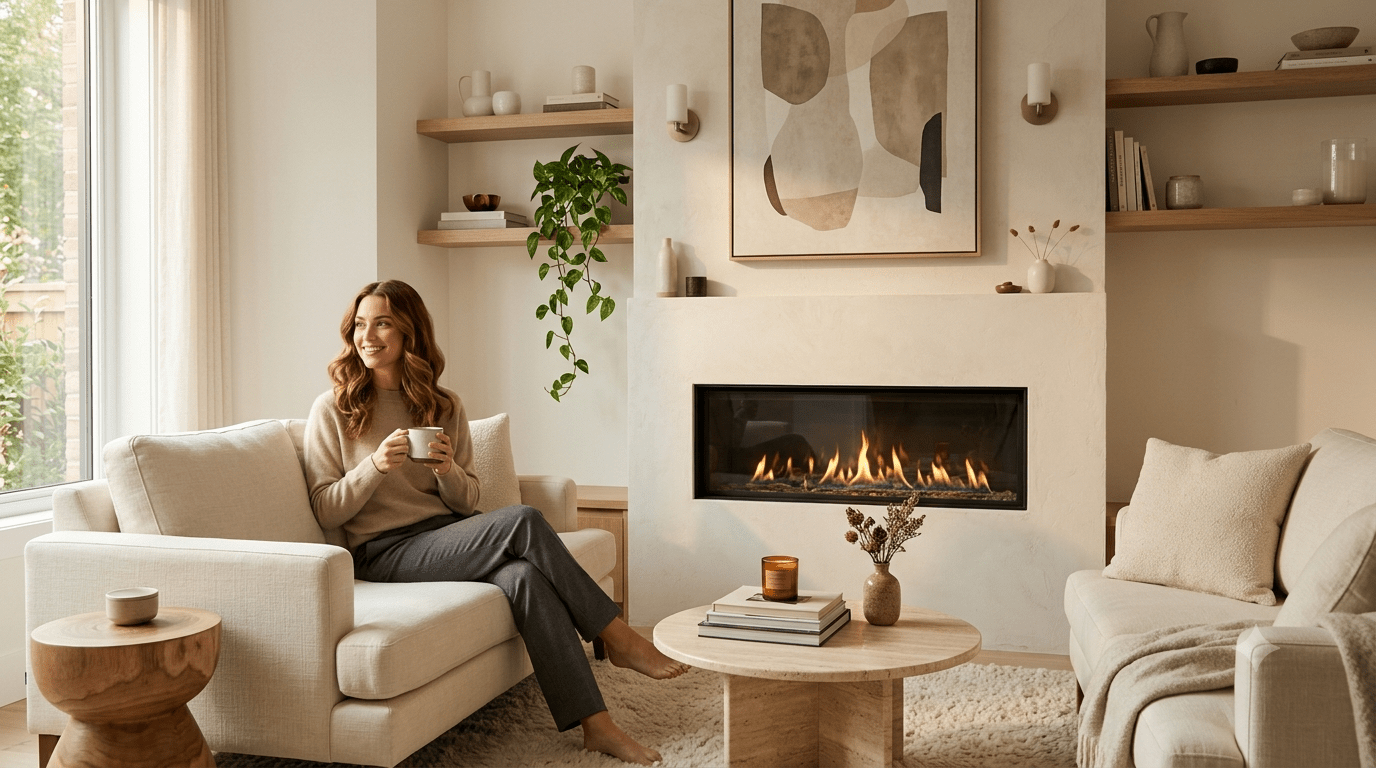
How To Make a Small Living Room With a Fireplace Feel Bigger?
- Choose an apartment-size sofa or loveseat instead of a standard full-size sofa
- Keep at least 30 inches of clear walkway around all furniture
- Use a round or oval coffee table to soften traffic patterns
- Stick to light, warm wall colors that reflect rather than absorb light
- Add a mirror near or above the fireplace to bounce light and create depth
- Use vertical space — shelves and art — instead of adding more floor furniture
- Choose multifunctional pieces like storage ottomans and nesting tables
- Layer your lighting instead of relying on one ceiling fixture
- Size your rug so the front legs of your seating rest on it
- Keep the mantel simple and edited, not packed with decor
Final Verdict
You don’t need a showroom’s worth of furniture to make a small living room feel inviting — especially one with a fireplace. Get the layout right, pick a sofa that actually fits, add a few pieces you love, and pay attention to the lighting. That’s usually enough to turn a cramped corner into somewhere you actually want to sit.
Start with the fireplace. Don’t treat it as an obstacle you’re forced to build around — let it anchor the room. Arrange your furniture around it the way you’d arrange a conversation around the person doing the talking. Keep pieces in proportion to the space, leave enough room to walk through without turning sideways, and skip anything that’s just sitting there looking pretty. If it doesn’t earn its spot, it doesn’t belong.
A few small touches go a long way: a mirror to bounce light around, a simple mantel display instead of a cluttered one, a lamp or two for warmth instead of one harsh overhead light, and some smart storage so the room doesn’t slowly fill up with stuff. None of this needs to be expensive or elaborate — it just needs to be intentional.
At the end of the day, the “best” small living room isn’t the one from a magazine. It’s the one that fits how you actually live — whether that’s curling up with a book by the fire, hosting friends on a Friday night, or just having a quiet spot to unwind after work. Modern, farmhouse, traditional, minimalist — the style matters less than whether the room feels like yours
Frequently Asked Questions (FAQs)
Question 1: How do you arrange furniture in a small living room with a fireplace?
Answer: Start by treating the fireplace as the anchor and arrange seating so it faces or angles toward it. Keep at least one clear walkway of about 30 inches, choose furniture scaled to the room rather than the largest pieces you can fit, and avoid lining every piece flat against the walls — a slight angle toward the fireplace usually makes the room feel more like an actual gathering space.
Question 2: Where should a sofa go in a small living room with a fireplace?
Answer: In most layouts, the sofa works best directly across from or diagonal to the fireplace, close enough to keep the conversation area tight but far enough to leave a walking path behind or beside it. In narrow rooms, placing the sofa perpendicular to the fireplace, rather than facing it head-on, often opens up more usable floor space.
Question 3: Should a TV go above a fireplace in a small living room?
Answer: It can, and it’s a popular solution because it consolidates two focal points onto one wall. The main tradeoff is viewing height — it can feel high for comfortable seated viewing, especially with low seating. If that’s a concern in your space, an adjacent wall or a swivel mount is a solid alternative.
Question 4: What furniture works best in a small living room?
Answer: Apartment-size sofas, loveseats, compact sectionals sized for the room, slim accent chairs, round coffee tables, and multifunctional pieces like storage ottomans all tend to work well. The common thread is furniture that’s proportional to the room and doesn’t block natural walkways.
Question 5: What colors make a small living room look bigger?
Answer: Light, warm colors — whites, creams, soft beige, warm gray, and gentle taupe — reflect more light and help walls recede visually. You don’t need to go stark white; a warm neutral with some depth still reads as light and open while adding more character.
Question 6: How do you decorate a small fireplace mantel?
Answer: Keep it edited: one larger anchor item, like a mirror or piece of art, paired with one or two smaller objects, rather than a long row of frames and trinkets. Leave visible open space on the mantel surface — that’s part of what keeps the styling from looking cluttered.
Question 7: Can you put a sectional in a small living room with a fireplace?
Answer: Yes, if the room is closer to square than long and narrow, and the sectional itself is sized appropriately — an apartment-size sectional rather than one built for a great room. If the room is narrow, a sectional often blocks natural walkways more than a sofa and a couple of chairs would.
Question 8: How do you make a small living room feel cozy without making it look cluttered?
Answer: Layer your lighting so the room can shift from bright to warm and low-lit, use a rug and consistent furniture arrangement to define the seating area, and let the fireplace’s own light do some of the work in the evening. Coziness comes more from lighting, texture, and scale than from adding more objects to the room.i
1 thought on “Small Living Room Ideas With Fireplace That Actually Work”
Comments are closed.