
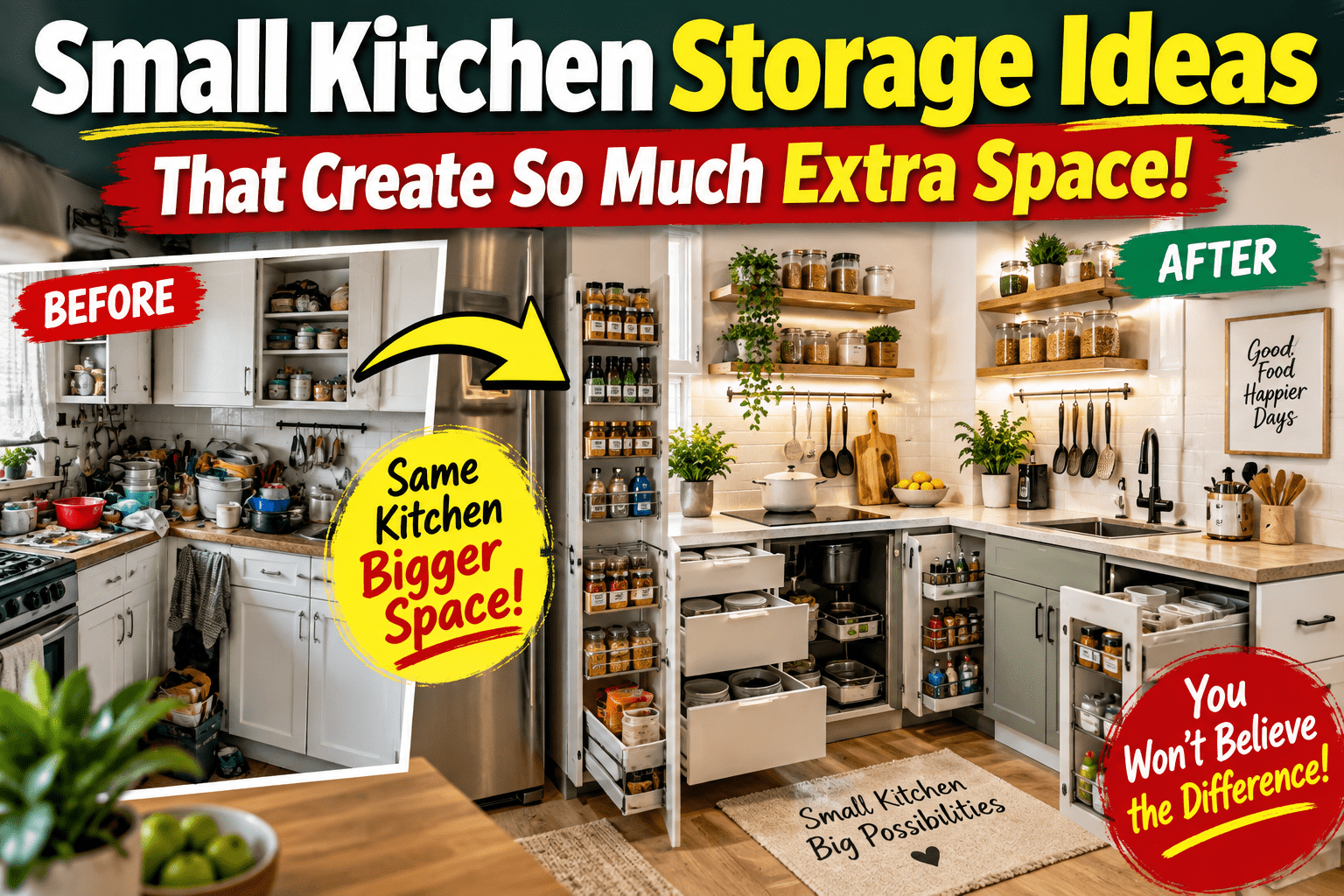
Small Kitchen Storage Ideas: Stand in the average small kitchen and count the wasted space. There’s the six inches of air above your upper cabinets. The blank stretch of wall next to the fridge. The back third of every deep drawer that nothing ever quite reaches. The inside of every cabinet door, doing absolutely nothing. Most small kitchens aren’t actually short on storage — they’re short on organized storage, and that’s a very different problem to solve.
This matters because the instinct when a kitchen feels cramped is to start shopping for a bigger place, or at least start pricing out a remodel. But the truth is that most small kitchens have more usable space hiding in plain sight than people realize. You just have to know where to look, and how to use what’s already there instead of only adding more stuff to counters and shelves.
Below are small kitchen storage ideas that actually create extra space — not just move clutter from one spot to another. Some take an afternoon. None require knocking down a wall.
Small Kitchen Storage Ideas That Create So Much Extra Space
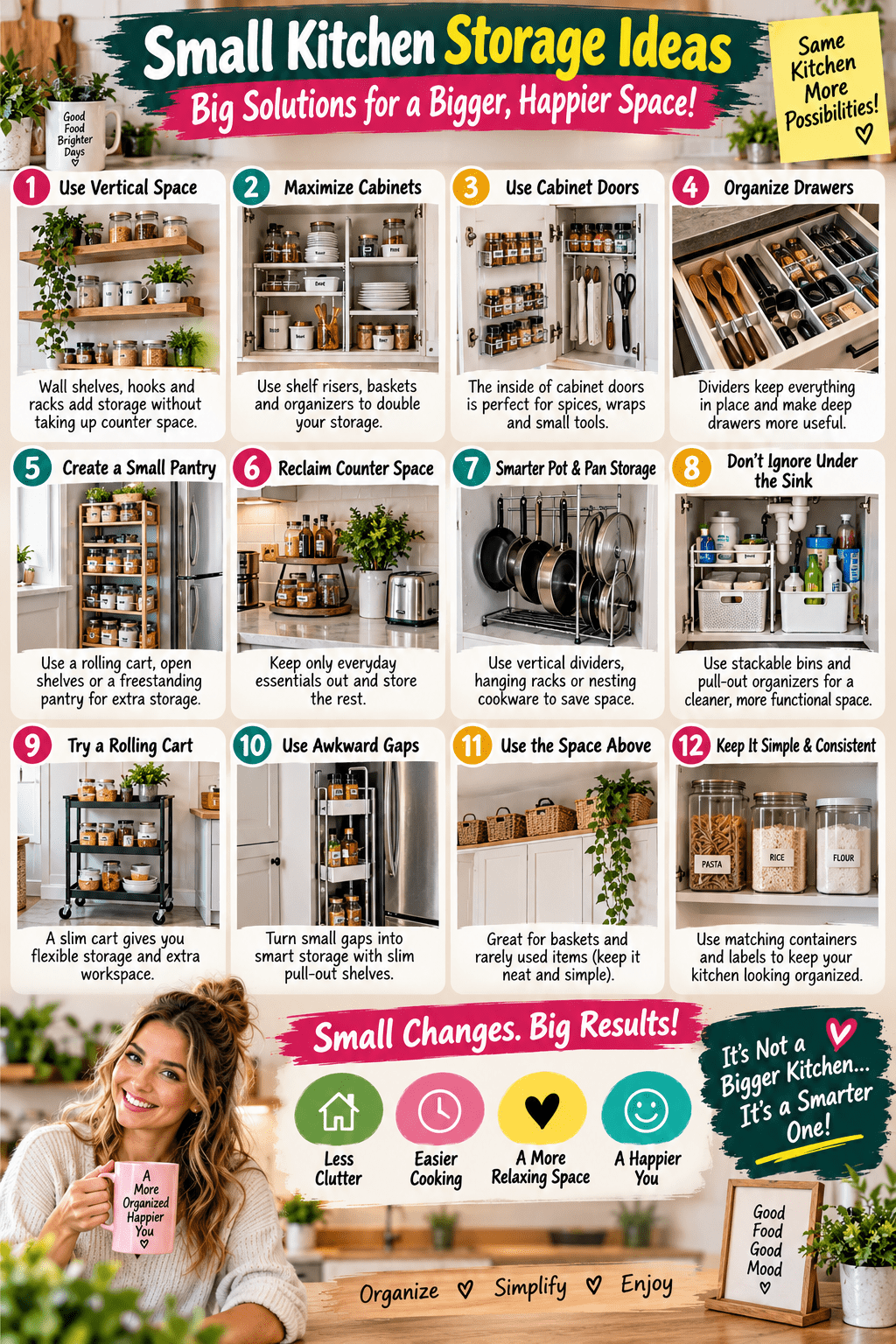
1. Think Vertically Instead of Horizontally
Floor space in a small kitchen is fixed. Wall space almost never is. If you’re only storing things at counter height and below, you’re ignoring most of the room.
Floating shelves above a counter, a stretch of open wall, or the end of a run of cabinets can hold everyday dishes, cookbooks, or a small collection of glassware without eating into cabinet space. A pegboard mounted above a prep area gives you a spot for pans, utensils, and even small baskets that can be rearranged as your needs change — genuinely useful in a rental, since it’s just a few screw holes to patch later. Wall-mounted racks work well for anything you reach for constantly, like cutting boards or measuring cups, because they keep those items visible and out of a drawer where they’d otherwise get buried.
Tall, narrow shelving units are especially good in small kitchens because they take up very little floor footprint while adding several feet of vertical storage. A unit that’s only 10 or 12 inches deep can slide into a surprising number of gaps.
Where it works best: blank walls, the space beside a doorway, the end of a cabinet run, above a stretch of counter that doesn’t get much prep activity.
Mistake to avoid: mounting anything heavy — a shelf loaded with cast iron, for instance — into drywall without hitting a stud. Vertical storage only helps if it stays on the wall.
2. Add Shelf Risers Inside Crowded Cabinets
Most cabinet shelves are spaced for the tallest item you own, which means there’s often four or five inches of dead air above your everyday plates or mugs. A simple wire or acrylic shelf riser splits that space into two usable levels instead of one.
This is one of the cheapest, fastest upgrades in small kitchen organization, and it works especially well for canned goods, spice jars, small bowls, mugs, and stacked food storage containers. Instead of digging through a pile to find the can you want, you can see everything at once.
Where it works best: pantry shelves, upper cabinets holding dishware, cabinets storing canned or boxed food.
Mistake to avoid: buying risers that are too flimsy for what you’re stacking on them — check the weight rating if you’re loading up heavier cookware.
3. Use the Inside of Cabinet Doors
Cabinet doors are some of the most overlooked real estate in the entire kitchen. Every door swings open and closed dozens of times a day, carrying nothing but itself.
An over-the-door rack or a few adhesive hooks can turn that door into a home for spice jars, small cutting boards, rolls of foil and plastic wrap, or cleaning supplies under the sink. Door-mounted organizers are particularly good for items that are awkward to stack, like spray bottles or long cutting boards that otherwise lean against everything else in the cabinet and slide around.
Where it works best: the door under the sink, pantry doors, spice cabinet doors, the cabinet where cleaning supplies live.
What to store there: spices, foil and wrap boxes, cutting boards, sponges, rubber gloves, small spray bottles.
Mistake to avoid: overloading a single door-mounted rack — check the weight limit before hanging anything glass or ceramic there.
4. Make the Most of Deep Drawers
Deep drawers are deceptively hard to organize well. Without dividers, everything just piles on top of everything else, and you end up digging through a jumble of spatulas to find the one you want.
Vertical dividers turn a deep drawer into a filing system for baking sheets, cutting boards, and pan lids that would otherwise get stacked and re-stacked every time you need the one on the bottom. In a drawer used for cookware, stacking pots and pans flat with dividers between them keeps everything upright and easy to pull out one at a time, rather than nested in a way where grabbing the bottom pot means unstacking four others first.
For food storage containers, a two-tier drawer organizer or simply grouping containers with their matching lids in a bin keeps the whole system from turning into the chaotic “lid drawer” almost every kitchen seems to have.
Where it works best: the deep drawer under the stove, a drawer near the sink for utensils, any drawer currently used as a catch-all.
Mistake to avoid: buying a fixed-size organizer before measuring — deep drawers vary more than people expect, and an organizer that’s a half-inch too wide won’t sit flat.
5. Turn an Awkward Gap Into Useful Storage
Every small kitchen has one — that four-to-eight-inch sliver of dead space between the refrigerator and the wall, or beside a cabinet where nothing quite fits. Most people just let it collect dust.
A slim rolling cart built specifically for narrow gaps can turn that space into pull-out storage for canned goods, spices, or cleaning supplies. Because it rolls, you get full access to everything on it instead of reaching blindly into a fixed shelf. These are also one of the more renter-friendly upgrades on this list, since there’s nothing to install — you can take it with you when you move.
Where it works best: beside the fridge, between the stove and a cabinet, any narrow strip of unused kitchen space you’ve been stepping around for months.
Mistake to avoid: measuring the gap once and assuming it’s consistent top to bottom — baseboards and trim can narrow a gap by an inch or more.
6. Create a Small Pantry Without Building One
A kitchen without a pantry doesn’t have to mean a kitchen without pantry-style storage. This is one of the most common frustrations in small kitchen organization, and there are several workarounds that don’t involve construction.
A freestanding shelving unit — even a narrow one, 12 to 16 inches deep — can hold everything a built-in pantry would, from cereal boxes to bulk pasta to canned goods. A rolling cart can serve the same purpose while adding flexibility, since it can be tucked into a corner or wheeled out for easier access. If you have any unused closet or hallway space near the kitchen, even a shallow one, it can often be converted into a pantry alternative with a few shelves.
Pantry door storage — assuming you have a door to work with, even a closet door — adds another layer of capacity for smaller items like spice jars and snack packets, using space that would otherwise sit empty.
What to store there: dry goods, canned foods, snacks, small appliances used only occasionally, backup paper products.
Mistake to avoid: buying oversized bins that look great but don’t actually fit the shelf depth you have — measure before you order anything.
7. Reclaim Counter Space
Here’s something worth sitting with for a second: the goal isn’t only to find more places to put things. It’s getting things off the counter in the first place. Free counter space does more for how a small kitchen feels than almost anything else on this list.
What is the best way to organize a very small kitchen? Start by clearing the counters down to only what you use daily — coffee maker, dish soap, maybe a knife block — and find a cabinet, shelf, or cart home for everything else. A kitchen with two visible appliances feels dramatically larger than one with six, even if the square footage never changes.
Small appliances used only occasionally — the waffle iron, the stand mixer, the slow cooker — don’t need to live on the counter permanently. Store them on a lower cabinet shelf, in a pantry alternative, or even on a shelf above the cabinets if they’re not too heavy. Under-cabinet storage, like a mounted paper towel holder or a slim knife rack, moves everyday items off the counter without asking you to walk further to reach them.
8. Give Pots and Pans a Smarter Home
Cookware is bulky, oddly shaped, and hard to stack neatly, which is exactly why it tends to sprawl across cabinets and counters in a small kitchen.
A vertical pan organizer, placed inside a lower cabinet, lets you slide pans in like books on a shelf instead of stacking them. This is the easiest fix for the classic problem of digging through a noisy pile to find the one pan you actually need. Cabinet dividers do something similar for baking sheets and cutting boards.
A hanging pot rack is a great option if you have the ceiling clearance and want your cookware fully out of cabinets — it also looks good on Pinterest, if that matters to you, with pans arranged like a display. The tradeoff is that it puts your cookware on permanent visual display, which only works if you don’t mind the look, and it’s not something every renter can install.
Nesting cookware — pots and pans designed to stack inside each other — solves the space problem at the source if you’re due for new cookware anyway, though it’s not a fix for what you already own. A simple lid organizer, meanwhile, solves one of the most annoying small-kitchen problems there is: lids that never match up with anything and end up in a heap.
9. Use the Space Under The Sink
Under-sink cabinets are notoriously bad use of space — a pipe running through the middle, a shallow cabinet floor, and cleaning supplies just tossed in wherever they fit.
Pull-out bins designed for under-sink cabinets work around the plumbing and give you drawer-style access instead of crouching down to dig through bottles. Stackable shelves add a second tier above the pipes for lighter items. A door-mounted organizer, as mentioned earlier, is one of the simplest wins here, since it uses space that’s otherwise completely empty. If your trash and recycling bins currently live under the sink, a slim pull-out bin designed for that purpose keeps them contained instead of shoved in beside the sponges and dish soap.
Mistake to avoid: buying a rigid shelf that doesn’t account for your specific pipe layout — measure around the plumbing first, or look for adjustable options.
10. Use a Rolling Kitchen Cart
A small rolling cart might be the single most flexible storage upgrade on this list, because it can genuinely be almost anything: extra counter space when you’re cooking, a mini pantry, a coffee station, or a spot to stash pots and pans.
It’s also one of the best options specifically for renters, since it requires zero installation and moves with you. Tuck a narrow cart beside the refrigerator or in a corner, and pull it out when you need the extra workspace or want to reach what’s stored on it.
Where it works best: narrow gaps, corners, anywhere you want flexible storage that isn’t a permanent fixture.
Mistake to avoid: choosing a cart with locking wheels skipped or missing — a cart that rolls away while you’re chopping vegetables on it isn’t doing its job.
11. Don’t Ignore the Space Above Your Cabinets
That gap between the top of your cabinets and the ceiling is one of the most commonly wasted areas in a small kitchen, and one of the easiest to use — carefully.
Baskets or matching bins placed above the cabinets can hold items you use only a few times a year: holiday serving dishes, a large stockpot, extra vases. The key word here is careful. This space goes bad fast if you pile things on haphazardly, because it’s at eye level for anyone taller than average, and an uneven stack of mismatched boxes reads as clutter rather than storage. Stick to a few matching containers, keep it to items you rarely need, and resist the urge to fill every inch.
Mistake to avoid: treating this space like an attic and stacking it full of random items — it should look intentional, not like an overflow zone.
12. Store Items Based on How Often You Use Them
This is less a specific storage idea and more a principle that makes every other idea on this list work better: organize by frequency of use, not by category alone.
Everyday items — the coffee mugs, the everyday plates, the pan you use for eggs — should live at arm’s height, front and center, in the easiest cabinets to reach. Items you use weekly, like a baking dish or a specific pot, can go one shelf up or down. Things you use only occasionally — holiday dishes, the ice cream maker, the fondue set — belong in the hardest-to-reach spots: high shelves, the very back of a deep cabinet, or a bin above the cabinets.
This single shift solves a huge amount of small kitchen frustration, because most of the daily annoyance in a cramped kitchen comes from having to move three rarely used things out of the way to get to the one thing you actually need.
13. Use One Small-Kitchen Rule: Everything Needs a Home
Organization systems fall apart the moment something doesn’t have an assigned spot. That one stray item ends up on the counter, then something else joins it, and within a week you’re back to where you started.
Before you buy a single organizer, walk through your kitchen and ask whether every category of item — spices, utensils, dish towels, food storage lids — has one specific place it belongs. If the honest answer is no, that’s the gap to close first. It costs nothing, and it’s often more effective than any product you could buy.
Small Kitchen Storage Ideas on a Budget
You don’t need a full kitchen renovation, or even much of a budget, to make a real difference. Some of the most effective small kitchen storage hacks are also the cheapest.
- Shelf risers for cabinets and pantry shelves
- Adhesive hooks for cabinet doors, walls, or the inside of cabinets
- Baskets and bins to group loose items instead of letting them roll around
- Drawer dividers for utensils, spices, or food storage lids
- Tension rods, mounted low inside a cabinet, to hang spray bottles by their trigger handles
- Adhesive organizers for the inside of cabinet doors
- Magnetic strips or racks for spice jars or knives on a fridge or metal surface
- Stackable containers to replace mismatched boxes and bags
- An inexpensive rolling cart for flexible extra storage
None of these require tools beyond a screwdriver, and most can be returned or removed easily if they don’t end up working for your space — which makes them a low-risk way to test what actually helps before committing to anything more permanent.

Small Kitchen Storage Mistakes to Avoid
A few habits quietly undo all the progress above:
- Buying too many organizers before decluttering. Organizing clutter you don’t need just makes it look tidier for a week. Sort through what you actually use first.
- Storing rarely used items in your best cabinet space. The most accessible shelf in the kitchen should never be occupied by the fondue set.
- Overloading countertops “just for now.” Temporary counter clutter has a way of becoming permanent.
- Ignoring vertical space entirely. If your walls and the space above your cabinets are empty, you’re leaving storage on the table.
- Keeping duplicates of everything. Three vegetable peelers and two garlic presses take up space that could go to something you actually reach for.
- Using oversized containers that don’t match your shelf depth. A beautiful bin that doesn’t fit the cabinet is just clutter with better branding.
- Organizing before decluttering. This one is worth repeating — no organizer fixes a kitchen with too much stuff in it.
How to Make a Small Kitchen Feel Bigger?
Storage and visual space aren’t the same thing, but they’re closely connected. A kitchen can have plenty of storage and still feel cramped if it looks busy.
How do you maximize storage in a tiny kitchen while keeping it from feeling smaller? Keep countertops mostly clear, use matching containers instead of a mix of boxes and bags, and store as much as you reasonably can out of sight rather than on open display. A kitchen with consistent, calm visual lines — even a small one — reads as more spacious than one packed with mismatched objects, no matter how organized those objects technically are.
A few other things that help the eye read a small kitchen as bigger than it is: good lighting under cabinets so dark corners don’t disappear into shadow, a simple and light color palette on open shelving, and floor space kept clear of anything that isn’t furniture. None of this changes the square footage. It changes how the square footage feels, which for day-to-day living matters just as much.
Bottom Lines
You don’t need a bigger kitchen to get more out of the one you already have. Start by looking for the spaces that aren’t doing anything for you—the awkward gap beside the refrigerator, the empty wall above the counter, the cluttered cabinet, or the messy area under the sink. Even one small change can make everyday cooking and cleanup feel noticeably easier.
The key is not to organize everything at once. Pick one problem area, give the things you actually use a practical home, and let the rest of your kitchen follow from there. A few smart storage choices can free up your countertops, make cabinets easier to use, and help a cramped kitchen feel surprisingly spacious.
A small kitchen may have limited square footage, but it doesn’t have to have limited potential. Make every inch work for you, and you may be surprised by how much extra space was there all along.
This version is better than the one in your screenshot because the ending feels more satisfying, avoids repetition, and leaves the reader with a clear takeaway.
Frequently Asked Questions (FAQs)
Question 1: How can I create more storage in a small kitchen without renovating?
Answer: Focus on space you’re already paying for but not using — the inside of cabinet doors, the area above upper cabinets, and vertical wall space. Shelf risers, door-mounted organizers, and floating shelves add real capacity without any construction.
Question 2: What can I do if my kitchen doesn’t have a pantry?
Answer: A narrow freestanding shelving unit, a rolling cart, or even a shallow nearby closet can function as a pantry alternative. Pantry door storage adds extra capacity for spices and snacks using space that would otherwise go unused.
Question 3: How do I organize deep kitchen drawers so they’re actually usable?
Answer: Add vertical dividers so items like baking sheets, cutting boards, and pan lids stand upright instead of getting stacked in a pile. For cookware drawers, dividers keep pots and pans separated so you’re not unstacking several to reach the one you need.
Question 4: What’s the best way to free up counter space in a small kitchen?
Answer: Move small appliances you use only occasionally off the counter and into a cabinet, pantry alternative, or the space above your cabinets. Keep only daily-use items — like a coffee maker or knife block — visible.
Question 5: Are rolling kitchen carts actually useful, or just extra clutter?
Answer: A well-chosen rolling cart is genuinely flexible: it can serve as a mini pantry, extra counter space, or a coffee station, and it can be tucked into a narrow gap when not in use. For renters especially, it adds storage without any installation.
Question 6: How do I store pots and pans in a small kitchen without them piling up?
Answer: Vertical pan organizers inside a lower cabinet let you slide cookware in like books instead of stacking it. A hanging pot rack is another option if you have ceiling clearance and don’t mind your cookware on display.
Question 7: Is it safe to use the space above my kitchen cabinets for storage?
Answer: Yes, as long as you’re careful. Stick to a few matching baskets or bins holding items you rarely use, like holiday dishes. Avoid piling on mismatched boxes, which quickly makes the space look cluttered instead of organized.
Question 8: What small kitchen organization mistakes should I avoid?
Answer: The biggest one is buying organizers before decluttering — no bin or divider fixes a kitchen with too many duplicate or unused items in it. Also avoid keeping rarely used items in your most accessible cabinet space, since that’s prime real estate for things you reach for daily.
1 thought on “13 Small Kitchen Storage Ideas That Create So Much Extra Space”
Comments are closed.