

Afrohemian Living Room Ideas: There’s a reason rooms built around clay tones, woven textures, and sculptural pottery photograph so well and feel even better in person. They’re layered without being loud, personal without being precious, and warm in a way that’s hard to fake with a single accent pillow. That layered, storytelling quality is exactly what defines the Afrohemian aesthetic — a style that blends African-inspired materials, patterns, and craftsmanship with the relaxed, collected spirit of bohemian design. If you’ve been hunting for Afrohemian living room ideas that actually feel livable and not like a showroom, you’re in the right place. What follows are fifteen distinct directions for bringing this look into your own space, whether you’re working with a full house or a 700-square-foot rental.
What Is Afrohemian Interior Design?
Afrohemian design sits at the intersection of two aesthetics that already share a lot of DNA. Bohemian interiors have always celebrated texture, pattern, and a collected, well-traveled feel. African-inspired design brings its own depth to that foundation: hand-carved wood, mudcloth and kuba-inspired patterns, woven raffia and sisal, clay pottery, and a color story rooted in the earth — terracotta, ochre, chocolate brown, olive, and warm neutrals.
Put together thoughtfully, the result is a living room that feels grounded and worldly at the same time. It’s not about filling a room with items that look vaguely “tribal” or turning a coffee table into a prop shelf of unrelated souvenirs. Real Afrohemian styling comes from intention — choosing pieces that are handcrafted or natural, letting the color palette do the heavy lifting, and layering textures the way a good outfit layers fabrics.
It also helps to understand where this differs from its design cousins. Traditional boho tends to lean heavier into globally sourced eclecticism — Moroccan poufs next to Indian textiles next to macramé wall hangings — with less of a unifying color story. Modern boho strips that down into cleaner lines and a more neutral, Scandinavian-adjacent palette. Eclectic design is broader still, mixing eras and styles with fewer rules at all. African-inspired interiors, meanwhile, can stand entirely on their own, often leaning more formal or gallery-like, with a stronger design pedigree tied to specific regions, materials, and artisans.
Afrohemian borrows the warmth and craftsmanship of African-inspired decor and the relaxed, lived-in comfort of bohemian style, then filters both through an earthy, cohesive color palette. It’s worth remembering, too, that “African-inspired” is not one single look. The continent holds dozens of countries and thousands of distinct cultural traditions, each with its own textiles, pottery styles, and patterns. The goal with Afrohemian decorating isn’t to flatten all of that into a stereotype — it’s to draw genuine inspiration from craftsmanship and material culture, and to style it with the same care you’d give any other design tradition you admire.
15 Afrohemian Living Room Ideas
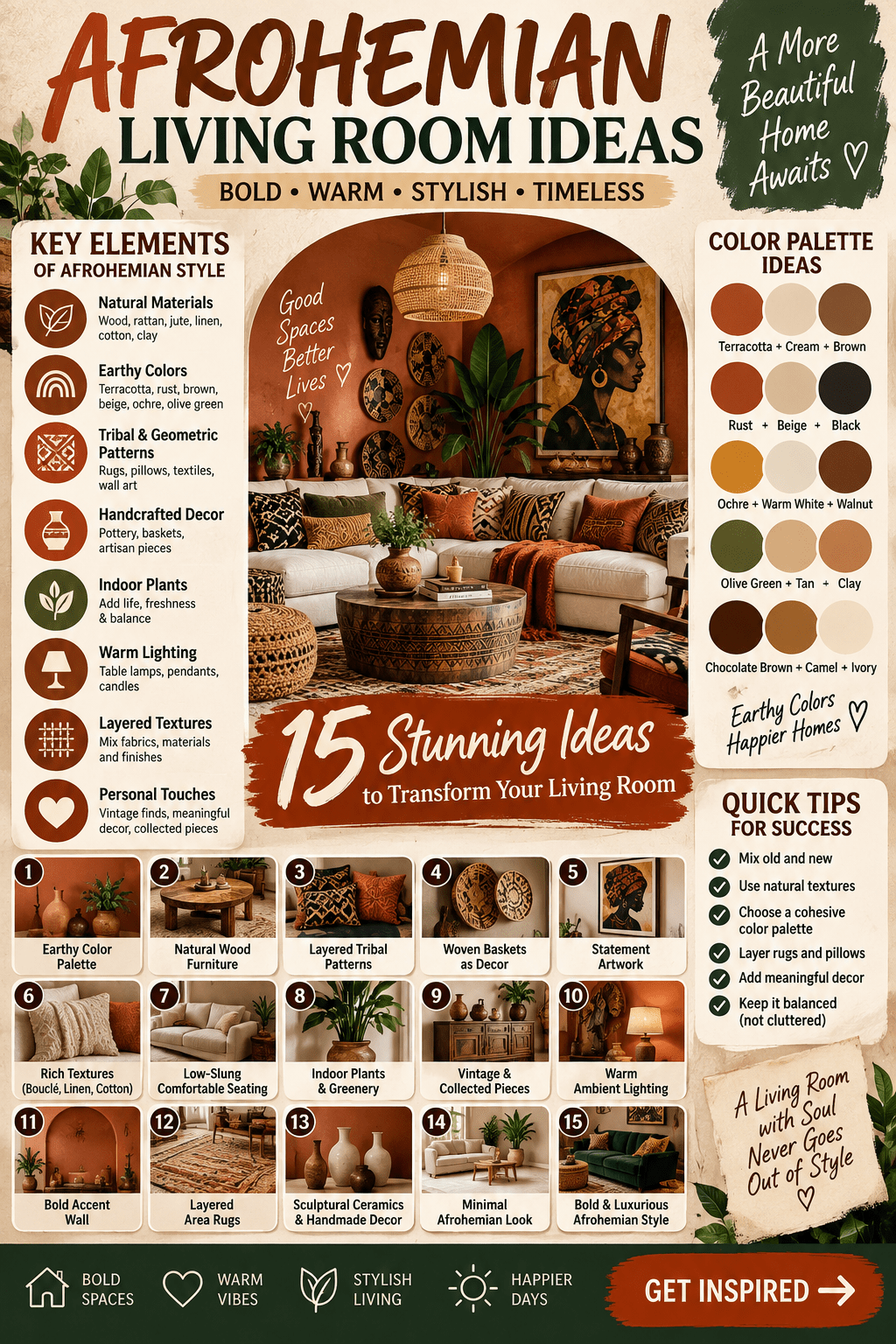
1. Lead With an Earthy Terracotta and Rust Color Palette
Almost every successful Afrohemian room starts with color, and terracotta is usually the anchor. Rust, clay, camel, and warm brown work as a family because they all sit on the same warm side of the color wheel, which means you can mix them freely without the room feeling disjointed. Paint a single wall in a muted terracotta, or bring the tone in through a sofa, an area rug, or a set of ceramic vases.
The trick is restraint elsewhere. Keep your walls and larger furniture in warm neutrals — cream, ivory, or a soft tan — so the terracotta reads as a rich accent rather than competing with itself. In a rented apartment where painting isn’t an option, a large clay-toned rug or a set of rust velvet throw pillows can do the same job. Add one broad, near-black accent, like a matte lamp base, to keep the palette from feeling too soft.
2. Bring In Natural Wood Furniture
Nothing grounds an Afrohemian living room quite like solid, natural wood. Think a walnut coffee table, a teak media console, or a set of carved wooden stools used as extra seating or side tables. Reclaimed and slightly imperfect wood tends to look more authentic here than anything glossy or overly polished.
Mixing wood tones is actually encouraged in this style — a lighter oak shelf can sit comfortably near a darker walnut table as long as the finishes both read as natural rather than painted or lacquered. Woven wood accents, like a rattan headboard-style piece repurposed as wall art or a cane-front cabinet, add even more texture. For apartment dwellers, a single well-chosen wood piece, like a substantial coffee table, can carry this idea without needing to replace every furniture item in the room.
3. Layer Tribal-Inspired and Geometric Patterns
Pattern is where Afrohemian rooms get their personality, but it’s also where things can go wrong fast. The fix is thinking in terms of scale and repetition rather than variety for its own sake. Choose one dominant pattern — say, a bold geometric rug — and let smaller patterns on throw pillows or a blanket echo its colors without competing in scale.
Mudcloth-inspired prints, angular geometric weaves, and organic, hand-drawn motifs all pair well together as long as they share a consistent color family. A good general rule: no more than three distinct patterns in a seating area, and always give the eye a break with a few solid-colored pillows or a plain linen throw. This keeps a richly patterned room from tipping into visual chaos.
4. Use Woven Baskets as Wall and Storage Decor
Woven baskets are one of the most versatile tools in Afrohemian styling because they work as both function and art. Group three or four different-sized baskets on a blank wall above the sofa for an instant textural statement that costs far less than framed art. Used on the floor, a large basket becomes stylish storage for throw blankets, magazines, or kids’ toys.
Look for variation in weave pattern and size when you’re shopping, since a matched set can look more like a store display than a collected one. Sisal, seagrass, and raffia baskets all bring slightly different textures, and mixing a couple of these materials adds depth. This is also one of the most budget-friendly ideas on this list, since baskets are widely available secondhand and at most home goods retailers.
5. Hang Statement African-Inspired Artwork
A single large piece of art can define the entire mood of an Afrohemian living room faster than almost anything else. Look for abstract paintings in earthy tones, black-and-white photography with African subjects or landscapes, textile art with woven or embroidered elements, or bold line drawings of figures and faces.
Scale matters more than most people expect — a piece of art hung above a sofa should generally span at least two-thirds of the sofa’s width to feel intentional rather than undersized. If a single oversized piece isn’t in the budget, a tightly curated gallery wall of smaller works in matching frames can create a similar impact. Whatever you choose, let the art’s colors pull from your existing palette so it feels connected to the room rather than dropped in.
6. Mix Bouclé, Linen, Cotton, and Rich Textures
A room built entirely from smooth, flat surfaces will always feel a little cold, no matter how good the color palette is. Afrohemian interiors rely on texture layering to create warmth. A bouclé accent chair next to a linen sofa, finished with cotton and wool throw pillows, gives your hands and eyes multiple things to register.
Texture also adds depth to a monochromatic color scheme. If your sofa, rug, and walls are all in similar tan and cream tones, varying the material — nubby bouclé, smooth linen, chunky wool — keeps the room from reading as flat or one-note. Even something as simple as swapping a smooth throw pillow cover for a textured woven one can noticeably change how a seating area feels.
7. Choose Low-Slung, Comfortable Seating
Afrohemian living rooms tend to favor a relaxed, grounded seating posture over anything stiff or formal. A low-profile sofa with deep cushions, a curved lounge chair, or a scattering of floor cushions and poufs all support the laid-back energy the style is known for.
This isn’t just an aesthetic choice — it changes how people actually use the room, encouraging lounging and conversation over perching. A single leather or woven-rattan lounge chair paired with a floor pouf can create a cozy reading nook in even a small space. If your existing sofa is on the taller, more formal side, you can soften its presence with a low coffee table and floor-level accessories like a large basket or a stack of oversized books.
8. Add Indoor Plants and Organic Greenery
Plants are almost a requirement in this style because they echo the natural materials everywhere else in the room. A tall fiddle leaf fig or a snake plant in a woven or ceramic planter adds height and life to a corner that might otherwise feel empty. Trailing plants like pothos look striking on a high shelf or in a hanging macramé planter.
Beyond aesthetics, greenery softens all the hard lines from wood furniture and geometric patterns, keeping the room from feeling too rigid. If you don’t have a particularly green thumb, dried pampas grass or preserved botanicals in a large ceramic vessel deliver a similar organic softness with far less upkeep. Even one or two well-placed plants can noticeably shift the feel of the room.
9. Incorporate Vintage and Collected Furniture
Nothing says “collected over time” quite like furniture that actually was. A vintage rattan chair, a scuffed leather ottoman, or a mid-century side table found at an estate sale brings a layer of authenticity that brand-new, matching furniture sets simply can’t replicate. Afrohemian rooms tend to look best when they feel assembled rather than purchased all at once.
This doesn’t mean everything needs to be old — mixing one or two vintage anchor pieces with newer furniture usually strikes the right balance. A worn leather chair next to a new linen sofa, for example, reads as intentional rather than mismatched. Estate sales, thrift stores, and online marketplaces are worth checking regularly, since the best vintage finds tend to move quickly.
10. Layer in Warm Ambient Lighting
Overhead lighting alone rarely does an Afrohemian room justice. Warm lighting from multiple sources — a woven rattan pendant, a ceramic table lamp, a tall floor lamp in the corner — creates the soft, golden glow this style relies on. Look for bulbs on the warmer end of the color temperature scale rather than anything cool or blue-toned.
Layering light sources at different heights also adds visual interest even when they’re off. A cluster of candles on a coffee table or a lantern-style floor lamp near a reading chair contributes to that collected, lived-in feel just as much as the furniture does. If your space has a single harsh overhead fixture, adding even two lamps can transform how the whole room feels in the evening.
11. Paint a Bold Afrohemian Accent Wall
An accent wall is one of the most effective ways to set the tone for an entire room without committing to a full renovation. Deep clay, chocolate brown, olive green, or a warm, textured ochre all work beautifully as accent wall colors in this style. Limewash-style paint finishes, which have a soft, slightly mottled texture, pair especially well with the handcrafted feel of Afrohemian decor.
Choose the wall behind your sofa or the one your eye lands on first when entering the room for the most impact. If painting isn’t possible in a rental, textured wallpaper in a similar tone, or even a large woven wall hanging that spans most of the wall, can create a comparable focal point. Keep the rest of the walls in a warm neutral so the accent wall has room to stand out.
12. Layer Area Rugs for Warmth and Depth
Using two rugs together — a larger jute or sisal rug as a base layer, topped with a smaller patterned rug — is a classic bohemian trick that works especially well in Afrohemian rooms. It adds visual depth and warmth underfoot while letting you introduce pattern without covering the entire floor in it.
Proportion matters here. Your base rug should be large enough that all your furniture’s front legs sit on it, while the top rug can be smaller and slightly off-center for a more relaxed, collected look. Natural fiber rugs like jute and sisal bring texture without adding more color to an already warm palette, which is part of why they work so well as the foundation layer.
13. Style With Sculptural Ceramics and Handmade Accessories
A shelf, mantel, or coffee table styled with handmade pottery, carved wooden bowls, and other artisan objects gives an Afrohemian room its finishing layer of authenticity. Look for pieces with visible texture or imperfection — a slightly uneven glaze or an organic, asymmetrical shape reads as handmade in a way that mass-produced decor never quite manages.
Grouping objects in odd numbers, usually three, tends to look more natural than pairs. Vary the height and shape within a grouping too — a tall carved vessel next to a low, wide bowl creates more visual interest than three similar pieces lined up. These smaller details are often what separates a room that feels genuinely curated from one that feels like it was decorated in a single afternoon.
14. Try a Minimal Afrohemian Living Room
Afrohemian doesn’t have to mean maximalist. A pared-back version of this style relies on the same earthy palette and natural materials but uses far fewer individual pieces, giving each one more visual weight. Think one statement art piece, one textured rug, a simple linen sofa, and a handful of ceramics rather than a dozen layered accessories.
This approach works particularly well for people who like the warmth of the style but don’t want a busy room, or for smaller spaces where too many objects can feel cramped rather than cozy. The key is choosing higher-quality, more distinctive pieces since there’s nowhere for a mediocre item to hide. Leave some visible negative space on shelves and walls rather than filling every surface.
15. Go Bold With a Luxurious Afrohemian Living Room
At the opposite end of the spectrum, a more elevated, luxurious take on this style leans into richer materials and a more dramatic presentation. Think a plush velvet sofa in a deep rust or chocolate tone, an oversized abstract painting, brass lighting fixtures, and a high-pile wool rug in place of something flatter and more casual.
Layered lighting becomes especially important here — dimmable fixtures and multiple lamp sources create the moodier, more sophisticated atmosphere this version calls for. A well-chosen vintage piece, like an antique carved cabinet or an heirloom-style rug, adds the sense of history that keeps a luxurious room from feeling showroom-new. Fewer, better pieces paired with confident color choices are what make this version feel expensive rather than simply expensive.
Afrohemian Color Palette Guide
The color story is really what holds an Afrohemian room together, and it works best when you think of it in proportions rather than a random assortment of favorite shades. A helpful starting point: let one warm neutral, like cream, tan, or warm white, cover roughly 60 percent of the room through walls, larger furniture, and rugs. Bring in a secondary tone — terracotta, rust, or ochre — for about 30 percent, showing up in an accent chair, a set of pillows, or an accent wall. Save the remaining 10 percent for a broader accent like chocolate brown, black, or deep olive, used sparingly in lamp bases, picture frames, or small decor objects.
Some combinations that consistently work well together: terracotta with cream and walnut brown; rust paired with beige and a touch of black; ochre alongside warm white and natural wood tones; chocolate brown with tan and olive green; or burnt orange balanced against natural wood and cream. Deep green shows up beautifully as an accent against rust and warm beige, especially through plants and a single upholstered piece. None of these ratios need to be exact — the point is simply to have one tone lead, one support it, and one show up in small, deliberate doses.
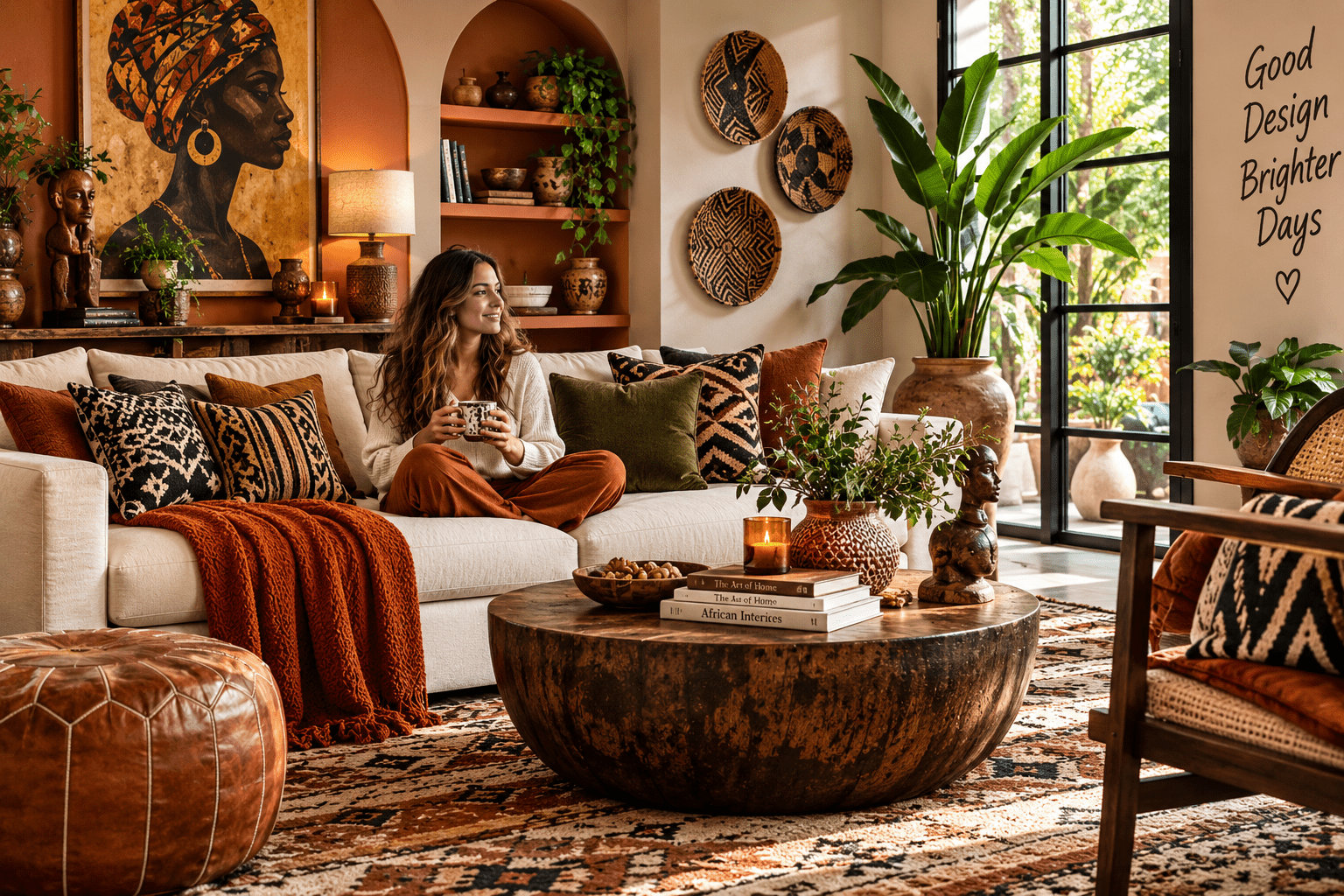
How to Mix Patterns Without Making the Room Look Busy?
Pattern mixing intimidates a lot of people, but a few practical rules make it much easier to get right. Start with scale: pair a large-scale pattern, like a bold geometric rug, with smaller-scale patterns on pillows or a throw, rather than combining several patterns of similar size. When patterns are too close in scale, they compete instead of complementing each other.
Color coordination matters just as much as scale. Even wildly different patterns — an organic hand-drawn print next to a crisp geometric weave — will look intentional together if they pull from the same three or four colors. Solid fabrics are your best friend here, too. A room with three patterned textiles and three solid ones will almost always feel more balanced than a room where every surface has a print.
Give your eye a resting point. If your rug and pillows are both patterned, keep your sofa upholstery solid. If your artwork is bold and graphic, let the furniture around it stay simple. This kind of alternation, rather than layering pattern on pattern everywhere, is what keeps a richly decorated room from tipping into chaos.
How to Make an Afrohemian Living Room Look Expensive?
The good news is that an expensive-looking room has less to do with your budget and more to do with editing. Fewer, larger, higher-impact pieces almost always read as more sophisticated than a room packed with lots of smaller items. One substantial piece of art will outperform five small prints every time.
Rug size trips people up more than almost anything else — a rug that’s too small for the seating area instantly makes a room look like it’s still being furnished, no matter how nice the individual pieces are. Aim for a rug large enough that at least the front legs of your sofa and chairs sit on it. Beyond that, consistency in your color palette does a lot of quiet work; a room where every piece feels like it belongs to the same story looks curated even if nothing in it was expensive.
Layered lighting, natural materials over synthetic ones, and leaving some negative space on shelves and walls all contribute to that elevated feeling too. Mixing in one or two vintage pieces alongside newer furniture also helps, since a room where everything was bought at once can sometimes read as less considered than one that looks gathered over time.
Small Afrohemian Living Room Ideas
Renters and anyone working with a compact living room can absolutely pull off this style — it just takes a slightly lighter hand. Multifunctional furniture is your best tool here: an ottoman with hidden storage, a nesting coffee table set, or a daybed that doubles as extra seating all help a small room work harder without feeling crowded.
Mirrors placed opposite a window or light source can make a small space feel noticeably larger while adding another reflective, textured surface to the room. Lean toward a lighter base palette — more cream and tan, less deep brown — so the walls recede rather than close in. A smaller-scale rug, wall-mounted baskets instead of floor storage, and one or two well-placed plants deliver the same warmth as a larger room without the visual weight. Limiting yourself to one dominant pattern, rather than the three-pattern layering that works in a bigger space, also keeps a small room feeling calm rather than cluttered.
Common Afrohemian Decorating Mistakes
Even with the right pieces, a few missteps can throw off the whole effect. Using too many patterns without any solid fabrics to balance them is one of the most common — the fix is simply pulling back to two or three patterns and letting the rest of the room breathe. A related issue is buying every piece from a single collection or store, which tends to look more like a catalog spread than a home that’s evolved over time; mixing sources and eras solves this.
Sticking to just one shade of brown throughout the room can flatten the whole palette — vary your warm tones and add a genuine accent color instead. Poorly sized rugs, mentioned earlier, are an easy fix once you know to size up. Ignoring lighting temperature is another quiet culprit; swap cool white bulbs for warm ones, and the whole room will feel different by evening.
It’s also worth watching for decor that leans on stereotypical or overly literal cultural motifs rather than genuine craftsmanship — favor pieces made with real skill and material integrity over anything that feels like a costume version of the style. Finally, don’t sacrifice comfort for aesthetics. A stiff, uncomfortable sofa doesn’t become more inviting just because the pillows match the rug.
How to Create The Look on a Budget?
You don’t need a full renovation budget to pull this off. Thrift stores, vintage shops, and secondhand marketplaces are genuinely some of the best sources for Afrohemian pieces, since worn, natural materials often look better with age rather than worse. A single afternoon of thrifting can turn up a wood side table, a ceramic vase, or a woven basket for a fraction of retail cost.
DIY artwork is another accessible option — even a simple abstract painting in your chosen palette, framed well, can stand in for a pricier statement piece. Repurposing furniture you already own by refinishing wood or reupholstering a chair in a new fabric stretches your budget further than buying new. Affordable baskets, plants, and a fresh coat of paint on a single accent wall can transform a room for relatively little money.
Perhaps most importantly, resist the urge to buy everything at once. Afrohemian rooms are meant to look collected over time, so shopping slowly and adding pieces as you find them isn’t just budget-friendly — it’s actually more true to the style than furnishing a whole room in one weekend.
Frequently Asked Questions (FAQs)
Question 1: What is Afrohemian interior design?
Answer: Afrohemian design combines African-inspired materials, patterns, and craftsmanship with the relaxed, layered spirit of bohemian decor. It relies on earthy colors, natural textures, and handmade pieces to create a warm, personal living space.
Question 2: What colors are best for an Afrohemian living room?
Answer: Warm, earthy tones work best — terracotta, rust, ochre, chocolate brown, camel, and olive green, typically paired with a warm neutral like cream or tan as the dominant color.
Question 3: How do I make my living room Afrohemian?
Answer: Start with an earthy color palette, add natural materials like wood, rattan, and jute, layer in textured textiles and a few patterned pieces, and finish with plants, ceramics, and warm ambient lighting.
Question 4: What is the difference between Afrohemian and boho?
Answer: Traditional boho pulls eclectic influences from many cultures with less of a unified color story, while Afrohemian centers specifically on African-inspired materials and craftsmanship within a cohesive earthy palette.
Question 5: Can Afrohemian decor work in a small living room?
Answer: Yes. Stick to a lighter base palette, one dominant pattern instead of several, multifunctional furniture, and wall-mounted storage to keep a small space feeling open rather than cluttered.
Question 6: How do I make Afrohemian decor look modern?
Answer: Lean into the minimal version of the style — fewer, higher-quality pieces, cleaner furniture lines, and a more restrained color palette — while keeping the natural materials and handmade accents that define the look.
Question 7: What materials work best in Afrohemian interiors?
Answer: Natural wood, rattan, cane, jute, sisal, linen, cotton, wool, clay, and leather all support the style’s grounded, textural feel.
Question 8: How can I decorate an Afrohemian living room on a budget?
Answer: Shop secondhand and vintage sources, repurpose furniture you already own, add plants and baskets for texture, and build the room gradually instead of buying everything at once.
Final Thoughts
An Afrohemian living room doesn’t have to follow a strict formula. The beauty of this style comes from mixing warm colors, natural textures, meaningful artwork, vintage finds, and comfortable pieces in a way that feels personal rather than perfectly matched.
Start with the elements you love most—perhaps a terracotta accent wall, a beautifully textured rug, woven baskets, or a statement piece of artwork—and build around them slowly. Give your room some breathing space, layer in different textures, and don’t be afraid to let a few imperfect or unexpected pieces become part of the story.
The goal isn’t to recreate someone else’s living room. It’s to create a space that feels warm, expressive, collected, and unmistakably yours.
Love these Afrohemian living room ideas? Save this post to Pinterest so you can come back to these decorating ideas whenever you’re ready to refresh your space.
1 thought on “15 Afrohemian Living Room Ideas That Feel Bold, Warm & Absolutely Stunning”
Comments are closed.