
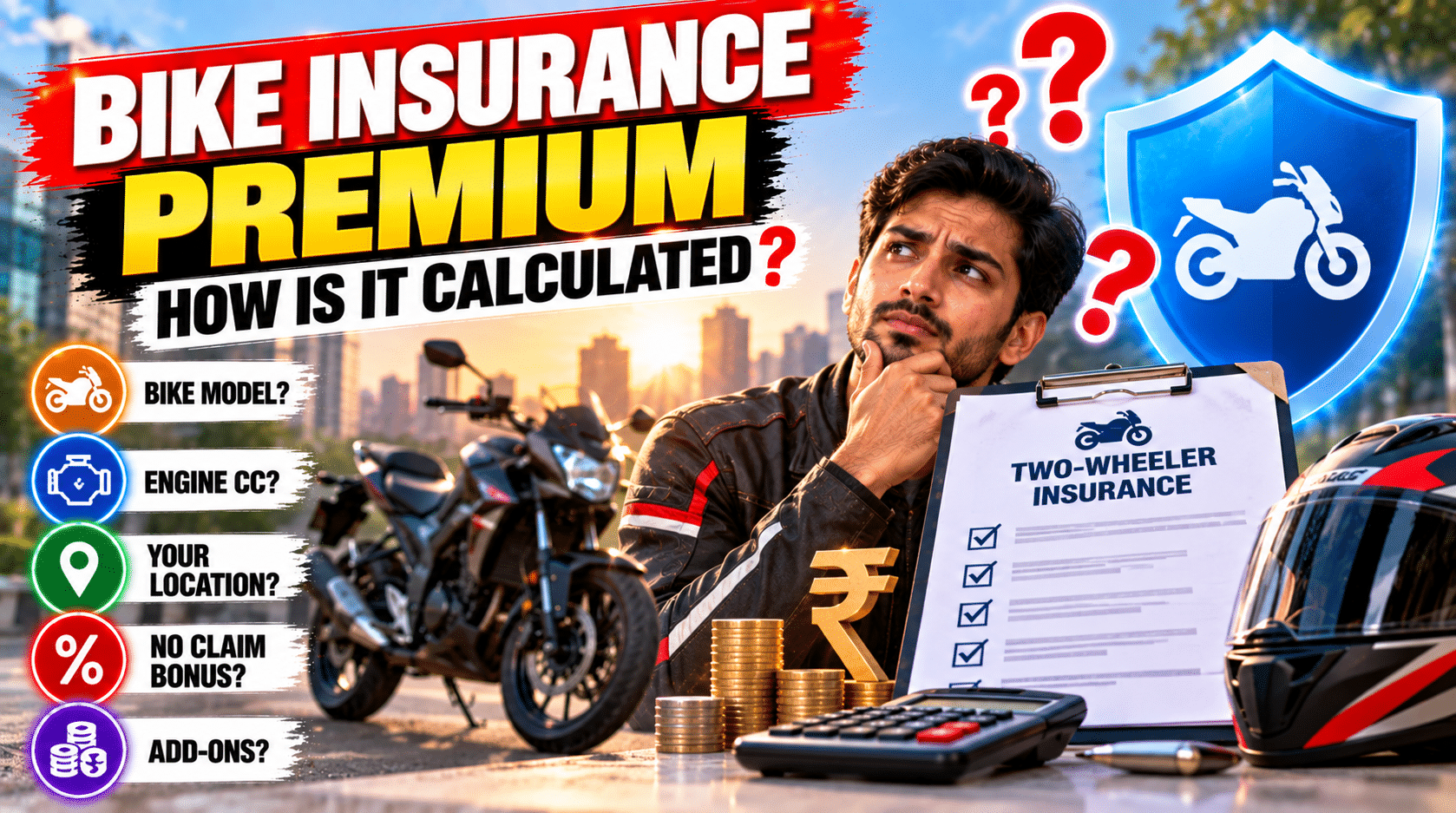
How Is Two-Wheeler Insurance Premium Calculated: Ever wondered why two people with similar-looking bikes can end up paying different amounts for two-wheeler insurance?
The answer is that your bike insurance premium is not decided by the vehicle alone. Insurers consider several factors, including the type of coverage, engine capacity, age and value of the bike, registration location, IDV, previous claims, No Claim Bonus (NCB), deductibles, and optional add-ons.
This is why simply choosing the cheapest insurance quote may not always be the smartest financial decision.
Before buying or renewing your bike or scooter insurance, it is worth understanding how the premium is actually calculated. Once you know the factors behind the price, it becomes much easier to compare policies and identify where you may be paying extra.
What Is a Two-Wheeler Insurance Premium?
A two-wheeler insurance premium is the amount you pay to the insurer to obtain the coverage offered under your policy.
The premium can differ depending on whether you choose only the legally required third-party liability cover or a broader policy that also protects your own vehicle.
In simple terms:
Higher coverage generally means a higher premium, while factors such as NCB, vehicle depreciation and selected deductibles can reduce the amount you pay.
For own-damage insurance, different insurers can charge different premiums for similar coverage. IRDAI recommends comparing quotes while also looking at IDV, deductibles and the actual coverage instead of comparing price alone.
How Is Two-Wheeler Insurance Premium Calculated?
There is no single formula that applies to every bike or scooter.
Broadly, the premium calculation can be understood through these major factors:
| Factor | How It Can Affect Premium |
|---|---|
| Type of insurance | Wider coverage generally costs more |
| Engine capacity | Higher-capacity vehicles can attract higher premiums |
| Bike model | Expensive/high-value models can cost more to insure |
| Vehicle age | Older vehicles generally have lower IDV |
| IDV | Higher insured value can increase own-damage premium |
| Location | Registration zone can influence premium |
| NCB | Claim-free history can reduce eligible own-damage premium |
| Deductible | A higher voluntary deductible can reduce premium |
| Add-ons | Additional protection increases premium |
| Previous claims | Claim history can affect pricing/discounts |
IFFCO Tokio identifies the vehicle model, type of cover, deductibles, NCB, IDV, vehicle age, fuel type, registration zone, and engine cubic capacity among the important factors used in determining two-wheeler insurance premiums.
Let’s look at each factor more closely.
1. Type of Two-Wheeler Insurance
One of the biggest factors affecting your premium is the type of insurance you choose.
Third-Party Insurance
Third-party liability insurance is the mandatory component required for vehicles used on public roads.
Its purpose is to cover specified liabilities arising from injury, death, or property damage caused to a third party, subject to applicable rules and policy conditions.
Because it provides limited protection compared with a comprehensive policy, its premium is generally lower.
Comprehensive Insurance
A comprehensive/package policy can combine third-party liability protection with own-damage protection.
Depending on the policy, own-damage coverage may protect against risks such as:
- Accidental damage
- Theft
- Fire
- Natural calamities
- Certain man-made events
Since the coverage is broader, the premium is generally higher than a basic third-party policy.
Standalone Own-Damage Cover
This type of policy focuses on protecting your own two-wheeler against covered damage or loss.
It is relevant where separate third-party liability protection already exists.
Therefore, the first question to ask while comparing premiums is not simply “Which insurer is cheapest?”
It should be:
“What exactly am I getting for this premium?”
2. Engine Capacity of Your Bike
The cubic capacity, or CC, of your two-wheeler is another important factor.
Generally, higher-engine-capacity bikes can attract higher insurance premiums because they may have higher vehicle values and different risk/pricing characteristics.
The applicable third-party premium structure is linked to engine capacity under the regulatory framework, while own-damage pricing is determined by insurers based on their filed rating factors.
For example, the insurance cost of a high-performance motorcycle may be different from that of a small commuter scooter even if both are used by their owners for similar daily travel.
3. Make and Model of the Two-Wheeler
The motorcycle or scooter you own also matters.
A premium bike with expensive components can cost more to insure than a basic commuter model.
Factors associated with the vehicle model can include:
- Purchase value
- Repair cost
- Availability and cost of spare parts
- Vehicle specifications
- Risk profile
- Current insured value
IFFCO Tokio notes that newer, technologically advanced, and expensive two-wheelers can attract higher insurance premiums than regular models.
4. Age of Your Bike
As a two-wheeler becomes older, its market value generally falls because of depreciation.
This affects the Insured Declared Value (IDV) and can consequently influence the own-damage premium.
An older bike may therefore have a lower own-damage premium than a newer vehicle, although the actual amount depends on the insurer and other rating factors.
However, a lower premium does not mean that an older vehicle is automatically cheaper to maintain or insure in every situation.
5. Insured Declared Value (IDV)
IDV is one of the most important terms to understand when buying own-damage two-wheeler insurance.
In simple language, IDV represents the insured value of your vehicle for applicable total-loss or theft situations.
As the vehicle gets older, depreciation generally reduces its IDV.
IFFCO Tokio explains that IDV is the maximum sum insured for the vehicle in situations such as total loss or theft, while IRDAI advises consumers to ensure that the IDV reasonably reflects the vehicle’s current market value.
Why Does IDV Matter?
Suppose two insurers offer apparently similar policies, but one has a significantly lower IDV.
The cheaper policy may not necessarily be the better deal.
A lower IDV can reduce the premium, but it can also reduce the financial protection available in an eligible total-loss or theft claim.
So always compare premium + IDV, not premium alone.
6. Your Registration Location
Where your two-wheeler is registered can also influence the premium.
Insurance pricing can consider the geographical zone in which the vehicle is registered. IFFCO Tokio notes that location or geographical zone is one of the factors used in premium calculation.
The reasoning is fairly straightforward: traffic density, accident exposure, theft risk, and other location-related factors can vary between areas.
This is why the same bike model may not necessarily have exactly the same premium in every city.
7. No Claim Bonus (NCB)
NCB is one of the most useful ways for eligible policyholders to reduce their own-damage insurance cost at renewal.
If you complete a policy period without making a claim, you can become eligible for an NCB discount on the own-damage premium.
Under the current norms referenced by IRDAI, NCB starts at 20% and can progressively increase up to 50% for successive claim-free years.
Why Is NCB Important?
Imagine you have maintained a claim-free record for several years.
Instead of losing that benefit, you may be able to use the accumulated NCB to reduce the eligible renewal premium.
Importantly, NCB belongs to the insured person rather than the vehicle. It can also be carried over when changing insurers at renewal, subject to the required proof and applicable conditions.
8. Previous Claim History
Your previous claim history can also affect the pricing of own-damage insurance.
A claim-free history can help you earn NCB, while making a claim can affect the NCB available for the following policy period.
This creates an important practical question:
Should you claim for every small scratch or minor repair?
Not necessarily.
If the repair cost is only slightly higher than your applicable out-of-pocket amount, using your insurance may not always make financial sense because of the potential loss of your NCB.
However, this decision should be based on your actual policy terms and the economics of the repair—not on a blanket rule to avoid all claims.
9. Deductible
A deductible is the portion of an eligible claim that you agree to bear yourself.
There are generally two concepts to understand:
Compulsory deductible:
The amount that applies as required under the applicable policy/rules.
Voluntary deductible:
An additional amount you choose to bear yourself in exchange for a potentially lower premium.
IFFCO Tokio explains that choosing a higher deductible can reduce the insurance premium, while choosing a lower deductible can increase the premium.
But Should You Always Choose a High Deductible?
No.
A higher deductible can save money on premium, but you will have to contribute more if you make an eligible claim.
So choose a deductible that you can comfortably afford rather than selecting the highest possible amount just to make the premium look cheaper.
10. Optional Add-Ons
Add-ons provide additional protection beyond the base policy.
Common two-wheeler add-ons can include:
- Roadside assistance
- Personal accident cover for eligible riders
- Zero depreciation/depreciation-related protection
- Engine protection, where available
- Other specialised protections
Every add-on comes at an additional cost.
That means selecting every available add-on can unnecessarily increase your premium.
The smarter approach is to identify the risks that are genuinely relevant to your bike and riding pattern.
IFFCO Tokio also recommends understanding the policy coverage and exclusions and comparing available protection before purchasing.
11. Fuel Type and Vehicle Condition
The fuel type and condition of the vehicle can also form part of the information considered during premium calculation.
The insurer may collect vehicle details such as model, registration information, engine capacity, and other specifications before calculating the applicable premium.
In other words, your bike’s insurance price is not determined by one number printed on the registration certificate.
It is based on a combination of vehicle and policy-related factors.
Third-Party Premium vs Own-Damage Premium
This distinction is extremely important.
Third-Party Premium
The premium for third-party liability is determined under the applicable regulatory framework and is not individually priced by every insurer in the same way as own-damage cover. IRDAI states that third-party liability premium rates are laid down by the regulator.
Own-Damage Premium
Own-damage pricing can vary between insurers.
Insurers consider factors such as:
- Vehicle age
- IDV
- Engine capacity
- Location
- Previous claims
- Discounts
- NCB
- Selected coverage
- Deductibles
- Add-ons
This is one reason why comparing different insurers can sometimes reveal noticeable price differences for own-damage coverage.
Does a Cheap Two-Wheeler Insurance Policy Mean a Better Deal?
Not necessarily.
This is perhaps the biggest mistake people make while renewing bike insurance.
Consider two quotes:
Policy A: Lower premium, lower IDV and higher deductible
Policy B: Slightly higher premium, better IDV and broader coverage
At first glance, Policy A looks cheaper.
But if something goes seriously wrong, Policy B could potentially provide more useful financial protection.
IRDAI specifically advises consumers to compare deductibles, coverage, and IDV, because a lower premium may sometimes come with lower coverage or a lower IDV.
How to Reduce Your Two-Wheeler Insurance Premium
You don’t necessarily need to compromise on essential protection to save money.
Here are some practical ways to control your insurance cost.
Maintain a Claim-Free Record
A claim-free history can help you accumulate NCB and reduce the eligible own-damage premium at renewal.
Compare Multiple Insurers
Don’t automatically renew with the same insurer every year without checking alternatives.
IRDAI recommends comparing multiple quotes for own-damage insurance.
Choose Add-Ons Carefully
Only pay for add-ons that address risks relevant to your vehicle and riding habits.
Select a Sensible Deductible
A voluntary deductible can reduce your premium, but don’t choose an amount that would become difficult to pay during a claim.
Check the IDV
Don’t select a very low IDV simply to reduce your premium.
The IDV should reasonably represent your vehicle’s applicable insured value.
Avoid Policy Lapses
Renew your policy before expiry.
IRDAI notes that a break in motor insurance can lead to vehicle inspection and additional charges.
Example: Why Two Riders Can Pay Different Premiums
Imagine two riders own similar motorcycles.
Rider A
- Newer bike
- Higher IDV
- Comprehensive cover
- Several add-ons
- No previous NCB
Rider B
- Older bike
- Lower IDV
- Comprehensive cover
- Fewer add-ons
- Several claim-free years
Even though the motorcycles may look similar, their premiums can be significantly different.
This illustrates why there is no universal “bike insurance price.”
The premium is based on the specific vehicle, coverage, and policyholder-related information used by the insurer.
What Should You Check Before Paying the Premium?
Before clicking the payment button, take a few minutes to compare:
- Policy type
- IDV
- Third-party cover
- Own-damage coverage
- Deductible
- NCB
- Add-ons
- Exclusions
- Claim process
- Renewal date
- Insurer’s service reputation
A difference of a few hundred rupees should not be the only deciding factor.
The better question is:
Which policy gives me the protection I actually need at a reasonable cost?
Final Verdict
The price of two-wheeler insurance is influenced by much more than the bike’s brand or engine.
Vehicle model, engine capacity, age, IDV, location, type of coverage, claim history, NCB, deductibles, and add-ons can all play a role in determining the final premium.
The smartest way to save money is not necessarily to buy the cheapest policy.
Instead, compare policies carefully, maintain a claim-free record where possible, use NCB, avoid unnecessary add-ons, choose a sensible deductible, and make sure the IDV and coverage are appropriate for your vehicle.
And before renewing, remember one simple rule:
Don’t compare only the premium. Compare what that premium actually buys you.
Frequently Asked Questions (FAQs)
How is two-wheeler insurance premium calculated?
The premium can depend on factors such as the type of cover, vehicle model, engine capacity, age, IDV, registration location, claim history, NCB, deductibles and selected add-ons.
Does bike engine capacity affect insurance premium?
Yes. Engine cubic capacity is an important factor, particularly in the applicable third-party premium structure and in insurer pricing for own-damage cover.
What is IDV in two-wheeler insurance?
IDV stands for Insured Declared Value. It represents the applicable insured value of the vehicle and is particularly important in total-loss or theft situations covered by the policy.
Does a higher IDV increase bike insurance premium?
Generally, a higher IDV can increase the own-damage premium because it represents a higher insured value. However, you should choose an IDV that reasonably reflects the vehicle’s applicable market value rather than selecting it solely to manipulate the premium.
What is NCB in bike insurance?
NCB, or No Claim Bonus, is a discount available to eligible policyholders who complete a policy period without making a claim. Under current norms referenced by IRDAI, it can progressively rise from 20% up to 50% on the own-damage premium.
Can I transfer my NCB to another insurance company?
Yes. NCB can generally be carried over when changing insurers at renewal, provided the required proof of NCB entitlement is submitted.
Does making a claim affect NCB?
A claim can affect the NCB available in the following policy period. Therefore, policyholders should consider the financial benefit of making a small claim against the potential loss of their accumulated NCB.
Can choosing a higher deductible reduce my premium?
Yes. A voluntary deductible generally means you agree to bear a larger portion of an eligible claim yourself, which can reduce the premium. However, choose an amount you can comfortably afford.
Is third-party bike insurance cheaper than comprehensive insurance?
Generally, yes, because third-party insurance provides a narrower form of protection. Comprehensive insurance can include own-damage protection in addition to third-party liability, which generally makes it more expensive.
Is comprehensive two-wheeler insurance mandatory?
No. Third-party liability insurance is the mandatory requirement for vehicles used on public roads. Comprehensive insurance provides broader optional protection.
Why does my bike insurance premium increase after a claim?
A claim can affect your NCB and the insurer’s assessment of your risk/discounts. The exact renewal price depends on the insurer and policy factors applicable to your vehicle.
Can the location of my bike affect the premium?
Yes. The geographical zone in which the vehicle is registered can be one of the factors considered when calculating the premium.
Do add-ons increase two-wheeler insurance premium?
Yes. Add-ons provide additional protection and generally require an additional premium.
Should I buy every bike insurance add-on?
No. Choose add-ons according to your vehicle, location, usage, and risk profile. Buying unnecessary add-ons can increase the premium without providing meaningful additional value for your situation.
What happens if my two-wheeler insurance expires?
A break in motor insurance can lead to vehicle inspection requirements and additional charges when you attempt to renew. IRDAI advises policyholders to renew before the due date.
How can I get a cheaper bike insurance premium?
You can compare insurers, maintain an eligible NCB, select suitable coverage, avoid unnecessary add-ons, and consider an appropriate voluntary deductible. However, don’t reduce essential protection simply to save a small amount on premium.
Is the cheapest bike insurance policy the best?
Not necessarily. A cheaper quote may have a lower IDV, higher deductible, or narrower coverage. Compare the complete policy rather than looking at premium alone.
How often should I compare two-wheeler insurance?
It is sensible to review your policy at every renewal. Compare the premium, IDV, coverage, NCB, deductibles, add-ons, and exclusions before renewing.