
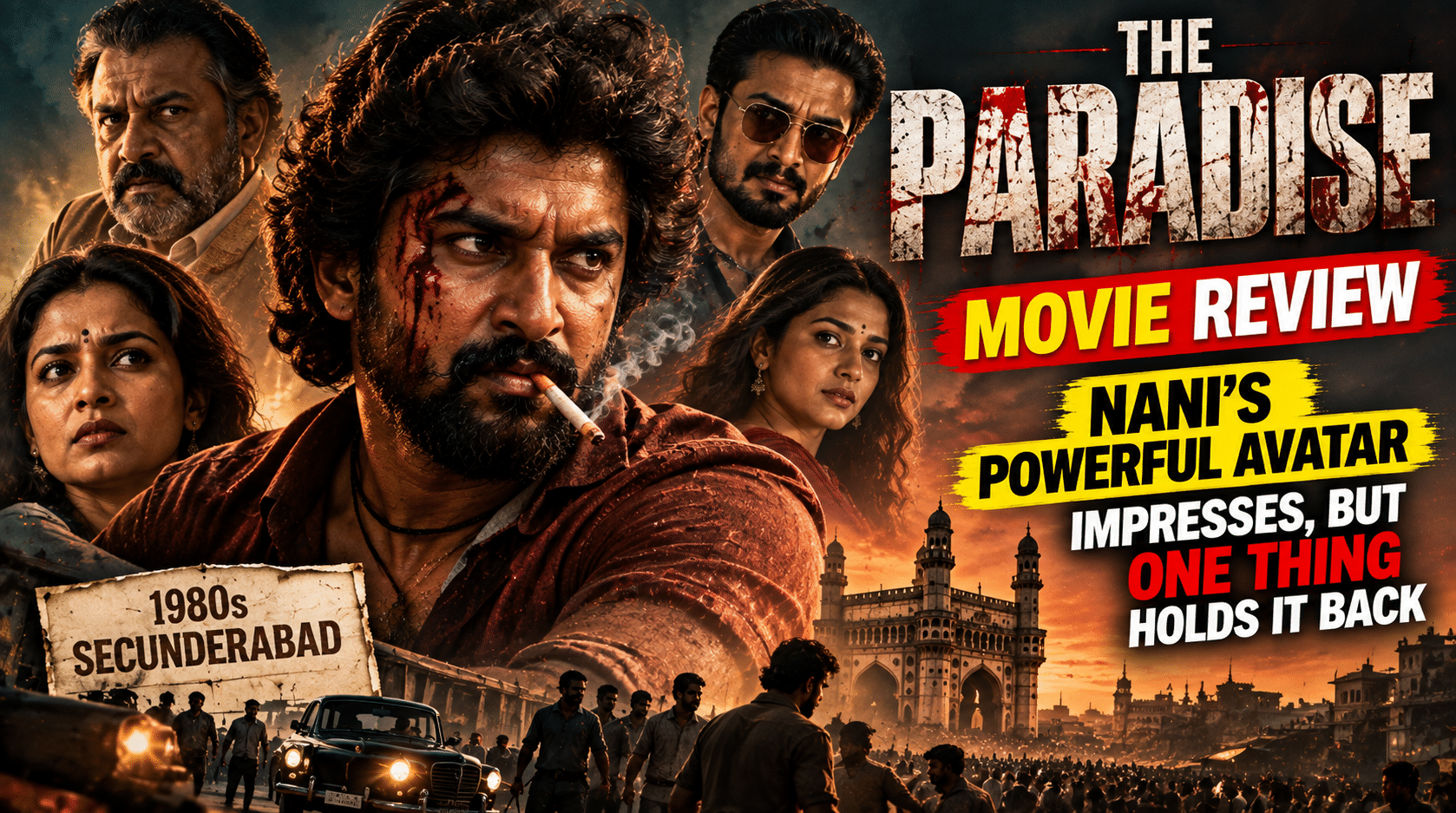
The Paradise Movie Review: Nani and director Srikanth Odela reunite after Dasara for a much darker and more ambitious action drama. Set in 1980s Secunderabad, The Paradise enters the world of a marginalised community and builds its story around power, identity, survival and the fight for dignity.
The film arrives with an impressive cast led by Nani, Mohan Babu, Kayadu Lohar, Sonali Kulkarni and Raghav Juyal. Anirudh Ravichander provides the music, while Srikanth Odela returns to the director’s chair for his second collaboration with Nani.
There is clearly a lot happening here.
The film wants to be a raw action drama, a social story, a character study, and a larger-than-life cinematic experience at the same time.
At its best, The Paradise creates a striking world and gives Nani a completely different screen presence.
But as the story progresses, the film’s ambition begins to work against it.
The Paradise: What Is the Movie About?
The story is set in 1980s Secunderabad, where the Savari community lives on the margins while dealing with discrimination, poverty, and a struggle for recognition.
At the centre of the story is Jadal, played by Nani.
Jadal isn’t introduced as a conventional hero.
He belongs to a difficult world and has been shaped by everything around him. His circumstances, anger and survival instincts gradually push him into a much larger conflict.
The film is essentially about what happens when an individual who has spent his life surviving is forced to confront a system built around power and oppression.
Rather than presenting the story as a straightforward revenge drama, the film tries to connect Jadal’s personal journey with the larger struggle of his community.
Nani’s Transformation Is One of the Film’s Biggest Strengths
Nani has spent much of his career playing characters who rely more on intelligence, emotion, and relatability than physical intimidation.
The Paradise asks him to go in a very different direction.
As Jadal, he has a noticeably more rugged appearance and physicality.
His body language is restrained rather than theatrical. Even when the character becomes aggressive, Nani doesn’t immediately turn him into a conventional mass hero.
That makes the transformation more interesting.
The change feels like something that develops from Jadal’s circumstances rather than simply being added for a few action scenes.
Several reviews have specifically highlighted Nani’s physical transformation and controlled performance as among the film’s stronger elements.
Jadal Is Not Your Typical Commercial Hero
One of the more interesting choices in The Paradise is the way Jadal is introduced.
He isn’t someone who walks into every situation with complete confidence.
There is vulnerability beneath the aggression.
His character has been shaped by his environment, and that becomes visible in the way he interacts with people around him.
The result is a protagonist who can be intimidating in one scene and emotionally exposed in another.
Nani handles that contrast with considerable commitment.
The problem is that the screenplay doesn’t always give the character enough room to develop naturally.
Kayadu Lohar Adds a Human Touch
Kayadu Lohar plays Subbu, a character who brings a different emotional dimension to Jadal’s world.
Her scenes with Nani provide some of the film’s quieter moments and help prevent the story from becoming entirely dominated by violence and conflict.
However, her character is also largely tied to the larger narrative surrounding Jadal.
The film could have benefited from giving this relationship more room to breathe instead of repeatedly rushing back toward the larger conflict.
Sonali Kulkarni’s Role Has Emotional Weight
Sonali Kulkarni plays Sammakka, Jadal’s mother.
Her role adds another layer to the film’s exploration of family and community.
Rather than treating her simply as the protagonist’s mother, the film gives the character emotional significance within the larger world.
Kulkarni brings maturity to these portions and creates some of the more grounded moments in the movie.
Her scenes also help reveal that the story isn’t only about Jadal’s transformation—it is about the people and circumstances that shaped him.
Mohan Babu Brings Authority
Mohan Babu plays Shikanja Maalik, an imposing figure within the story.
His presence gives the power structure surrounding Jadal a face.
The character isn’t designed to be subtle in the traditional sense. He represents authority and control, making his interactions with Jadal important to the film’s larger conflict.
Mohan Babu’s screen presence suits the role, particularly during the more confrontational sequences.
Raghav Juyal Goes Darker
After making an impact with intense roles in recent Hindi cinema, Raghav Juyal steps into Telugu cinema with The Paradise.
He plays Vikram Maalik, a character whose presence brings menace and unpredictability to the story.
The performance is deliberately aggressive and theatrical at points.
Juyal clearly embraces the darker side of the character, and his physical presence adds another layer of tension to the conflict.
His Telugu debut is therefore one of the casting choices that immediately catches attention.
Srikanth Odela Creates a Powerful World
Director Srikanth Odela clearly wants The Paradise to feel larger than a conventional action movie.
The world-building is one of the film’s strongest aspects.
The 1980s setting, the community backdrop, the costumes, production design, and raw environments all contribute to a distinctive atmosphere.
The film doesn’t try to make its characters look glamorous.
Instead, it embraces dirt, chaos, heat, and violence.
That visual approach fits the story.
But the movie’s presentation sometimes becomes more impressive than the narrative itself.
The Action Sequences Make an Impact
The first half contains some of the film’s more effective action moments.
What works particularly well is that the violence generally feels connected to the environment and the characters.
Jadal isn’t suddenly transformed into an invincible superhero.
His physicality develops as the story pushes him further.
The action therefore feels like an extension of the world rather than something inserted between dramatic scenes.
However, as the movie progresses, the sheer amount of violence begins to dominate the storytelling.
When Violence Starts Replacing Emotion
This is where The Paradise becomes less consistent.
The movie clearly wants audiences to feel the pain and anger behind Jadal’s journey.
But emotional moments don’t always land with the same power as the action sequences.
There are scenes where the film tells the audience exactly what it wants them to feel rather than allowing the emotion to develop naturally.
As a result, some dramatic moments feel less powerful than they should.
This is particularly noticeable because the film has a strong emotional foundation.
The characters have enough history and conflict to create genuine emotional impact.
The screenplay simply doesn’t always give those moments enough breathing space.
The Chapter-Based Structure
The movie is divided into different chapters, with titles that attempt to give the story a larger thematic structure.
The intention is understandable.
A sprawling story can sometimes benefit from clearly separated chapters.
But here, the structure can make the narrative feel fragmented.
Instead of creating a smooth progression, some transitions feel abrupt.
The result is a movie that occasionally feels like several connected pieces rather than one steadily building story. India Today also noted that the chapter structure contributes to a sense of fragmentation.
The Paradise and Its Social Themes
Beneath all the action, the movie is attempting to discuss serious subjects.
The story touches upon:
- Social discrimination
- Identity
- Community
- Poverty
- Power
- Human dignity
- Survival
- Oppression
- The desire for recognition
The 1980s setting is important because it gives these themes a specific historical and cultural environment.
The movie isn’t simply showing an individual’s fight.
It is trying to place that fight inside a larger social reality.
That ambition is one of the reasons The Paradise feels bigger than a routine action entertainer.
Anirudh’s Music Adds to the Scale
Anirudh Ravichander handles the music, and the soundtrack plays a major role in establishing the film’s atmosphere.
The background score especially contributes to the movie’s aggressive tone.
When the action begins, the music helps increase the sense of scale and intensity.
The score often makes scenes feel larger than they might otherwise appear.
At the same time, the film occasionally relies so heavily on its sound and visual intensity that the quieter emotional elements struggle to get equal attention.
The Visual Presentation Is Impressive
One thing that is difficult to ignore is the movie’s visual ambition.
The world of The Paradise has a distinct identity.
The period setting, crowded environments, and rough textures create a cinematic atmosphere that separates the film from polished urban action dramas.
The production feels deliberately raw.
That visual approach is particularly effective during the larger action sequences.
Even critics who found problems with the storytelling have acknowledged the film’s striking world and Nani’s performance.
Where The Paradise Loses Its Way
The central issue is not a lack of ambition.
There is plenty of ambition here.
The problem is that the film tries to do too many things simultaneously.
It wants to be:
A social drama + an action film + a period story + a character study + a mass entertainer.
Sometimes these elements complement one another.
At other times, they compete for attention.
The result is an uneven experience.
The movie has several powerful ingredients, but they don’t always combine into a consistently engaging narrative.
Is The Paradise Worth Watching?
That depends largely on what you expect from the film.
If you’re watching for Nani’s transformation, intense action, atmosphere, and Srikanth Odela’s visual world, there is plenty to appreciate.
If you’re expecting a tightly written story where every character and subplot receives equal attention, the film may feel less satisfying.
The Paradise isn’t short on ideas.
Its bigger challenge is turning those ideas into a consistently engaging story.
The Paradise Movie Review: Final Verdict
The Paradise is a film with a strong visual identity and a committed lead performance.
Nani steps far outside his familiar comfort zone and gives Jadal the physical intensity the role demands. Sonali Kulkarni brings emotional depth, Mohan Babu supplies authority, Kayadu Lohar provides warmth, and Raghav Juyal adds an unpredictable edge to the conflict.
Srikanth Odela also deserves credit for attempting something much larger than a straightforward action drama.
But the movie’s narrative doesn’t always match the scale of its presentation.
The violence becomes increasingly dominant, some emotional beats don’t land as strongly as intended, and the chapter-based storytelling can make the overall journey feel disconnected.
That explains why the film has received mixed critical reactions, despite strong interest around Nani and the Dasara reunion.
The Paradise has the look, ambition, and performance of a much bigger film—but its storytelling doesn’t consistently reach the same height.
For Nani fans, there is still plenty to see.
For everyone else, the question is whether the film’s striking world and intense action are enough to overcome its uneven narrative.
The Paradise Movie Details
| Category | Details |
|---|---|
| Movie | The Paradise |
| Language | Telugu |
| Genre | Action, Drama |
| Setting | 1980s Secunderabad |
| Director | Srikanth Odela |
| Lead Actor | Nani |
| Character | Jadal |
| Cast | Nani, Mohan Babu, Kayadu Lohar, Sonali Kulkarni, Raghav Juyal |
| Music | Anirudh Ravichander |
| Producer | Sudhakar Cherukuri |
| Release Date | September 24, 2026 |
| Certification | A |
| Runtime | Around 2 hours 49 minutes |
The release date, certification, runtime, and principal cast are reflected in current listings and reporting.
Frequently Asked Questions (FAQs)
What is The Paradise movie about?
The Paradise is set in 1980s Secunderabad and follows Jadal, a man from a marginalised community who becomes involved in a larger struggle surrounding identity, dignity, power and survival.
Who plays the lead role in The Paradise?
Nani plays Jadal, the central character of the film.
Who directed The Paradise?
The movie is directed by Srikanth Odela, marking his second collaboration with Nani after Dasara.
Is The Paradise based on a true story?
The film is presented as a fictional story set against the social and cultural backdrop of 1980s Secunderabad. Its story explores themes surrounding a marginalised community rather than functioning as a straightforward biographical account.
Who is Raghav Juyal playing in The Paradise?
Raghav Juyal plays Vikram Maalik, a character positioned on the opposing side of the central conflict.
Who plays Nani’s mother in The Paradise?
Sonali Kulkarni plays Sammakka, the mother of Nani’s character, Jadal.
Is The Paradise a full action movie?
Action is a major part of the film, but it also attempts to explore social inequality, identity, community, and family relationships.
What is the runtime of The Paradise?
Current listings put the film at approximately 169 minutes, or around 2 hours and 49 minutes.
What is The Paradise certification?
The film has received an A certificate, meaning theatrical admission is restricted to adult audiences.
When was The Paradise released?
The Paradise was released theatrically worldwide on September 24, 2026, with paid premieres beginning the previous evening.
Who composed the music for The Paradise?
The music and background score are by Anirudh Ravichander.
Is The Paradise worth watching?
The film’s appeal depends on individual taste. Viewers interested in Nani’s transformation, intense action and visually ambitious period dramas may find several elements worth exploring, while the uneven narrative and heavy violence may not work equally well for everyone.
Is The Paradise available on OTT?
Netflix has been reported as the post-theatrical streaming partner, but the exact OTT premiere date should be confirmed through an official announcement rather than relying on an estimated window.