
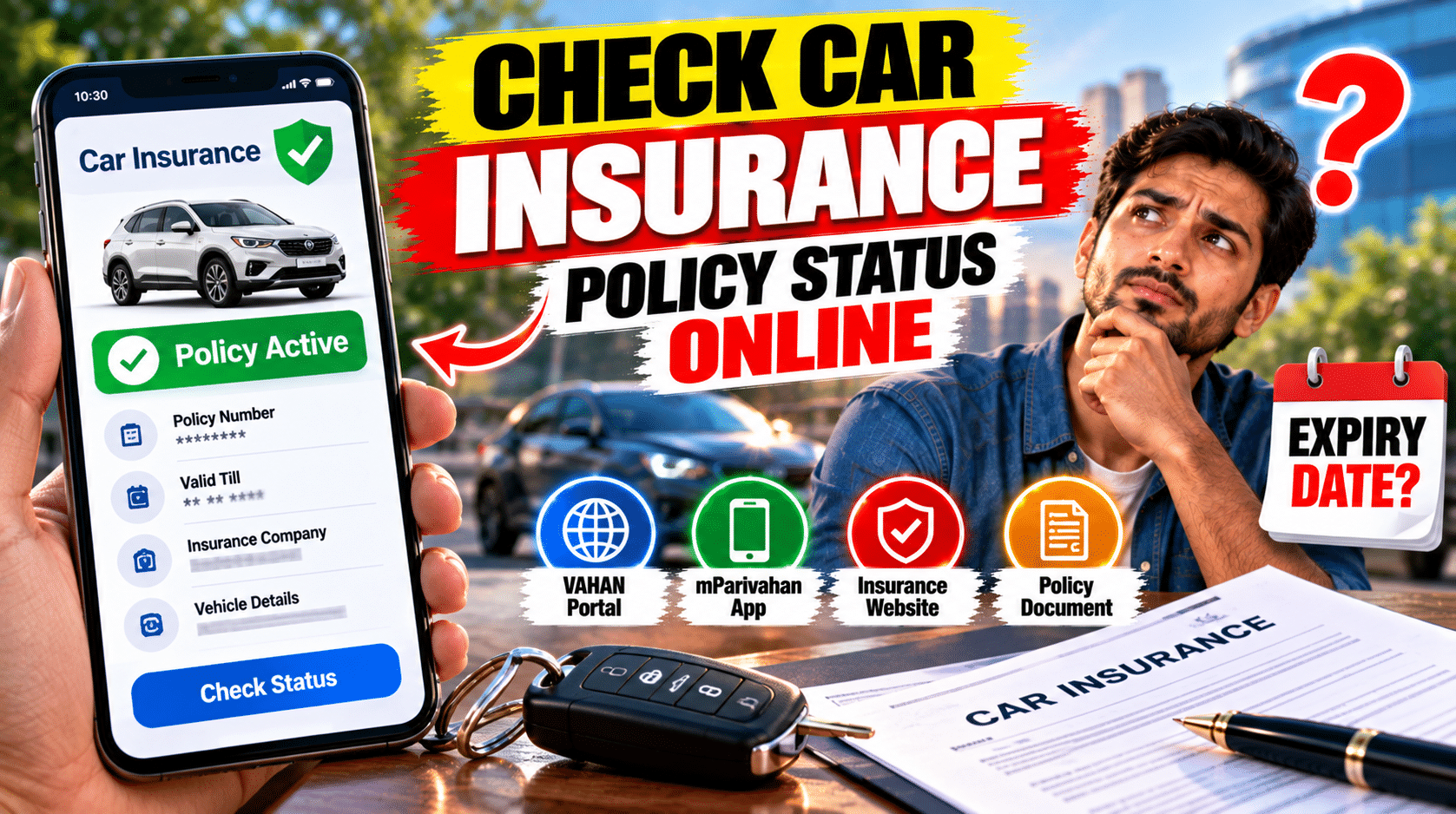
How to Check Car Insurance Policy Status Online: You may know your car’s registration number by heart, but do you remember exactly when its insurance policy expires?
For many car owners, the answer is no.
An insurance policy can quietly approach its expiry date while the vehicle continues to be used every day. The problem usually becomes obvious only when someone needs to renew the policy, show insurance details during a roadside check, or—much worse—deal with an accident after the policy has already expired.
The good news is that checking your car insurance status is no longer a complicated process.
You can verify insurance details through VAHAN-related services, mParivahan, your insurance company’s website or app, your policy document, and other available channels. Government transport systems can display insurance-related vehicle information, while your insurer remains the best source for the complete policy terms and exact coverage.
Here is everything you need to know about checking your car insurance status, finding the expiry date and avoiding an unwanted policy lapse.
What Is Car Insurance Policy Status?
Car insurance policy status basically tells you whether your vehicle currently has an active insurance policy and, where available, the relevant validity or expiry information.
Depending on the source you use, you may be able to see details such as:
- Insurance company name
- Policy number
- Policy validity
- Insurance type
- Vehicle registration details
- Policy start and expiry information
The national vehicle database includes insurance-related information such as insurer name, policy number, and validity.
However, remember that a vehicle database may not show every detail of your insurance contract. For complete information about coverage, exclusions, add-ons, deductibles, and claim conditions, check the actual policy document or contact your insurer.
Why Should You Check Your Car Insurance Status?
Checking your insurance status isn’t just an administrative task.
It can help you avoid several problems.
1. Avoid Driving With Expired Insurance
Third-party liability insurance is mandatory for vehicles being driven on public roads in India.
If your policy has expired, you should not assume that you remain covered simply because you have been insured in previous years.
2. Avoid an Unexpected Coverage Gap
A policy lapse can leave you without the protection you expected when an accident or other covered event occurs.
That’s why knowing the exact expiry date matters.
3. Protect Your No Claim Bonus
NCB can provide a valuable discount on the own-damage premium for eligible claim-free policyholders.
IRDAI states that NCB can range from 20% and progressively increase up to 50% based on successive claim-free years, subject to applicable conditions.
A long lapse can also affect accumulated NCB. IRDAI’s guidance notes that if a comprehensive policy remains lapsed for more than 90 days, the accrued NCB benefit is lost.
4. Renew Before the Due Date
Knowing your expiry date gives you enough time to compare policies and renew without last-minute confusion.
IRDAI advises approaching the insurer at least 15 days before the existing policy expires.
How To Check Car Insurance Status Online?
There are several ways to verify your car’s insurance status.
The easiest options are:
- VAHAN/Parivahan services
- mParivahan
- Insurance company’s website or mobile app
- Your insurance policy document
- InsuranceDekho dashboard, if the policy was purchased there
- QR code on the policy document, where supported
- Customer support
- RTO or insurer’s office if online verification isn’t working
Let’s look at the practical methods one by one.
1. Check Car Insurance Status Through VAHAN
VAHAN is part of India’s national vehicle registration system and contains vehicle-related information, including insurance data.
Government transport infrastructure supports insurance-validity information associated with vehicle records.
General Steps
- Open the official VAHAN/Parivahan vehicle services.
- Select the option for checking vehicle details.
- Enter your car’s registration number.
- Complete the required verification.
- Submit the details.
- Check the insurance information displayed for the vehicle.
The exact interface can change over time, so follow the options currently shown on the official portal.
What Can You See?
Depending on the information available in the database, you may see the insurer, policy details, and validity information associated with the vehicle.
If the information looks incorrect or outdated, don’t immediately assume that your insurance is invalid. Contact your insurer and ask them to verify the policy record.
2. Check Insurance Through mParivahan
For people who prefer using a smartphone, mParivahan can be a convenient option.
Parivahan states that mParivahan allows citizens to access transport-related services and check vehicle insurance validity through its connection with the Transport National Register.
How to Check
Generally, you can:
- Open the official mParivahan application.
- Enter or search using your vehicle details.
- Select the relevant vehicle.
- Look for the insurance information.
- Check the displayed validity details.
The app can be especially useful if you frequently travel and want access to vehicle documents and related information from your phone.
3. Check Through Your Insurance Company’s Website or App
This is one of the most reliable ways to check your policy because the insurer issued the policy in the first place.
Visit your insurer’s official website or open its official mobile application.
Depending on the insurer, you may be asked for:
- Policy number
- Registered mobile number
- Email ID
- Vehicle registration number
- OTP
- Other verification details
Once logged in, look for sections such as My Policies, Policy Details, Motor Insurance or Policy Documents.
You may be able to see:
- Policy status
- Start date
- Expiry date
- Policy number
- Premium
- Coverage
- Add-ons
- Vehicle details
- Downloadable policy document
For complete contractual details, the insurer’s policy document remains particularly important.
4. Check Your Insurance Policy Document
Sometimes the fastest method is also the simplest.
Open the PDF or physical copy of your car insurance policy.
Look for:
Policy Period / Period of Insurance
The document should show the date and time from which the insurance becomes effective and its expiry details. The prescribed motor insurance certificate format itself includes the effective date/time and expiry date of insurance.
If you purchased your policy online, search your email inbox for terms such as:
- Car insurance
- Policy document
- Motor insurance
- Policy number
- Insurer name
You may find the original PDF attached to the purchase or renewal email.
5. Check Through InsuranceDekho
If you purchased your car insurance through InsuranceDekho, you may be able to access the policy through your customer account/dashboard.
The platform’s policy-related services can display information such as policy status, start and end dates, policy number, premium, coverage, and vehicle details.
This option is particularly useful if you have forgotten which insurer you selected or misplaced the original policy document.
6. Use the QR Code on Your Policy
Many modern insurance documents contain a QR code that can be used to access policy-related information.
If your policy document includes a QR code, scan it using your smartphone and follow the information displayed.
However, don’t rely on an unfamiliar QR code or third-party website blindly. Always verify that the information comes from a legitimate insurance or government-related source.
7. Contact Your Insurance Company’s Customer Support
Can’t find the policy online?
Call the insurer’s official customer-care channel.
Keep these details handy:
- Car registration number
- Policy number, if available
- Registered mobile number
- Name of policyholder
The insurer can verify your policy and help you obtain a duplicate policy document or clarify the current status.
IRDAI also confirms that if a motor policy document is lost, the policyholder can approach the issuing insurer for a duplicate copy.
8. Visit the RTO or Insurer’s Office
If online methods aren’t working, you can take the offline route.
You can contact:
- Your insurance company’s branch
- The insurer’s authorised office
- The concerned RTO
Carry relevant vehicle and identity documents where required.
For most people, however, online verification through the insurer or government vehicle services will be considerably quicker.
What Information Do You Need to Check Car Insurance Status?
The exact information required depends on the platform.
Usually, it helps to keep the following details available:
| Information | Why It May Be Needed |
|---|---|
| Vehicle registration number | Identifies the vehicle |
| Policy number | Identifies the insurance contract |
| Registered mobile number | Verification/OTP |
| Email address | Account or policy verification |
| Chassis/engine details | May be required for certain records |
| Policy document | Confirms exact policy terms |
Your registration number is generally the most useful starting point for vehicle-level verification.
What If Your Insurance Details Are Not Showing Online?
Don’t panic immediately.
There can be a delay or mismatch between the insurance record and the vehicle database.
For example, if you recently purchased or renewed your insurance, the updated information may not appear immediately in every system.
Parivahan has stated that insurance data is uploaded to the VAHAN database and reflected through services such as mParivahan/eChallan.
If your policy is active according to the insurer but the government vehicle record is showing something different, contact the insurer and request verification or correction.
Keep your policy document and payment confirmation available.
What If VAHAN Shows the Wrong Insurance Details?
This is a serious situation.
Suppose you recently renewed your policy, but VAHAN still shows the previous insurer or an older expiry date.
Do not assume that your new policy has failed.
First:
- Check your latest policy PDF.
- Verify the policy number and validity.
- Contact your insurer.
- Ask whether the updated insurance data has been uploaded/updated.
- Keep proof of purchase or renewal.
The insurance company can guide you if there is a discrepancy in the database.
What Happens If Your Car Insurance Has Expired?
This is where many vehicle owners make a costly mistake.
IRDAI’s motor insurance guidance states that a motor policy generally needs to be renewed before its due date and that insurers do not provide a grace period for payment of motor insurance premiums. If there is a lapse, vehicle inspection may be required.
So don’t rely on the common assumption that you automatically get a few extra days of coverage after expiry.
If Your Policy Has Already Expired
Avoid driving the vehicle until the required insurance cover is restored.
Contact the insurer or compare a new policy immediately.
Depending on the situation, the insurer may require inspection before issuing or renewing own-damage coverage.
Does an Expired Policy Mean You Lose NCB?
It depends on how long the policy remains lapsed and the applicable conditions.
IRDAI states that if a comprehensive policy is allowed to lapse for more than 90 days, the accrued NCB benefit is lost.
This is another reason not to ignore the expiry date.
If you’re close to expiry, renewing on time can save you from unnecessary complications.
Can You Check Insurance Status Without the Policy Number?
Yes, in many cases.
Vehicle-level services can allow you to find insurance information using the vehicle registration number.
mParivahan and VAHAN-related services can provide vehicle information associated with the registration record.
However, for detailed policy information, the policy number or registered contact details may still be required by the insurer.
Can You Check Car Insurance Status Using the Registration Number?
Yes.
The vehicle registration number is one of the most useful details for checking vehicle insurance information through government vehicle services.
However, the exact information available depends on the database and whether the insurance record has been updated.
How Often Should You Check Your Car Insurance Status?
You don’t need to check it every week.
A practical approach is to check:
- A few weeks before expiry
- Before a long road trip
- When buying or selling a used car
- After renewing the policy
- After changing insurers
- If your policy details appear incorrect
- After receiving an unexpected insurance-related message
Setting a calendar reminder several weeks before the expiry date is one of the easiest ways to avoid forgetting.
Car Insurance Status: Online vs Offline
| Method | Convenience | Best For |
|---|---|---|
| VAHAN/Parivahan | High | Vehicle-level verification |
| mParivahan | High | Mobile users |
| Insurer website/app | Very high | Complete policy information |
| Policy PDF | Very high | Exact policy dates and terms |
| QR code | High | Quick document verification |
| Customer care | Medium | Missing/incorrect records |
| RTO | Low | Offline assistance |
Important Difference: Insurance Status vs Insurance Coverage
This distinction is easy to overlook.
A database may show that your vehicle has an active insurance policy.
But that doesn’t automatically mean every type of damage is covered.
For example, a policy could be third-party liability only.
Another policy may include own-damage protection, while additional risks may require specific add-ons.
So, after checking the status, also check:
- Type of policy
- Own-damage cover
- Third-party cover
- IDV
- Deductible
- Add-ons
- Exclusions
- Policy expiry
IRDAI recommends comparing coverage, deductibles, and IDV rather than relying only on the premium or the existence of a policy.
7 Smart Tips to Never Miss Your Car Insurance Renewal
1. Save the expiry date in your phone calendar
Set a reminder at least 15–30 days before expiry.
2. Keep a digital copy of your policy
Store the PDF in a secure location so you can access it whenever needed.
3. Check after renewal
Don’t simply assume that the renewal went through. Verify the new policy document and validity.
4. Check the insurer’s name
Make sure the policy actually belongs to your vehicle and contains the correct registration details.
5. Compare before renewing
You can compare available policies rather than automatically accepting the first renewal quote.
6. Keep NCB documents
If you change insurers, retain proof of your eligible NCB.
7. Don’t wait until the expiry date
IRDAI recommends approaching the insurer at least 15 days before the existing policy expires.
Final Verdict
Checking your car insurance status takes only a few minutes, but it can prevent a surprisingly big headache later.
For a quick vehicle-level check, VAHAN and mParivahan can be useful. For detailed information about your actual coverage, the insurer’s website/app and your policy document are more important.
Most importantly, don’t confuse “insurance showing online” with “complete protection.”
Always check the policy’s expiry date, type of cover, IDV, deductibles, add-ons, and exclusions.
And if your policy is approaching expiry, don’t wait for the last day.
A two-minute insurance-status check today can save you from a much bigger problem tomorrow.
Frequently Asked Questions (FAQs)
How can I check my car insurance status online?
You can check it through VAHAN/Parivahan services, mParivahan, your insurer’s official website or app, and other authorised policy-service platforms.
Can I check car insurance using the registration number?
Yes. Vehicle registration details can be used to retrieve available insurance information through government vehicle services such as VAHAN-related services.
How can I check my car insurance expiry date?
You can check the expiry date on your policy document, insurer’s website/app, or available vehicle-information services. The insurance certificate includes an expiry date.
Can I check insurance status without a policy number?
Yes, vehicle-level services may allow you to search using your registration number. However, your insurer may require additional information to access the complete policy.
How can I check car insurance through mParivahan?
Open the official mParivahan app, search for your vehicle using the available vehicle details, and view the insurance information associated with the vehicle record. Parivahan states that mParivahan provides access to vehicle insurance validity information.
What should I do if VAHAN shows old insurance details?
First, verify your latest policy document with the insurer. If your policy is active but the vehicle record has not been updated, contact the insurer and ask them to verify or update the insurance information.
What happens if my car insurance expires?
A motor insurance policy should be renewed before its due date. IRDAI states that motor insurers do not provide a grace period for premium payment, and a lapse can result in vehicle inspection requirements.
Can I drive my car after insurance expiry?
You should not drive on public roads without the required third-party motor insurance. Third-party liability insurance is mandatory for vehicles plying on public roads in India.
Will I lose my NCB if my car insurance expires?
A lapse does not necessarily mean immediate loss of NCB, but IRDAI states that if a comprehensive policy remains lapsed for more than 90 days, the accrued NCB benefit is lost.
Can I renew car insurance before the expiry date?
Yes. In fact, IRDAI recommends approaching the insurance company at least 15 days before the existing policy expires.
Can I change my car insurance company during renewal?
Yes. You can compare policies and switch insurers at renewal. Eligible NCB can also be carried over when changing insurers, subject to the required proof.
Is a physical insurance copy necessary?
Electronic insurance records and documents available through recognised digital platforms can be used in applicable situations. Parivahan has also stated that insurance information reflected in mParivahan/electronic records is legally recognised in the relevant context.
How do I get a duplicate car insurance policy?
Contact the insurer that issued the policy and request a duplicate copy. IRDAI confirms that a duplicate policy can be obtained from the issuing office on request.
How often should I check my car insurance status?
Check it before renewal and ideally a few weeks before expiry. It is also useful to verify the status after purchasing or renewing a policy.
What details should I check in my car insurance policy?
Check the policy number, vehicle registration number, policy period, insurer, type of cover, IDV, premium, deductibles, add-ons, and exclusions.