
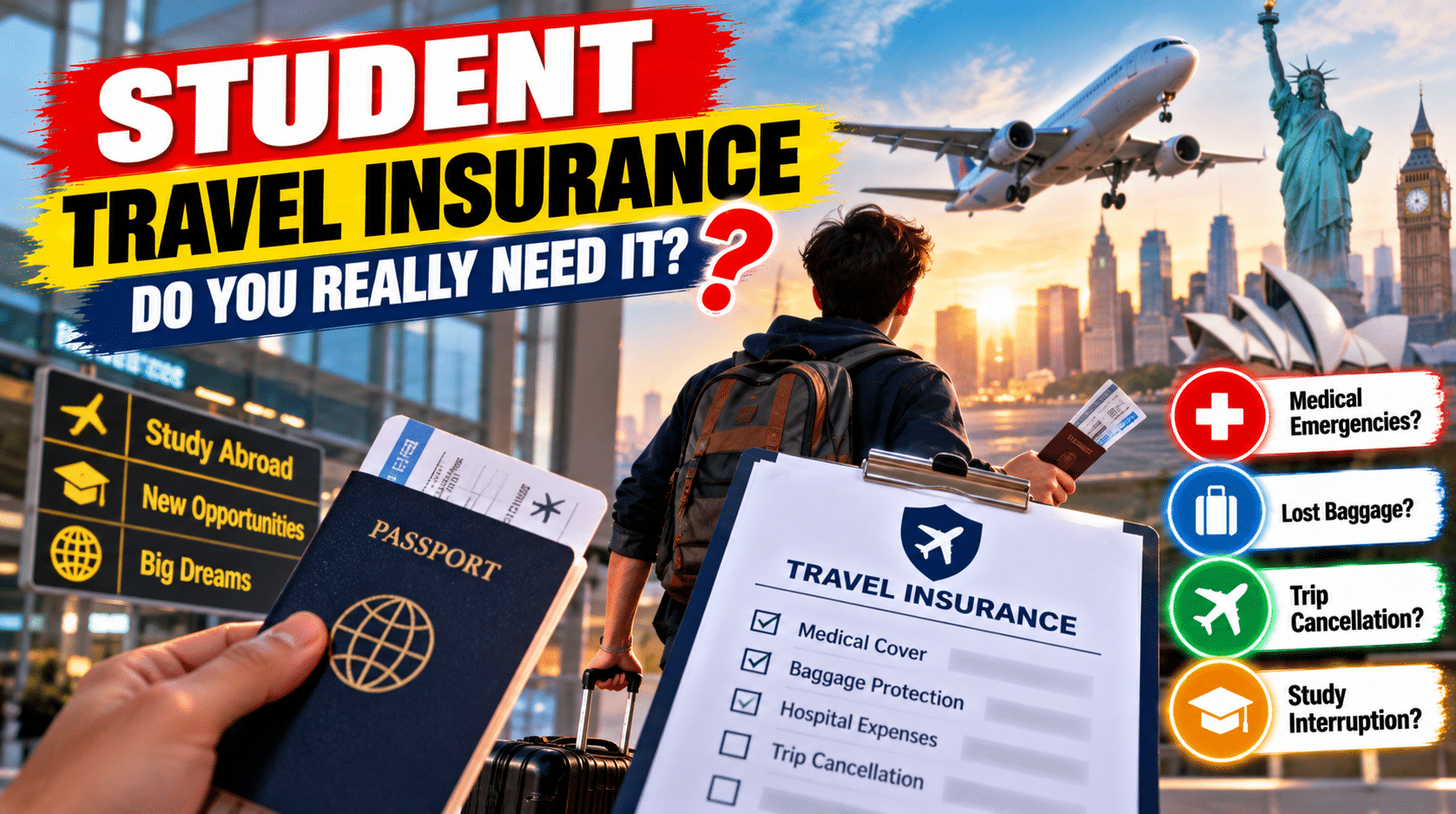
Student Travel Insurance for Studying Abroad: Getting admission to a foreign university is a major milestone. But before packing your bags, booking a flight, and preparing for a new academic life, there is one financial protection step students should not overlook: student travel insurance.
For an international student, an unexpected hospitalisation, accident, lost passport, or baggage problem can quickly turn into a major financial and logistical headache. Medical treatment can also be expensive in many countries.
That is where student travel insurance can help. Depending on the policy, it may provide financial protection for eligible medical expenses and several travel-related emergencies during an overseas study period.
However, there is an important catch: not every student travel insurance policy provides the same benefits. Coverage limits, exclusions, deductibles, pre-existing disease conditions, study interruption benefits, and university requirements can differ significantly.
So before buying the first policy that appears online, students should understand what the insurance actually covers and whether it satisfies the requirements of their university, destination country and visa.
What Is Student Travel Insurance?
Student travel insurance is a specialised form of international travel insurance designed for students travelling outside India for higher education, vocational courses, training programmes or similar academic purposes.
Unlike a short holiday travel policy, a student-oriented plan may be structured around a longer stay and can offer benefits specifically relevant to students.
Depending on the insurer and policy, coverage may include:
- Emergency medical treatment
- Hospitalisation expenses
- Emergency medical evacuation
- Repatriation
- Loss of passport
- Baggage loss or delay
- Personal liability
- Study interruption
- Family visit following certain medical emergencies
- Sponsor protection in specified situations
- Other travel-related emergencies
However, these benefits are not automatically included in every student travel policy. The policy schedule, wording, exclusions, limits and conditions should always be checked before purchase.
Why Do Students Need Travel Insurance Abroad?
Studying in another country means dealing with a different healthcare system, currency, and legal environment.
A problem that might be manageable financially in India could become extremely expensive overseas.
For example, a student could unexpectedly face:
- An accident requiring hospital treatment
- Sudden illness
- Emergency surgery
- Loss of passport
- Delayed or lost baggage
- Flight-related disruption
- Need for emergency evacuation
- A situation requiring a family member to travel overseas
Travel insurance cannot prevent these situations from happening, but suitable coverage can reduce the financial impact of certain eligible events.
The Consumer Affairs guidance on overseas travel insurance for students also highlights medical expenses, study interruption and family visits among the reasons students may consider such protection.
Is Student Travel Insurance Mandatory for Studying Abroad?
This is one of the most important questions students should answer before buying a policy.
There is no single worldwide rule that applies to every international student.
Requirements can vary depending on:
- Country
- University
- Course
- Visa category
- Duration of study
- Local regulations
- University’s own insurance requirements
Some educational institutions require students to maintain specified health or travel insurance coverage before enrolment or during their academic programme.
For example, students travelling to countries such as Australia, Canada, France, Germany or the UK may encounter insurance requirements, but the exact requirements should be checked directly with the university and relevant immigration authorities rather than relying on a generic list.
Always Check the University’s Official Requirements
Before purchasing insurance, look at the university’s official admission or international-student page.
Check:
- Minimum medical coverage
- Required policy duration
- Evacuation requirements
- Repatriation requirements
- Whether an Indian insurer is accepted
- Whether the university requires its own insurance plan
- Whether specific benefits or limits are mandatory
This step can save you from buying a policy that looks comprehensive but does not satisfy the institution’s requirements.
What Does Student Travel Insurance Usually Cover?
The exact coverage depends on the policy, but several benefits are commonly associated with student travel insurance.
1. Emergency Medical Expenses
Medical emergencies are one of the most important reasons students purchase overseas travel insurance.
Depending on the policy, eligible expenses related to illness or accidental injury may be covered up to the specified limit.
This could include certain:
- Hospitalisation expenses
- Doctor consultations
- Emergency treatment
- Diagnostic tests
- Medicines
- Surgery
- Ambulance services
However, exclusions, deductibles, sub-limits and policy conditions can apply.
Never assume that every medical bill will automatically be reimbursed.
2. Emergency Medical Evacuation
Some policies provide emergency evacuation coverage when the insured student needs to be transported to another medical facility because suitable treatment is not available at the current location.
This can be particularly important in countries or locations where specialised treatment may not be easily accessible.
The eligibility and maximum amount payable depend on the policy.
3. Repatriation
Certain travel insurance policies provide repatriation-related benefits in specified circumstances.
This can include arrangements associated with returning the insured person to India following a covered medical emergency or, under applicable policy conditions, repatriation of mortal remains.
Because this is a highly sensitive benefit, students should carefully read the exact wording rather than relying only on a brochure summary.
4. Loss of Passport
Losing a passport in a foreign country can create both financial and logistical problems.
Depending on the policy, eligible expenses associated with obtaining a replacement or dealing with the loss may be covered.
The student may need to provide supporting documentation, and exclusions or limits can apply.
5. Baggage Loss or Delay
Some student travel policies offer protection against specified baggage-related problems.
Depending on the policy, this may include:
- Checked baggage loss
- Baggage delay
- Damage to baggage
- Loss of personal belongings
However, policies generally impose limits on individual items and categories of belongings.
Items such as laptops, mobile phones, cameras, and other valuables may have specific conditions or sub-limits.
Always read these provisions before assuming your entire baggage value is protected.
6. Study Interruption
This is one of the benefits that can be particularly relevant to students.
Some student insurance products may provide a benefit if a covered medical emergency prevents the student from continuing their academic programme.
Depending on the policy, eligible tuition or semester-related expenses may be covered under specified circumstances.
This is not a universal benefit, so students should verify the exact terms before relying on it.
7. Family Visit Benefit
Some student policies may provide assistance or financial coverage for the travel of a family member if the insured student is hospitalised overseas due to a covered medical emergency.
Again, this benefit is subject to conditions such as:
- Minimum hospitalisation period
- Relationship of the visitor
- Maximum travel expense
- Maximum benefit amount
- Geographical conditions
Don’t assume that simply being hospitalised automatically triggers this benefit.
8. Sponsor Protection
Certain student insurance products can provide a benefit related to the death or permanent disability of the student’s financial sponsor.
Depending on the policy, the remaining eligible tuition fees may be covered subject to specified conditions and limits.
This is a policy-specific feature and should be checked carefully before purchase.
9. Personal Liability
Personal liability cover can provide protection if the student becomes legally liable for certain covered third-party injury or property damage situations.
This can be particularly useful for students living independently in a foreign country.
However, liability coverage generally comes with exclusions and conditions, so students should understand exactly what situations qualify.
What Are the Most Important Student Travel Insurance Requirements?
A suitable student travel insurance policy should satisfy two different requirements:
Your university’s requirements + your own financial protection needs.
Before buying, check whether the policy provides the required:
Medical Coverage
Confirm the minimum medical sum insured required by your university or destination.
Hospitalisation Coverage
Check whether emergency hospitalisation is covered and understand the applicable limits.
Medical Evacuation
Some institutions or destinations may require emergency evacuation coverage.
Repatriation
Check whether repatriation-related expenses are included and under what circumstances.
Policy Duration
The insurance period should match the required duration of your overseas stay or academic programme.
Consumer guidance for overseas student travel insurance specifically recommends checking that the policy period matches the student’s stay abroad.
Accepted Insurer
Some universities may have specific requirements regarding the insurer or the country in which the insurance is purchased.
Never assume that every international university will accept every Indian travel insurance policy.
How to Buy Student Travel Insurance Online?
Buying a student travel policy online can be relatively straightforward if you already know your university’s requirements.
Step 1: Confirm the University’s Insurance Requirements
Before comparing policies, find out exactly what your university requires.
Check the official university website or contact the international student office.
Step 2: Choose Your Destination
Insurance requirements and premiums can vary depending on the destination.
Enter the correct country rather than selecting a similar region simply because the premium is lower.
Step 3: Enter Your Travel Dates
Provide the actual departure and return or expected study-period dates requested by the insurer.
For long-term study, make sure the policy period is sufficient for the required academic stay.
Step 4: Enter Your Personal Details
You may need to provide:
- Name
- Date of birth
- Passport details
- Contact information
- Travel details
- Course information
- Destination
- Other information requested by the insurer
Always enter accurate information.
Step 5: Select the Coverage
Compare the available plans based on:
- Medical cover
- Hospitalisation
- Evacuation
- Repatriation
- Baggage protection
- Passport protection
- Study interruption
- Personal liability
- Other relevant benefits
Step 6: Compare the Exclusions
This step is just as important as comparing the benefits.
Look for:
- Pre-existing disease exclusions
- Treatment-related exclusions
- Adventure sports exclusions
- Alcohol-related exclusions
- Self-inflicted injury exclusions
- War-related exclusions
- Unattended baggage conditions
- Other policy-specific exclusions
Step 7: Check Deductibles and Sub-Limits
A policy may have a large overall sum insured but still impose limits on particular benefits.
Check:
- Deductible
- Hospitalisation sub-limits
- Baggage limits
- Individual item limits
- Medical treatment limits
- Dental treatment limits
- Other benefit-specific caps
The Consumer Affairs guidance also recommends checking exclusions, sub-limits and deductibles before choosing overseas student insurance.
Step 8: Pay the Premium
Once you’ve confirmed that the policy satisfies your requirements, pay through the insurer’s authorised online payment channel.
Step 9: Download and Store the Policy
After purchase, save the policy document digitally.
It is also a good idea to keep:
- Policy number
- Insurer contact details
- Emergency assistance number
- Policy PDF
- Passport copy
- University insurance requirements
- Claim instructions
Keep a copy accessible on your phone and another copy in your email or cloud storage.
How Much Does Student Travel Insurance Cost?
There is no single fixed premium for student travel insurance.
The price can depend on:
- Destination
- Age
- Policy duration
- Medical coverage
- Sum insured
- Optional benefits
- Deductibles
- Pre-existing medical conditions
- Other underwriting factors
A longer overseas stay will generally require a longer insurance period, which can affect the premium.
The cheapest plan should not automatically be selected if it fails to meet the university’s requirements or provides inadequate medical protection.
How to Choose the Right Student Travel Insurance?
Instead of asking:
“Which policy is cheapest?”
ask:
“Which policy gives me the protection I actually need at a premium I can afford?”
Use this checklist:
Check the medical coverage
Medical emergencies should be one of the first things you compare.
Match the university requirements
A policy is not useful for admission purposes if it fails the institution’s minimum requirements.
Check evacuation and repatriation
These benefits can become important during serious emergencies.
Review pre-existing conditions
Never assume that an existing medical condition is automatically covered.
Look at deductibles
A lower premium may come with a higher amount payable by you during a claim.
Compare sub-limits
A large headline sum insured does not mean every benefit has the same limit.
Check baggage conditions
Look at the limits for laptops, electronics, and other valuable items.
Understand the claim process
Know how to contact the insurer or assistance provider from abroad.
Check 24/7 assistance
For students living in another country, round-the-clock emergency assistance can be useful.
Read the policy wording
The policy document is more important than a short promotional description.
What About Pre-Existing Diseases?
This is an area students should never ignore.
A pre-existing medical condition may not be covered automatically under a travel insurance policy.
Some products may have specific provisions, exclusions, or limited coverage for certain conditions.
Therefore, if you have an existing medical condition, disclose it accurately when applying.
Do not assume that hiding the condition will make the policy cheaper or easier to obtain.
If you are unsure whether a condition is covered, ask the insurer for clarification before purchasing the policy.
The Consumer Affairs guidance also highlights the importance of checking how pre-existing diseases are treated under overseas travel insurance.
What Documents May Be Needed?
The exact documentation depends on the insurer and claim type.
For buying the policy, you may need information such as:
- Passport
- Travel dates
- University/admission details
- Personal information
- Course details
- Destination information
- Other KYC or application details
For claims, additional documents may be required.
Depending on the situation, these could include:
- Claim form
- Medical reports
- Hospital bills
- Prescriptions
- Passport
- Boarding pass
- Police report/FIR
- Airline documentation
- Proof of baggage loss
- Other supporting records
IRDAI-published travel policy documents show that insurers can require claim forms, travel documents, bills, reports, and other evidence depending on the type of claim.
What Should You Do If You Need Medical Treatment Abroad?
If you experience a medical emergency, your first priority should be getting appropriate medical attention.
After that, follow the insurer’s claim or assistance procedure as soon as reasonably possible.
Depending on the policy, you may need to:
- Contact the insurer’s international assistance provider.
- Provide your policy number.
- Explain the medical emergency.
- Visit an appropriate hospital or medical facility.
- Keep medical records and bills.
- Follow the insurer’s instructions regarding cashless or reimbursement procedures.
- Submit the required documents.
Do not wait until returning to India before checking the claim procedure unless the policy specifically permits it.
Some travel policies require prompt notification of an event that may give rise to a claim.
Cashless Treatment vs Reimbursement
Depending on the insurer and location, medical claims can sometimes be handled through a cashless arrangement at an approved facility.
In other situations, the student may have to pay first and subsequently submit the documents for reimbursement.
The exact process depends on the policy and the insurer’s assistance network.
Before leaving India, save the insurer’s emergency assistance number so you don’t have to search for it during a stressful situation.
Common Mistakes Students Should Avoid
Buying insurance before checking university requirements
This can result in purchasing a policy that doesn’t meet the required coverage.
Choosing the cheapest policy
A low premium should never be the only consideration.
Ignoring medical exclusions
A policy may have significant limitations around certain conditions or treatments.
Not checking policy duration
A policy that ends before the required study period may leave a coverage gap.
Ignoring deductibles
Understand how much you may need to pay yourself during a claim.
Not checking sub-limits
A high overall sum insured doesn’t mean every benefit is unlimited.
Assuming every item in your baggage is fully covered
Electronics and high-value items may have individual limits or conditions.
Forgetting the emergency assistance number
Keep it saved before travelling.
Not carrying the policy document
A digital copy should be accessible even when you are travelling.
Giving incorrect medical information
Always disclose relevant medical information honestly.
Student Travel Insurance Checklist Before Flying Abroad
Before leaving India, make sure you have:
- Valid passport
- Student visa
- University admission documents
- Flight tickets
- Student travel insurance
- Emergency assistance number
- Policy number
- Digital policy copy
- Important medical records
- Prescription details
- Emergency family contacts
- University international office contact
Also check that your policy remains valid from the date required by your university or destination.
Student Travel Insurance vs Regular Travel Insurance
A regular travel policy is generally designed around short-term trips such as holidays or business travel.
Student travel insurance can be structured for longer academic stays and may include student-focused benefits depending on the product.
| Feature | Regular Travel Insurance | Student Travel Insurance |
|---|---|---|
| Typical purpose | Holiday/business travel | Overseas education |
| Policy duration | Usually shorter | Can be longer |
| Medical cover | Usually available | Usually central to the product |
| Study interruption | Generally not a core feature | May be available |
| Family visit benefit | Product-specific | May be available |
| Sponsor protection | Generally not a core feature | May be available |
| Baggage protection | Often available | Often available |
| Personal liability | Product-specific | May be available |
| University requirements | Usually not relevant | Important consideration |
The exact features vary by insurer, so this table should be treated as a broad comparison rather than a universal product definition.
Should Students Buy Insurance From India or Abroad?
This depends on the university and destination requirements.
Some institutions may accept policies purchased from Indian insurers, while others may specify particular insurance arrangements.
Before purchasing, check the university’s official requirements.
If the university mandates a particular insurance provider or requires coverage that an Indian policy cannot satisfy, the student may need to follow the institution’s specified route.
The Consumer Affairs guidance also notes that some universities may not accept policies from insurers outside the destination country.
Final Verdict
Student travel insurance should not be treated as just another document on the overseas education checklist.
For a student living thousands of kilometres away from home, the right policy can provide an important financial safety net against eligible medical emergencies and unexpected travel-related problems.
But the smartest purchase isn’t necessarily the policy with the biggest headline coverage or the lowest premium.
Before buying, check the university’s requirements, medical coverage, evacuation and repatriation benefits, policy duration, exclusions, deductibles, sub-limits, baggage protection and claim procedure.
Most importantly, read the actual policy wording.
A few minutes spent comparing the fine print before leaving India can prevent a much bigger financial surprise after reaching your destination.
Frequently Asked Questions (FAQs)
What is student travel insurance?
Student travel insurance is a type of overseas travel insurance designed for students travelling abroad for higher education, vocational training or similar academic programmes.
Is student travel insurance mandatory for studying abroad?
It depends on the destination, university, course, and visa requirements. Some universities or institutions require students to maintain specified insurance coverage. Always check the official requirements before purchasing a policy.
What does student travel insurance cover?
Depending on the policy, it may cover eligible medical emergencies, hospitalisation, evacuation, repatriation, baggage loss, passport loss, personal liability, and certain student-specific benefits such as study interruption.
Does every student travel policy cover tuition fees?
No. Tuition or semester-fee protection is a policy-specific benefit. Students should check the exact policy wording and eligibility conditions before assuming such expenses are covered.
Does student travel insurance cover pre-existing diseases?
Not necessarily. Coverage for pre-existing diseases depends on the specific policy and its conditions. Students should disclose relevant medical conditions and check the exclusions before buying.
Is medical insurance required for international students?
Some universities, countries, or visa categories may require students to maintain specified health or travel insurance. The exact requirement varies, so students should check the official university and immigration information.
How long should student travel insurance be valid?
The policy duration should meet the requirements of your university and destination. For long-term education, make sure the policy does not expire before the period for which coverage is required.
Can I buy student travel insurance online?
Yes. Many insurers allow students to purchase travel insurance online by entering destination, travel dates, personal information, and desired coverage, reviewing the policy, and paying the premium.
What documents are required to buy student travel insurance?
Requirements vary, but students may need a passport and travel information along with personal and course-related details. The insurer may request additional information depending on the product.
Does student travel insurance cover lost baggage?
Many policies provide baggage-loss or baggage-delay benefits, but the amount payable, exclusions, and limits vary. High-value items can also have specific sub-limits.
Does student travel insurance cover a lost passport?
Some policies provide a benefit for loss of passport, subject to the policy’s conditions, limits and documentation requirements.
What is emergency medical evacuation?
It refers to transportation arranged in an eligible medical emergency when the insured student needs to be moved to an appropriate medical facility, subject to the policy terms.
What is repatriation in travel insurance?
Repatriation generally refers to arrangements for returning the insured person to their home country under specified circumstances. The exact benefit depends on the policy wording.
What is a deductible in student travel insurance?
A deductible is the amount the insured may have to bear themselves for an eligible claim before the insurer pays the remaining admissible amount, according to the policy terms.
Is cashless treatment available abroad?
Some insurers may provide cashless treatment through their assistance network or approved medical facilities. Availability depends on the insurer, destination, hospital, and policy terms.
What should I do if I get sick abroad?
Seek appropriate medical attention first and contact the insurer or its emergency assistance provider as soon as reasonably possible. Keep medical records, prescriptions and bills because they may be required for the claim.
Can a family member travel to see me if I am hospitalised abroad?
Some student insurance products provide a family-visit benefit in specified circumstances. This is not universal and may require minimum hospitalisation periods and other conditions.
Does student travel insurance cover study interruption?
Some policies may provide study-interruption benefits if a covered event prevents the student from continuing their course. The benefit, eligibility and amount vary by policy.
How much does student travel insurance cost?
The premium depends on factors such as destination, age, policy duration, medical coverage, sum insured, selected benefits and other underwriting factors.
Is the cheapest student travel insurance the best option?
No. The cheapest policy may not satisfy the university’s requirements or provide sufficient medical and emergency protection. Compare coverage, exclusions, limits, and deductibles along with the premium.
What should I check before buying student travel insurance?
At minimum, check:
- University requirements
- Destination requirements
- Medical sum insured
- Hospitalisation coverage
- Emergency evacuation
- Repatriation
- Policy duration
- Pre-existing disease conditions
- Deductibles
- Sub-limits
- Baggage coverage
- Personal liability
- Claim procedure
- Emergency assistance availability
Should I carry a physical copy of my insurance policy?
It is useful to carry a physical copy as well as a digital copy. Also save the emergency assistance number and policy number on your phone.