
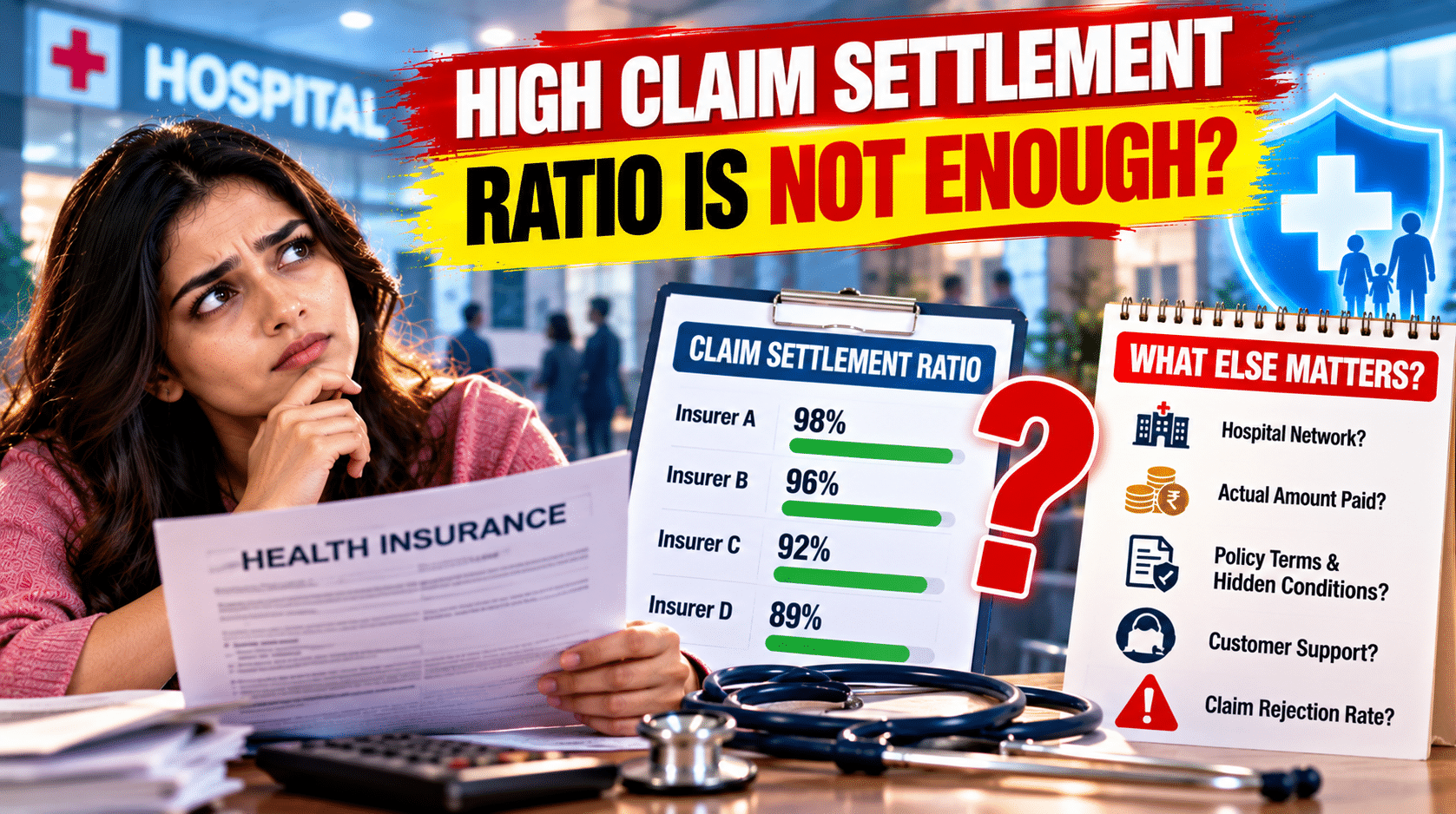
Health Insurance Claim Settlement Ratio: Imagine comparing two health insurance companies. One advertises an impressive claim settlement ratio, while the other has a slightly lower figure. At first glance, the first insurer may appear to be the obvious choice.
But what if the first company settles a large number of smaller claims while customers face disputes over deductions, delays, or substantial hospital bills? What if the second company offers a smoother claims process and has hospitals you can conveniently access?
This is why choosing health insurance based on a single percentage can be misleading.
A September 19, 2026, Business Today report highlighted an important point discussed by Aditya Shah, founder of Hercules Advisors: claim settlement ratios do not necessarily reveal the actual amount paid against claims. The discussion also emphasised complaint data, incurred claims ratios, customer feedback, rejection practices, and the importance of a reliable insurance adviser.
For buyers, the lesson is simple: the right health insurer is not necessarily the company with the most impressive headline number. It is the company whose coverage, claim practices, and service are suitable for your needs.
Here is what you should examine before choosing a policy.
What Is a Health Insurance Claim Settlement Ratio?
The claim settlement ratio, or CSR, is a measure used to understand an insurer’s claim-handling performance. It generally expresses the proportion of claims settled relative to a specified number of claims received or considered during a reporting period.
However, the precise definition and calculation matter. Some figures are based on the number of claims, while others examine the amount involved. The reporting period and the way pending, rejected, or partially paid claims are treated can also affect comparisons.
For example, consider a hypothetical insurer that receives 1,000 claims and settles 950 during a reporting period. Its simple settlement proportion would be 95% if calculated using those figures.
That sounds reassuring, but the percentage alone does not tell you:
- How much money was paid against the total amount claimed.
- Whether some claims were only partially settled.
- How long customers waited for a decision.
- How many complaints customers raised.
- Whether cashless treatment was accessible at nearby hospitals.
- Whether customers experienced repeated documentation problems.
A high ratio can be a useful positive signal, but it should not be treated as a guarantee that your particular claim will be approved or paid in full.
Why a High Claim Settlement Ratio May Not Tell the Whole Story
The problem is not that claim settlement ratios are useless. It is that they answer only one part of a much bigger question.
1. The number of claims settled is not the same as the amount paid
This is one of the most important distinctions for health insurance buyers.
Suppose two insurers both report a 95% claim settlement ratio based on claim count. That does not automatically mean they have paid 95% of the total amount customers claimed.
One insurer may settle most claims in full, while another may settle many claims but make substantial deductions on some of them. Their count-based ratios could look similar even though the amount paid relative to the amount claimed differs.
Consider this simplified illustration:
| Hypothetical measure | Insurer A | Insurer B |
|---|---|---|
| Claims received | 1,000 | 1,000 |
| Claims settled | 950 | 950 |
| Settlement ratio by count | 95% | 95% |
| Total amount claimed | ₹10 crore | ₹10 crore |
| Amount paid | ₹9 crore | ₹7 crore |
| Amount paid as a share of amount claimed | 90% | 70% |
Illustration only. These figures are hypothetical and do not represent actual insurance companies or industry averages.
Both insurers have the same count-based settlement ratio in this example, but the amounts paid are different. The illustration shows why consumers should look for reliable amount-based information where available.
It also does not mean that every difference between the amount claimed and the amount paid is unfair. Deductibles, co-payments, sub-limits, exclusions, and other valid policy conditions may affect the final settlement.
The key is to understand why the amount was reduced.
2. A settled claim may still involve a dispute
The word “settled” can sound reassuring, but it does not always mean the policyholder received the entire amount expected.
A claim might be paid after applying a deductible or co-payment, or after excluding expenses that are not covered by the policy. In other cases, the customer may dispute whether a deduction was justified.
This is why buyers should understand how the insurer defines a settled claim and whether its public disclosures distinguish fully paid claims from partially paid claims and rejected claims.
Before purchasing a policy, read the terms that determine how much you may need to pay from your own pocket during hospitalisation.
3. Complaint levels can reveal service problems
An insurer’s claim settlement ratio does not directly measure how many customers complain about its service.
Complaint data can provide a different perspective. For instance, recurring complaints about delayed processing, disputed deductions, cashless authorisation or unclear communication may indicate issues that deserve closer investigation.
However, complaint figures also need context. A large insurer may receive more complaints simply because it handles a much larger number of policies and claims.
Where possible, compare complaints relative to the insurer’s business volume or claims handled, rather than looking only at the raw total.
Also check what the complaints concern. A complaint about a delayed response is not identical to a complaint about a rejected claim, and the final resolution matters.
4. The claim rejection picture deserves attention
A high settlement ratio does not automatically tell you how many claims were rejected, why they were rejected, or whether the decisions were disputed.
Before choosing an insurer, look for available information about repudiated or rejected claims, pending claims, and the reasons customers encounter difficulties.
Be careful not to interpret every rejection as evidence of unfair treatment. Insurers may legitimately reject claims that fall outside the policy’s coverage or fail to meet applicable conditions.
What matters is whether the policy wording is clear, the decision is supported by the facts, and the insurer follows the applicable rules.
5. The hospital network matters when you need treatment
Even an insurer with a strong claims track record may not be the best fit if its cashless hospital network is inconvenient for your family.
Check whether the insurer has suitable network hospitals near your home and in places you frequently visit. Consider the quality and accessibility of those facilities, not just the total number advertised.
Also remember that a hospital being part of a network does not guarantee cashless approval for every treatment. Authorisation, policy terms, and the circumstances of the claim still matter.
Before buying, verify the current network list and ask how cashless claims are handled at your preferred hospitals.
6. Customer support can make a stressful situation easier—or harder
A hospitalisation is already difficult for a family. Confusing instructions, repeated requests for documents or difficulty reaching the insurer can make the experience more stressful.
Customer reviews can help identify recurring service concerns, but individual online reviews should not be treated as conclusive evidence. Look for patterns across multiple sources and consider how recent and relevant the feedback is.
You should also check whether the insurer provides clear claims guidance, accessible support channels, and a formal grievance redressal process.
Six Factors to Compare Before Choosing a Health Insurance Company
Instead of selecting a policy based on one percentage, use a broader checklist.
| Factor | What to examine | Why it matters |
|---|---|---|
| Claim settlement ratio | Calculation method and reporting period | Provides one measure of claim outcomes |
| Amount-based settlement data | Amount claimed compared with amount paid, where disclosed | Helps explain the financial side of claim performance |
| Complaints | Number, type, rate and resolution of complaints | Offers insight into customer disputes and service issues |
| Rejections and pending claims | Available data on rejected, repudiated and outstanding claims | Helps you understand the wider claims picture |
| Hospital network | Current network hospitals in your area | Affects convenience when seeking cashless treatment |
| Policy wording and support | Exclusions, waiting periods, limits, co-payments and service channels | Determines what is covered and how the claims process may work |
No single factor should decide your purchase. Look at the overall picture, and make sure the policy provides the coverage your family actually needs.
What Is the Incurred Claims Ratio, and Should You Check It?
The incurred claims ratio, often abbreviated as ICR, is another metric consumers may encounter when researching health insurers.
Broadly, it compares claims incurred by an insurer with the premiums earned over a specified period, subject to the applicable reporting definition.
It can help provide context about the relationship between premiums and claims costs. However, it is not a direct measure of customer satisfaction or the probability that your individual claim will be approved.
An unusually high or low figure should not automatically be treated as proof that an insurer is good or bad. Differences in business mix, pricing, product design and other factors may affect the ratio.
Use ICR alongside claim outcomes, complaints, policy terms and service information. Do not use it as a substitute for examining the policy itself.
How to Choose the Right Health Insurance Policy for Your Family
Once you have reviewed an insurer’s track record, turn your attention to the actual policy.
Choose adequate coverage
Consider medical costs in your city, your family’s needs, and the potential cost of major hospitalisation. A policy with a low premium may not be suitable if its coverage is insufficient for the expenses you want to protect against.
Read exclusions and waiting periods
Check which treatments and conditions are covered, which are excluded, and whether waiting periods apply. Pay particular attention to any restrictions that could affect a treatment you may need.
Understand co-payments, deductibles and sub-limits
These provisions can change the amount you must pay yourself.
- Co-payment: A specified share of eligible expenses that you must pay.
- Deductible: An amount you must bear before the insurer pays under the applicable terms.
- Sub-limit: A cap on payment for a particular expense or category of treatment.
The precise effect depends on the wording of your policy. Do not compare premiums without checking these provisions.
Check the cashless process
Confirm the current network hospital list and ask what happens if cashless authorisation is delayed or not available. Keep the insurer’s claims contact details accessible.
Disclose medical information accurately
Provide complete and accurate information when applying for insurance. Do not hide medical history or other information requested by the insurer. Incorrect or incomplete disclosures can create serious problems when a claim is made.
Compare the complete policy, not just the price
A cheaper policy is not necessarily better value. Compare coverage, exclusions, limits, waiting periods, renewal conditions, claim service, and the premium together.
Is a Health Insurance Agent Still Useful?
A knowledgeable insurance adviser can help explain policy terms, compare options, and guide you through the application or claims process. That can be especially valuable if you are buying health insurance for the first time.
However, do not rely entirely on verbal assurances. Ask for important explanations in writing and verify them against the official policy wording.
Before purchasing, make sure the adviser explains exclusions, waiting periods, co-payments, and sub-limits—not only the benefits highlighted in promotional material.
You should also understand whom to contact directly if a claim is delayed or disputed. Your access to claim support should not depend solely on the continued availability of one agent.
Why Insurance Claim Disclosures May Become More Important?
The debate over claim settlement ratios is also part of a wider conversation about transparency in India’s insurance industry.
A September 29, 2026, Moneycontrol report discussed IRDAI proposals aimed at standardising how insurers disclose claim performance. The report highlighted concerns that different calculation methods can make insurer comparisons difficult and that a count-based ratio may not fully reflect the amounts paid, pending claims, or rejected claims.
For consumers, clearer and more consistent disclosures could make it easier to compare insurers on a like-for-like basis.
Until information is presented in a way that makes meaningful comparisons straightforward, buyers should check the definitions behind published figures, the period covered, and the source of the data.
Do not compare two percentages blindly if they have been calculated differently.
Final Verdict: Look Beyond the Headline Percentage
A high health insurance claim settlement ratio can be a useful sign, but it should never be treated as a guarantee of a smooth or fully paid claim.
The better approach is to combine claim performance data with complaint trends, available amount-based settlement information, rejection practices, hospital access, customer support, and the actual terms of the policy.
Most importantly, choose coverage that fits your family’s needs and understand the conditions before you sign up. Health insurance is meant to reduce financial uncertainty during a medical emergency. The more carefully you evaluate the insurer and the policy beforehand, the better prepared you will be when you need that protection.
Frequently Asked Questions (FAQs)
1. Is a high health insurance claim settlement ratio always better?
A high ratio can be a positive indicator, but it does not tell the entire story. You should also review complaint data, available information about amounts paid and rejected claims, hospital access, policy conditions, and customer service.
2. What does a 95% claim settlement ratio mean?
Its meaning depends on the insurer’s calculation method. If it is calculated by claim count, it generally indicates that 95% of the claims included in the relevant calculation were settled. It does not necessarily mean that the insurer paid 95% of the total money claimed.
3. What is the difference between claim settlement ratio and amount-based settlement ratio?
A count-based ratio focuses on the number of claims settled relative to a specified number of claims. An amount-based measure examines the money paid compared with the amount claimed, using the relevant reporting definition. They answer different questions and should not be treated as interchangeable.
4. What is the incurred claims ratio in health insurance?
The incurred claims ratio compares claims incurred with premiums earned over a specified period, subject to the applicable definition. It provides information about claims costs relative to premium income but does not directly measure customer satisfaction or guarantee claim approval.
5. How can I check an insurer’s complaint record?
Review the insurer’s public disclosures and relevant IRDAI publications, where available. Look at the type and rate of complaints, the reporting period, and whether the figures are comparable with those of other insurers. Consider complaint resolution information as well as the total number of complaints.
6. Does a high claim settlement ratio guarantee cashless hospitalisation?
No. Cashless treatment depends on factors such as the hospital’s current network status, policy coverage, applicable conditions, and claim authorisation. Always verify the hospital network and understand the insurer’s cashless process before treatment.
7. Should I choose health insurance with the lowest premium?
Not necessarily. A lower premium may come with restrictions, lower coverage, co-payments, deductibles, or sub-limits. Compare the complete policy and choose coverage that fits your needs and budget.
8. Where can I complain if my health insurance claim is wrongly rejected?
Start by submitting a written grievance to your insurer through its official grievance redressal channel. If the issue remains unresolved, you can explore the appropriate IRDAI grievance channel or Insurance Ombudsman process, subject to the applicable rules and eligibility requirements.
Disclaimer: This article is for general information and consumer awareness, not individual insurance or financial advice. Claim metrics can use different definitions and reporting periods. Verify the latest official disclosures and policy wording before making an insurance decision.