
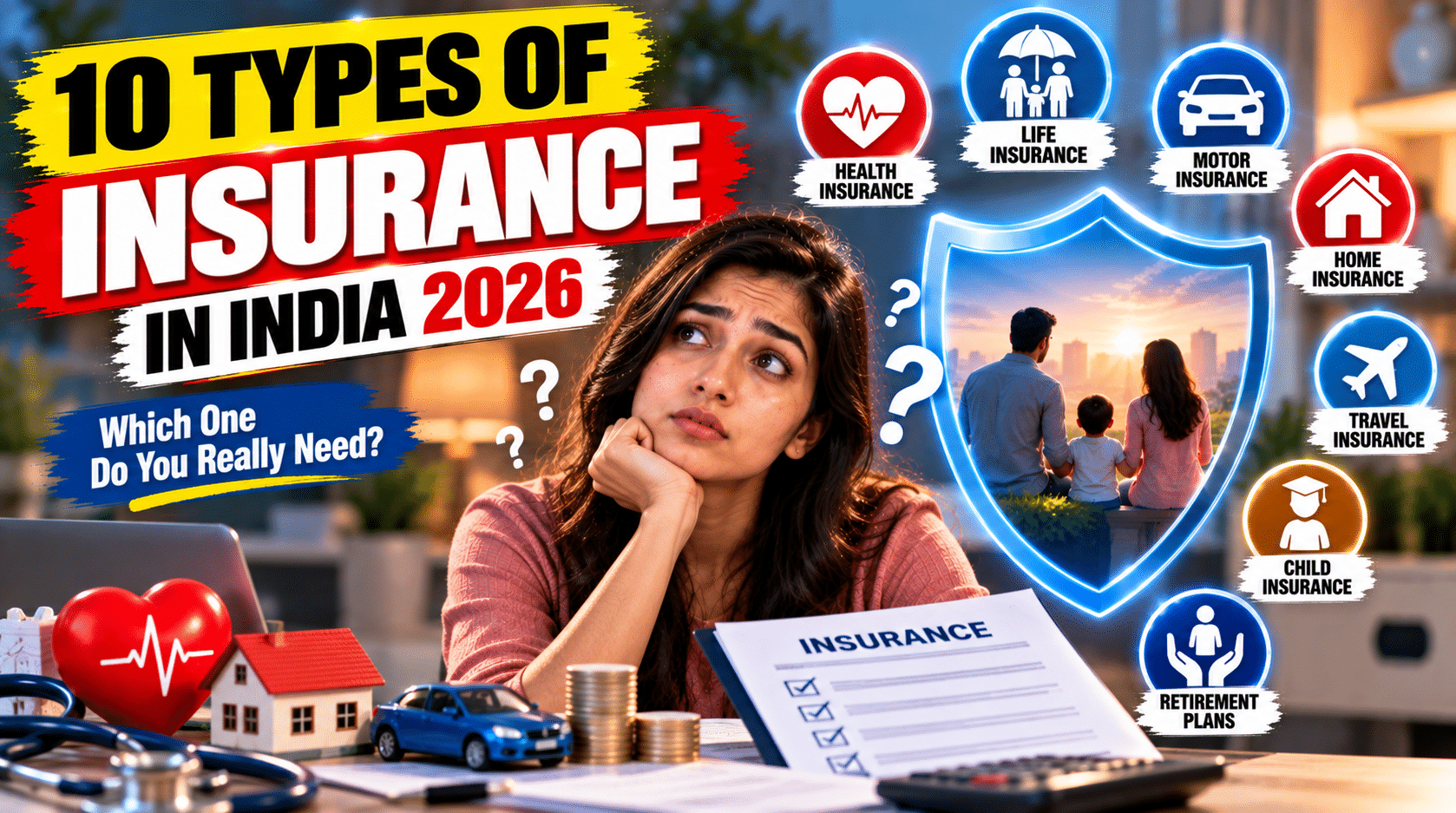
10 Types of Insurance In India: Insurance is one of those financial decisions that most people think about only after something goes wrong. A sudden hospital bill, a major car accident, damage to a home, or the loss of the family’s primary earner can turn into a serious financial problem within days.
That is where the right insurance policy can make a major difference.
But insurance is not a single product. There are different types of insurance designed for different risks and financial goals. Some policies protect your health and assets, while others provide financial support to your family or help you build long-term savings.
In India, insurance is broadly divided into life insurance and general insurance, with several products falling under these categories. The right choice depends on what you want to protect, your financial responsibilities, your age, and your long-term goals.
What Is Insurance and Why Do You Need It?
Insurance is essentially a financial protection arrangement. You pay a premium to an insurer, and in return, the insurer provides coverage against specified risks according to the terms and conditions of the policy.
The purpose is not simply to “get money back.” The bigger objective is to prevent an unexpected financial event from seriously damaging your savings, income, or family’s financial plans.
For example:
- Health insurance can help manage eligible medical expenses.
- Motor insurance can cover specified vehicle-related losses and third-party liabilities.
- Home insurance can protect against covered damage to property and belongings.
- Life insurance can provide a death benefit to the nominee.
- Travel insurance can provide protection against certain medical and travel-related emergencies.
The important point is that every insurance policy has its own coverage, exclusions, limits and conditions. So buying a policy only because the premium looks cheap can be a costly mistake.
Main Types of Insurance in India
The broad insurance landscape can be divided into two major categories:
- General Insurance
- Life Insurance
General insurance primarily deals with non-life risks such as health, vehicles, property, and travel. Life insurance focuses on financial protection related to the life of the insured and may also include savings, investment, or retirement-related features depending on the product.
Let’s understand the major types one by one.
1. Health Insurance
Health insurance is designed to reduce the financial burden arising from eligible medical treatment and healthcare expenses.
Depending on the policy, coverage may include hospitalization, surgeries, treatment expenses, and other specified medical costs. Some policies may also provide benefits for critical illnesses, preventive care, or other healthcare services.
Why Health Insurance Matters
Medical treatment can become expensive quickly, particularly when hospitalization or major surgery is involved. Having adequate health insurance can prevent you from having to use a large portion of your savings for a covered medical event.
When comparing plans, don’t look at the premium alone. Check:
- Sum insured
- Network hospitals
- Cashless facility
- Waiting periods
- Pre-existing disease conditions
- Room-rent limits
- Co-payment
- Exclusions
- Sub-limits
- Restoration benefits
A policy with a low premium may not necessarily provide the most useful protection.
2. Motor Insurance
Motor insurance is designed to protect vehicle owners against specified risks involving cars, bikes, and other insured vehicles.
Third-party motor insurance is mandatory for vehicles used on public roads in India. Beyond mandatory liability protection, vehicle owners can also consider broader own-damage or comprehensive coverage depending on their needs.
Major Types of Motor Insurance
Third-party insurance:
Primarily protects against covered legal liabilities arising from injury, death, or property damage caused to a third party.
Comprehensive/package coverage:
Generally combines third-party liability protection with own-damage protection, subject to the policy’s terms, exclusions and deductibles.
A comprehensive policy may provide protection against risks such as accidents, theft and certain natural or man-made events, depending on the selected coverage.
Before buying, compare the IDV, deductible, add-ons, exclusions, claim process, and network garage availability rather than choosing purely on price.
3. Home Insurance
Your home may be one of the biggest assets you ever own, but many homeowners underestimate the financial impact of damage caused by fire, natural disasters, or other covered events.
Home insurance can provide financial protection for the structure of a house and, depending on the policy, its contents as well.
Coverage can vary, but policies may protect against risks such as:
- Fire
- Theft
- Certain natural calamities
- Earthquake, where covered
- Damage to household contents
- Certain alternative accommodation expenses
The exact protection depends entirely on the policy wording.
What Should You Check?
Before buying home insurance, understand whether you are insuring only the building, household contents, or both. Also check the sum insured, exclusions, deductibles, and claim requirements.
4. Travel Insurance
A holiday or business trip can quickly become expensive if an unexpected medical emergency, flight disruption, or baggage problem occurs.
Travel insurance is designed to provide financial protection against specified risks during a trip.
Depending on the plan, it may cover:
- Emergency medical expenses
- Trip cancellation or interruption
- Lost or delayed baggage
- Missed connections
- Emergency evacuation
- Repatriation in eligible circumstances
International travellers should pay particular attention to medical coverage because healthcare costs can be extremely high in some countries.
Frequent travellers may also compare annual multi-trip policies with individual-trip plans, depending on how often they travel.
5. Term Life Insurance
Term insurance is one of the simplest forms of life insurance.
You pay a premium for a selected policy term. If the insured person dies during the policy period and the claim is payable under the policy terms, the nominee receives the applicable death benefit.
The major attraction is that term insurance can provide a relatively large amount of life cover for a comparatively lower premium than many savings-oriented life insurance products.
Who May Need Term Insurance?
It can be particularly relevant for:
- Young earners
- Married individuals
- Parents
- Primary income earners
- People with home or other loans
- Families dependent on one person’s income
The objective is mainly income protection and financial security, rather than investment returns.
6. Whole Life Insurance
Whole life insurance is designed to provide life cover for a much longer period, potentially for the insured’s lifetime, subject to the policy’s terms and premium payments.
Some whole-life products may also have savings or cash-value-related features.
Why Consider Whole Life Insurance?
It may be relevant for people looking at:
- Long-term family protection
- Legacy planning
- Estate-related goals
- Lifelong financial protection
However, whole-life policies can be more expensive than pure term insurance. Buyers should therefore understand exactly what benefits they are receiving for the additional premium.
7. Endowment Plans
Endowment insurance combines life protection with a savings component.
Generally, the policy provides a death benefit if the insured dies during the policy term. If the insured survives until maturity, the policy may provide a maturity benefit according to its terms.
These plans may appeal to people who prefer structured, long-term savings along with life insurance.
Endowment Plans May Suit People Looking For:
- Disciplined long-term savings
- Life protection
- A defined financial goal
- A maturity benefit
- Lower exposure to direct market-linked investment products
However, buyers should carefully check guaranteed benefits, non-guaranteed benefits, bonuses, surrender terms, and the actual return profile before purchasing.
8. Unit Linked Insurance Plans (ULIPs)
ULIPs combine life insurance with market-linked investment.
A portion of the premium is allocated towards the insurance component, and the remaining amount is invested in selected funds, depending on the product structure.
Depending on the policy, investors may have exposure to equity, debt, or other available fund options.
Who Should Consider a ULIP?
ULIPs may be relevant for individuals who:
- Have a long investment horizon
- Understand market-linked risks
- Want insurance and investment within one product
- Are comfortable with fluctuations in investment value
- Have specific long-term financial goals
Unlike traditional guaranteed products, market-linked returns are not fixed. Therefore, investors should understand charges, lock-in provisions, fund choices, and risk before investing.
9. Child Insurance Plans
Parents often want to make sure that their children’s education and other important milestones remain financially protected even if something unexpected happens.
Child-focused insurance products are designed around these long-term goals. Depending on the product, benefits may be paid at predetermined stages, while certain plans can include features designed to protect the child’s financial goals if the parent or policyholder dies.
Why Parents Consider Child Plans
These plans may help with:
- Higher education
- Future financial milestones
- Long-term savings
- Structured financial planning
However, parents should compare child insurance products with other ways of building an education corpus rather than choosing a policy solely because it is marketed for children.
10. Pension and Retirement Plans
Retirement planning becomes increasingly important as people move through their working years.
Pension or retirement-oriented insurance products are designed to help build financial resources for the post-working phase. Depending on the product, the accumulated corpus may eventually support regular income through annuity or other retirement benefits.
Why Retirement Insurance Can Matter
A retirement plan can help you prepare for:
- Monthly post-retirement expenses
- Healthcare costs
- Lifestyle expenses
- Financial independence
- A predictable income stream
The biggest advantage of starting retirement planning early is that you have more time to build the required corpus.
Other Types of Insurance You Should Know About
The insurance market is much wider than the 10 categories discussed above.
Depending on the risk and industry, people and businesses may also use:
Crop Insurance
Designed to provide financial protection to farmers against specified agricultural risks and losses.
Marine Insurance
Used to cover certain risks associated with cargo, goods and marine transportation.
Liability Insurance
Can protect businesses and professionals against specified legal liabilities arising from covered events or claims.
These products are usually more specialised and should be selected according to the specific risk involved.
Life Insurance vs General Insurance: What’s the Difference?
| Feature | Life Insurance | General Insurance |
|---|---|---|
| Main purpose | Life and financial protection | Protection against non-life risks |
| Typical examples | Term, whole life, ULIP, endowment | Health, motor, home, travel |
| Coverage | Often long-term | Frequently short-term/renewable |
| Main beneficiary | Nominee/dependents in applicable claims | Insured/policyholder or third party, depending on policy |
| Common objective | Family protection, savings, or retirement | Managing specific financial risks |
The distinction is simple: life insurance primarily addresses risks related to a person’s life, while general insurance covers specified non-life risks.
How to Choose the Right Insurance Policy
Buying insurance should begin with the risk you are trying to protect—not with the policy advertisement.
1. Identify Your Biggest Financial Risks
Ask yourself:
- What would happen to my family if I were no longer earning?
- Could I afford a major hospital bill from my savings?
- What would happen if my car were badly damaged?
- Is my home financially protected?
- Do I travel frequently?
Your answers can help determine which type of insurance deserves priority.
2. Don’t Compare Premiums Alone
Two policies can have very different premiums because their coverage, limits, deductibles, exclusions, and benefits may differ.
Always compare the actual protection you receive for the premium.
3. Read the Policy Documents
This is one of the most important steps.
Look for:
- Coverage
- Exclusions
- Waiting periods
- Deductibles
- Claim conditions
- Renewal terms
- Surrender rules
- Policy duration
- Premium payment requirements
The brochure may give you the highlights, but the policy document determines the contractual terms.
4. Choose Adequate Coverage
Underinsurance can defeat the purpose of buying insurance.
For life insurance, consider your income, loans, dependents, future expenses, and financial goals before deciding the sum assured.
For health insurance, consider healthcare costs, age, family size, existing medical conditions, and the possibility of medical inflation.
5. Review Insurance as Your Life Changes
Your insurance requirements at 25 may not be the same at 35 or 45.
Marriage, children, a home loan, a higher income, new assets or retirement planning can all change the amount and type of protection you need.
Review your insurance portfolio periodically rather than buying a policy once and forgetting about it.
Which Insurance Should You Prioritise First?
There is no universal answer because every household has different financial responsibilities.
For many working individuals, a sensible starting point is to consider:
Health protection + adequate life protection + mandatory motor cover where applicable.
Home insurance, travel insurance, retirement products and other specialised covers can then be considered according to your circumstances.
The important thing is to build insurance around your actual risks instead of buying multiple policies simply because they are available.
Final Verdict
Insurance should not be treated as just another financial product.
The real value of insurance becomes visible when an unexpected event threatens to wipe out years of savings or disrupt a family’s financial future.
From health and motor insurance to term plans, ULIPs, endowment policies, and retirement solutions, each type serves a different purpose. There is no single policy that is automatically right for everyone.
The smarter approach is to first identify the risk, calculate how much financial protection you need, compare suitable policies, and then read the exclusions and conditions carefully before buying.
And remember: the cheapest insurance policy is not necessarily the best policy—the right policy is the one that provides meaningful protection when you actually need it.
Frequently Asked Questions (FAQs)
What are the two main types of insurance in India?
Insurance is broadly divided into life insurance and general insurance. Life insurance focuses on risks associated with a person’s life, while general insurance covers non-life risks such as health, vehicles, property, and travel.
What are the 10 major types of insurance?
Major types include health insurance, motor insurance, home insurance, travel insurance, term insurance, whole life insurance, endowment plans, ULIPs, child plans and pension or retirement plans.
Which type of insurance is best for family protection?
For pure income protection, term insurance is generally the most straightforward option. The appropriate cover depends on income, dependents, loans, and long-term financial obligations.
Is health insurance different from life insurance?
Yes. Health insurance primarily provides coverage for eligible healthcare-related expenses according to the policy, while life insurance can provide a death benefit to the nominee if the insured dies under covered policy conditions.
Is motor insurance mandatory in India?
Third-party motor insurance is mandatory for vehicles being used on public roads in India. Broader own-damage or comprehensive coverage is optional depending on the vehicle owner’s requirements and policy terms.
What is the difference between term insurance and whole life insurance?
Term insurance generally provides life cover for a specified period. Whole life insurance is designed for much longer-duration protection and may include savings or cash-value-related features depending on the product.
Are ULIPs insurance or investment products?
ULIPs are life insurance products that combine insurance protection with market-linked investment. Their investment component is exposed to market performance, so returns are not the same as those of a guaranteed savings product.
What is an endowment insurance plan?
An endowment plan combines life insurance with a savings component. Depending on the policy, the nominee may receive a death benefit during the term, while survival to maturity can result in a maturity benefit according to the policy terms.
Are child insurance plans necessary for every parent?
Not necessarily. Child plans are one way to plan for future education and other milestones, but parents should compare them with other investment and savings options based on their goals, risk tolerance, and financial situation.
What are pension or retirement insurance plans?
These are products designed to help individuals build financial resources for retirement and potentially generate income after they stop working. The exact benefits depend on the product structure.
Can one person have more than one insurance policy?
Yes, a person can have multiple insurance policies, subject to the applicable rules and policy terms. For example, someone may have health insurance, life insurance, motor insurance, and travel insurance simultaneously.
What is double insurance?
Double insurance generally refers to a situation where the same asset or risk is covered under more than one insurance policy. Whether multiple policies can respond to the same loss depends on the nature of the insurance and applicable policy conditions.
What is reinsurance?
Reinsurance is an arrangement in which an insurance company transfers part of its risk to another insurer, known as the reinsurer. It helps insurers manage large or accumulated risks.
How much life insurance should I buy?
There is no universal number. Consider your annual income, outstanding loans, number of dependents, children’s future expenses, existing investments, and the income your family would need if you were no longer around.
What should I check before buying an insurance policy?
At minimum, compare the coverage, premium, exclusions, deductibles, waiting periods where applicable, claim process, policy duration, renewal conditions, and insurer’s service record. Never make a decision based only on the advertised premium.
Is buying insurance online safe?
Buying insurance online can be convenient, but always use the insurer’s official website or a reputable regulated intermediary. Verify the policy details, premium, coverage, exclusions, and payment information before completing the purchase.
Does insurance guarantee that every claim will be paid?
No. A claim is assessed according to the policy’s terms, conditions, exclusions, and applicable documentation. This is why understanding the policy wording before buying is so important.