

Cozy Window Nook Ideas: There’s almost always one spot in a house that gets overlooked — the strip of floor under a window, the awkward gap beside a radiator, the deep sill in an old bay window that’s currently home to a stray plant and a stack of mail. It’s not quite big enough to be a room. It’s not quite small enough to ignore. And most of the time, it just sits there collecting clutter instead of doing anything for you.
That’s a shame, because window nooks are some of the most rewarding spaces to fix in an entire house. They don’t need a renovation budget. They need a comfortable seat, a few soft layers, and lighting that actually works once the sun goes down. Do those three things well, and that forgotten patch of floor turns into the place you drink your coffee, finish a chapter, or just sit for ten quiet minutes before the day gets loud.
This guide walks through real, workable cozy window nook ideas — for homeowners with a built-in bay window and for renters who can’t drill a single hole in the wall. Some ideas take a weekend. Others take an afternoon and a trip to a home goods store. All of them are meant to be lived in, not just photographed.
Why a Window Nook Can Change the Feel of a Room
Natural light does something furniture placement alone can’t. A chair pulled up to a window catches morning light in a way the same chair three feet back never will. There’s a reason window seats show up again and again in old farmhouses, Craftsman bungalows, and prewar apartments — people have always known that the spot closest to the glass is the one worth sitting in.
A window nook also gives a room a sense of purpose it might be missing. A living room with furniture pushed against every wall can feel like it’s arranged for traffic flow rather than for people. Pulling one corner toward the window and turning it into a dedicated little retreat breaks that up. It gives your eye somewhere to land, and it gives you somewhere to actually go when you want five minutes to yourself.
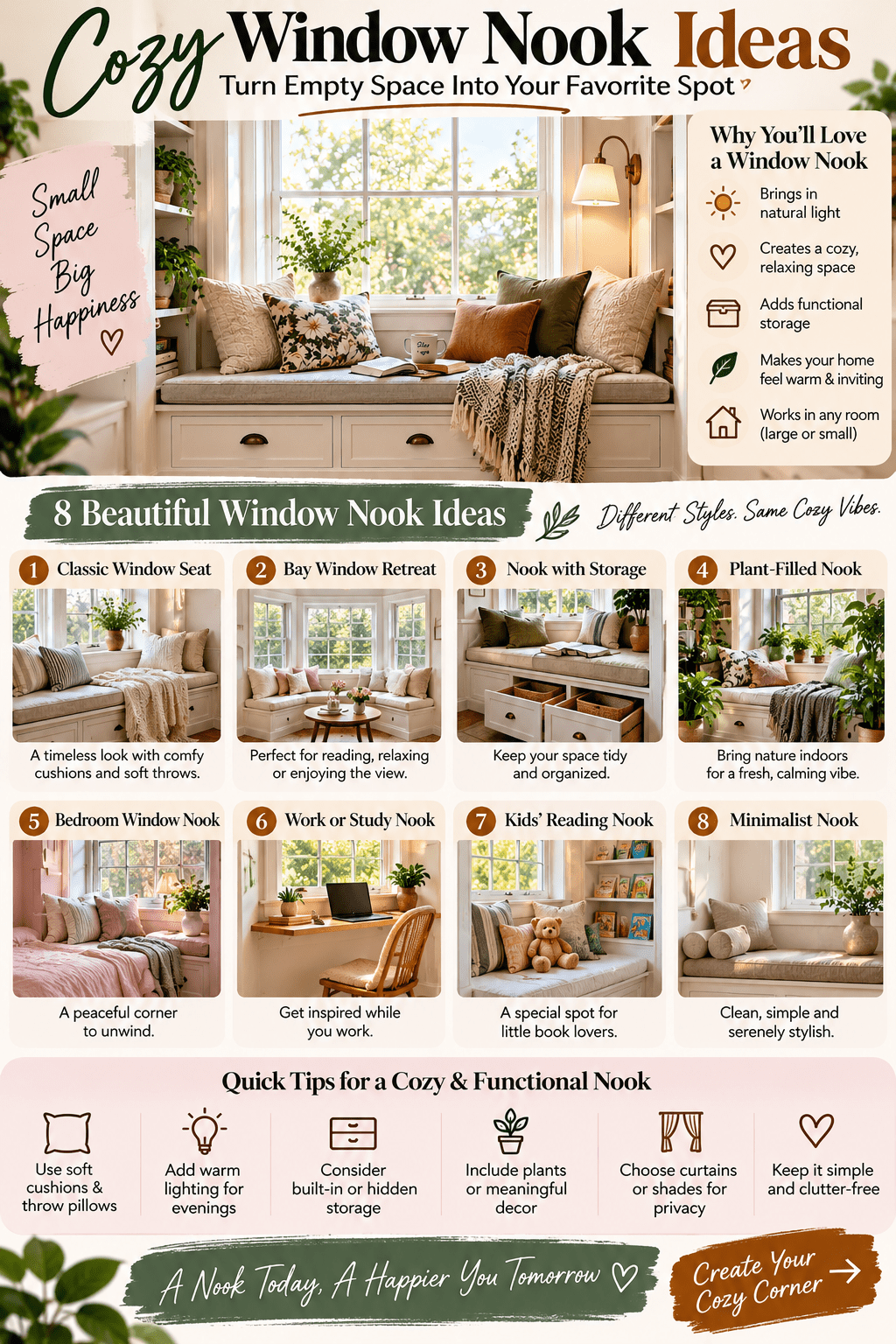
1. Create a Classic Cushioned Window Seat
This is the idea most people picture first, and for good reason. A window seat — whether it’s a built-in bench or a simple platform with a cushion on top — instantly signals that a window is meant to be used, not just walked past.
The formula is straightforward: a seat around 18 to 20 inches high (close to standard chair height), a cushion with enough depth to actually recline into, and a couple of oversized pillows tucked into the corners. Depth matters more than most people expect. A cushion under three inches thick tends to feel more like a bench pad than a place to curl up, while something in the four-to-six-inch range invites you to draw your knees up and stay a while.
If you’re building from scratch, a plywood platform with a hinged lid gives you seating and storage in one move. If you’re working with what you have, a low bookshelf or a sturdy console table pushed beneath the window can serve as the base, topped with a custom window seat cushion cut to fit.
One honest trade-off: a built-in window seat looks polished and uses every inch of the space perfectly, but it’s a real carpentry project, and it’s not going anywhere once it’s in. A freestanding bench is far easier to install and just as easy to remove if you move out, though it may leave a sliver of unused space on either side depending on your window’s width.
2. Turn a Bay Window Into a Reading Retreat
Bay windows are, frankly, a gift. That extra few feet of floor space jutting out from the main wall practically begs to become a bay window reading nook, and the three-sided glass means you get light from multiple angles throughout the day.
The trick with a bay window seat is treating the whole alcove as one composition rather than three separate window treatments. A continuous cushion that wraps the full curve or angle of the bay, rather than three separate pads, reads as much more intentional. Fill the corners with bolster pillows, which handle the angled ends of a bay far better than square throw pillows do.
Because bay windows often sit slightly apart from the rest of the room, they’re also a natural spot for a small side table — just enough surface for a mug and a book, without crowding the seat itself.
3. Add Built-In Storage Beneath the Seat
If you’re already building a platform, storage under the window seat is nearly a freebie. A lift-top bench or a row of pull-out drawers turns dead space into a place for extra bedding, board games, out-of-season clothing, or the twenty throw blankets every household seems to accumulate.
Hidden storage works especially well in small apartments, where every piece of furniture is under pressure to do more than one job. A window bench with storage can replace a dresser drawer or two, which matters when you don’t have a mudroom or a linen closet to fall back on.
The one thing to plan for ahead of time: hinges and drawer slides need clearance, so decide on your storage mechanism before you finalize the cushion thickness. A cushion that’s too thick can make a lift-top lid awkward to open one-handed.
4. Create a Cozy Window Nook in a Small Bedroom
A bedroom window nook doesn’t need to be large to earn its keep. Even 24 to 30 inches of width is enough for a slim bench or a pair of floor cushions, and in a bedroom, that little bit of separate space does something psychologically useful — it gives you somewhere to sit that isn’t the bed.
Layer in linen or cotton bedding-adjacent textiles so the nook feels connected to the room rather than like a separate zone. A narrow shelf above the seat can hold a small lamp and a stack of books without needing a full nightstand’s footprint. If the window faces a street or a neighboring building, this is also where privacy earns some real consideration — a sheer curtain paired with a room-darkening shade gives you daytime softness and nighttime coverage without choosing one over the other.
5. Style a Window Nook Without a Built-In Bench
Not every window nook idea requires construction. A deep armchair angled toward the window, a small loveseat, or even a chunky floor cushion can create the same feeling of a dedicated reading spot without any carpentry at all.
This approach is often the most realistic for renters or anyone who isn’t ready to commit to a fixed structure. Choose a chair with a low profile so it doesn’t block the window’s sightline, and add a small round side table for a drink or a stack of books. A floor lamp behind the chair, angled so the light falls over your shoulder onto the page, does more for the space than almost any other single addition.
6. Make a Small Apartment Window Nook Feel Intentional
In a small apartment, a window nook can quietly solve two problems at once: it gives you a cozy corner, and it makes the room look more furnished without adding bulk. The trick is restraint. One chair, one small table, one lamp, and a plant reads as designed. The same footprint with a chair, a stack of magazines, a floor mirror, and three throw pillows starts to read as clutter.
An apartment window nook also benefits from vertical thinking, since floor space is usually the scarcest resource. A slim floating shelf above the seat can hold a few books and a small plant without eating into the footprint below.
7. Layer Pillows, Throws, and Soft Textures
This is the step that turns a technically comfortable seat into one you actually want to sit in. Two to three pillows in varied sizes, one substantial throw blanket, and a textured cushion cover go a long way. Mixing materials — a linen pillow next to a bouclé one, a chunky knit throw over a smoother cushion — gives the eye something to notice without looking busy.
It’s worth saying plainly: more pillows is not automatically cozier. Past three or four, pillows start competing with the actual seat, and you end up moving half of them onto the floor every time you sit down. A nook that requires a five-minute pillow relocation before you can use it isn’t really serving its purpose.
For families or anyone with kids or pets nearby, washable fabric covers are worth the extra cost upfront. A velvet cushion looks wonderful in photos and shows every water ring and crumb in real life.
8. Add Bookshelves for a True Reading Nook
If the goal is a genuine reading nook by the window, shelving nearby makes the whole setup click into place. Built-in bookshelves flanking a window seat is a classic look for a reason — it turns the entire wall into a single, considered feature instead of a window with some furniture near it.
Floating shelves are the lower-commitment version. Two or three mounted above or beside the seat, styled with books stacked both upright and on their sides, plus the occasional small object or framed print, keep the area from feeling like a straight row of spines. Leave some negative space on each shelf. A shelf packed edge to edge starts to look like storage rather than styling.
9. Bring Plants Into a Sunlit Window Nook
A window nook is, by definition, one of the sunniest spots in the room, which makes it a natural home for indoor plants. A trailing pothos on the sill, a larger fiddle-leaf fig or rubber plant in the corner, or a small grouping of potted herbs on a sunny kitchen-adjacent window all bring life into a space that might otherwise be just fabric and wood tones.
Worth knowing before you commit: direct, unfiltered sun for several hours a day can fade fabric over time, particularly on cushions in deeper or more saturated colors. If your window gets strong afternoon light, a sheer curtain or a fade-resistant fabric will save your cushion’s color in the long run, and most plants will still thrive with that slight filtering.
10. Use Warm Lighting for Evening Comfort
Daylight makes a window nook glow, but by six o’clock in winter, that same spot can feel dim and a little forgotten unless you’ve planned for it. This is where a lot of otherwise beautiful nooks fall short — they’re gorgeous at 10 a.m. and unusable at 8 p.m.
A dedicated reading light solves this. Wall sconces mounted on either side of the window, a slim pendant light hung above the seat, or a simple floor lamp with a warm bulb all work, depending on how much you want to commit to the wall. For renters, a plug-in sconce or a floor lamp avoids any wiring at all. Aim for warm white bulbs (look for a color temperature around 2700K) rather than cool white — it’s the difference between a nook that feels like a retreat and one that feels like an office.
11. Create a Calm Minimalist Window Nook
Not every window nook needs to be dense with texture and objects. A minimalist window nook works with restraint: one neutral cushion, a single well-chosen pillow, a plain woven blanket folded rather than draped, and nothing else competing for attention.
This version tends to suit modern or Scandinavian-leaning interiors, where the goal is a sense of calm rather than layered coziness. It’s also the easiest version to keep looking good day-to-day, since there’s simply less to keep tidy. If your window has a nice view or interesting architectural trim, a minimalist approach lets that be the star instead of competing with it.
12. Make a Window Nook Feel More Luxurious
For a window nook with a little more polish, material choices do most of the work. Velvet or bouclé upholstery on the cushion, a wool or cashmere-blend throw, and brass or warm-metal fixtures on any nearby lighting all push a nook toward the higher end without necessarily costing a fortune.
Symmetry helps here too. A pair of matching bolster pillows on either end of the seat, or two identical sconces flanking the window, reads as more considered than an asymmetrical mix. Adding one substantial object — a single large framed print above the seat, or a sculptural vase on the side table — tends to look more luxurious than several small decorative pieces scattered around.
13. Create a Family-Friendly or Kids’ Reading Nook
A kids’ reading nook by a window earns its keep fast, especially if it gets your children away from a screen for even twenty minutes a day. The priorities shift a little here: durability over delicacy, and easy cleaning over precious fabrics.
A low bench or a stack of floor cushions works better than a tall chair for younger kids, since they can climb on and off freely. A small basket or two for books keeps the area from turning into a pile on the floor, and a soft rug beneath the nook adds a buffer for anyone reading cross-legged on the ground rather than on the seat itself. Skip anything with small removable parts, fringe, or delicate trim if young children will be using the space unsupervised.
14. Turn the Nook Into a Small Work or Journaling Spot
A window nook doesn’t have to be purely for lounging. A narrow desk or a wide, sturdy windowsill can double as a home office window nook — enough surface for a laptop, a notebook, and a cup of coffee, with natural light doing a better job than most desk lamps ever could.
Keep the chair firm rather than plush if you’ll be working there for real stretches of time; a deep lounge cushion is wonderful for reading but not for typing. A small stool tucked beneath a narrow shelf, paired with a task lamp for overcast days, makes this version workable even in a studio apartment where a full home office isn’t an option.
15. Use Curtains and Window Treatments for Privacy and Coziness
Window treatments do more for a nook than most people give them credit for. Curtains around a window seat soften the hard edges of the frame, add a sense of enclosure, and give you control over both privacy and glare — a real concern if your nook faces west and gets blinding late-afternoon sun.
Roman shades offer a cleaner, more tailored look and work well in smaller nooks where floor-length curtains might feel heavy. For a softer, more layered feel, pair a sheer curtain for daytime privacy with a heavier linen or cotton curtain that can close fully in the evening. Whatever you choose, make sure the treatment can actually close all the way — a curtain that’s more decorative than functional won’t help on the nights you actually want the privacy.
16. Make an Awkward Window Area Feel Designed
Plenty of window nook opportunities aren’t obvious ones. An oddly shaped alcove, a window beside a chimney breast, or a narrow gap between two doorways can all become a workable corner window nook with the right approach.
The general fix for awkward space by a window is to stop trying to make it symmetrical and instead build the seat or shelf to the room’s actual dimensions. A custom-cut cushion for an irregular space costs more than an off-the-shelf one, but it’s the difference between a nook that looks built for the room and one that looks like leftover furniture pushed into a gap. If custom upholstery isn’t in the budget, a simple foam pad wrapped in fabric and cut to size gets you most of the way there for far less.
17. Create a Rental-Friendly Window Nook Without Construction
Renters can absolutely have a real window nook — it just has to be built entirely from furniture rather than fixtures. A freestanding bench, a deep armchair, or even a daybed positioned beneath the window gives you the seating. A floor lamp and a plug-in sconce handle the lighting. A woven basket holds blankets and books in place of a built-in drawer.
Look for a bench or bookshelf sized close to your window’s width so the whole arrangement feels intentional rather than improvised, and use a large rug to visually anchor the nook to that part of the room. Everything here can go with you when the lease ends, which is really the whole appeal.
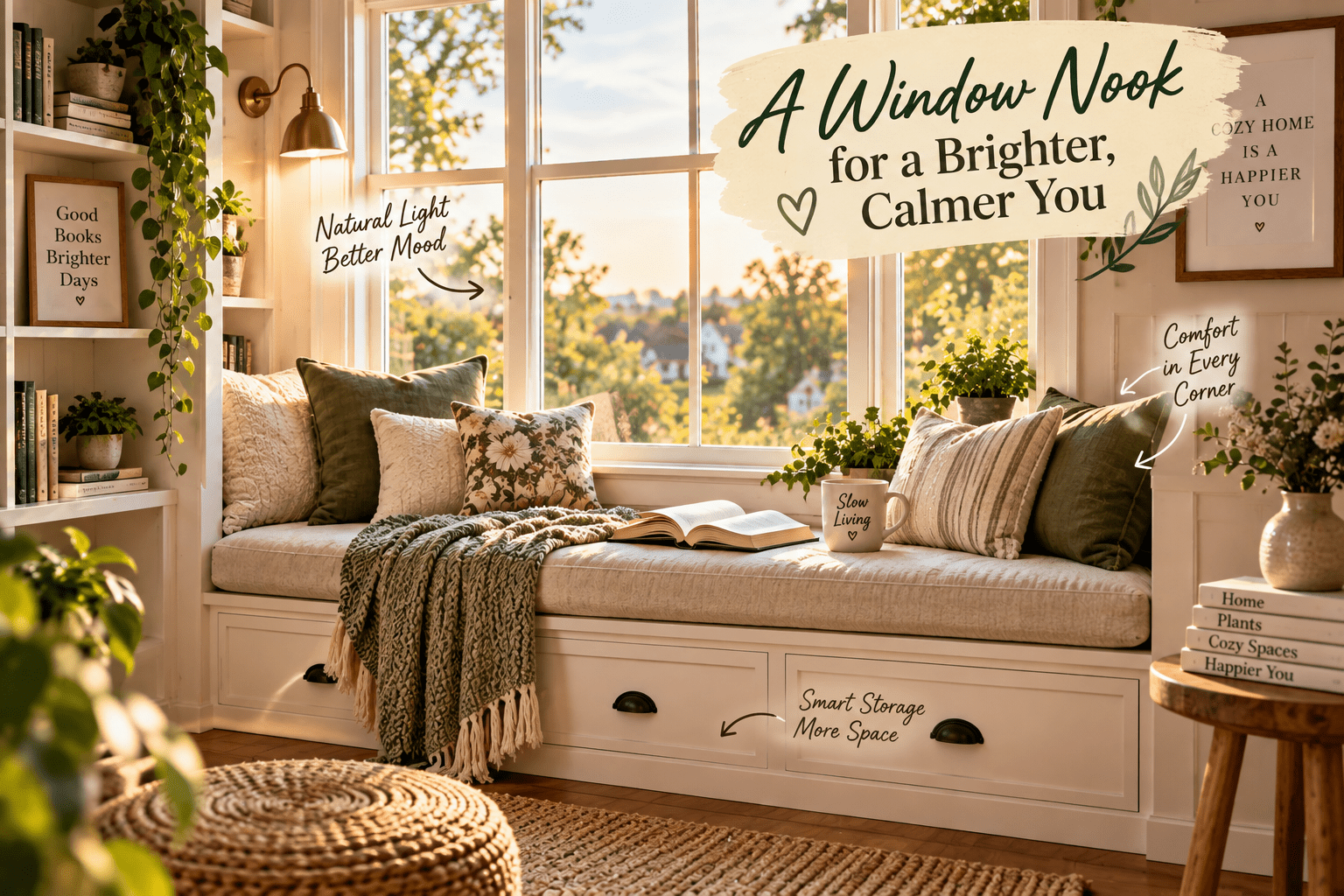
How to Design a Window Nook That Actually Feels Comfortable?
Choose the right seat depth
A seat under 16 inches deep will feel more like a perch than a place to relax. Aim for 20 to 24 inches if you want to sit cross-legged or curl your feet up, and closer to 16 to 18 inches if you mainly plan to sit with your feet on the floor.
Get the cushion thickness right
There’s a real trade-off between comfort and usable depth. A thick, plush cushion feels wonderful but eats into your seat depth and can make a lift-top storage bench harder to open. A four-inch high-density foam cushion is a reasonable middle ground for most builds.
Layer textures instead of clutter
The goal is a nook that looks gathered, not accumulated. One or two textures — a woven throw, a knit pillow — read as cozy. Five different patterns competing for attention read as busy.
Use the natural light to your advantage
Notice how the light moves through the space before you finalize the layout. A nook that catches soft morning light might want to face east-facing mornings with minimal window covering, while a west-facing nook getting harsh afternoon sun will need a shade or curtain to stay comfortable past 3 p.m.
Add storage where possible
Even without a full built-in bench, a basket, a small trunk repurposed as a side table, or a slim shelf can absorb the blankets and books that would otherwise pile up on the seat itself.
Choose lighting for evenings
Decide before you finish the space whether you’ll be using it after dark. If so, plan the light source — sconce, lamp, or pendant — at the same time you plan the seating, not as an afterthought once the cushion’s already in place.
Common Window Nook Mistakes to Avoid
A few missteps show up again and again. Overstuffing the seat with pillows until there’s nowhere to actually sit is the most common one. Skipping evening lighting entirely is a close second — a nook that’s only usable in daylight gets used half as often as one that works around the clock.
Ignoring drafts is another one worth mentioning, especially in older homes with single-pane windows. A cold draft along the back of your neck will undo even the coziest cushion setup, so a heavier curtain or a draft stopper along the sill is worth the small effort in winter months.
Choosing a fabric that looks beautiful but can’t survive daily use — light-colored linen in a house with a shedding dog, for instance — is a mistake most people only make once. And finally, treating the nook as purely decorative rather than something meant to be sat in tends to backfire: the most successful window nooks are the ones that get a little worn in, not the ones that stay perfectly staged and empty.
Final Thoughts
The best window nooks aren’t the most elaborate ones. They’re the ones that match how you actually want to use them — a spot for a Sunday morning coffee, a chapter before bed, or twenty quiet minutes with a journal. Start with the seat, get the depth and cushion right, add enough soft layers to make it inviting without overdoing it, and don’t forget the lighting once the sun goes down. That empty stretch of floor by the window has more potential than almost anywhere else in the house — it just needs a reason to be used.
Frequently Asked Questions (FAQs)
Question 1: What is a window nook?
Answer: A window nook is a small, dedicated seating or lounging area built into or arranged around a window, typically featuring a cushioned seat, soft textiles, and sometimes built-in storage or shelving.
Question 2: How do you make a window nook cozy?
Answer: Focus on three things: a seat with enough cushion depth to sink into, layered soft textures like pillows and a throw blanket, and warm lighting for use after sunset.
Question 3: Can you create a window nook without a built-in seat?
Answer: Yes. A deep armchair, loveseat, or floor cushions positioned near the window can create the same effect as a built-in bench, and it’s a flexible option for renters.
Question 4: What cushions are best for a window seat?
Answer: A high-density foam cushion around four inches thick, covered in a durable, washable fabric like cotton or performance linen, holds up well and stays comfortable over time.
Question 5: How can I add storage to a window seat?
Answer: A lift-top bench, pull-out drawers beneath a platform seat, or simply a woven basket beside the nook can all add functional storage without much added cost.
Question 6: How can renters create a window nook?
Answer: Renters can use freestanding furniture — a bench, chair, or daybed — along with plug-in lighting and a rug, avoiding any built-in construction while still achieving a cozy, finished look.
Question 7: What lighting works best for a reading nook?
Answer: Warm white lighting (around 2700K) from a wall sconce, floor lamp, or small pendant positioned to fall over the shoulder works best for evening reading.
Question 8: How can I decorate a bay window?
Answer: Treat the full bay as one continuous space with a wraparound cushion, bolster pillows in the angled corners, and a small side table, rather than styling each window section separately.