
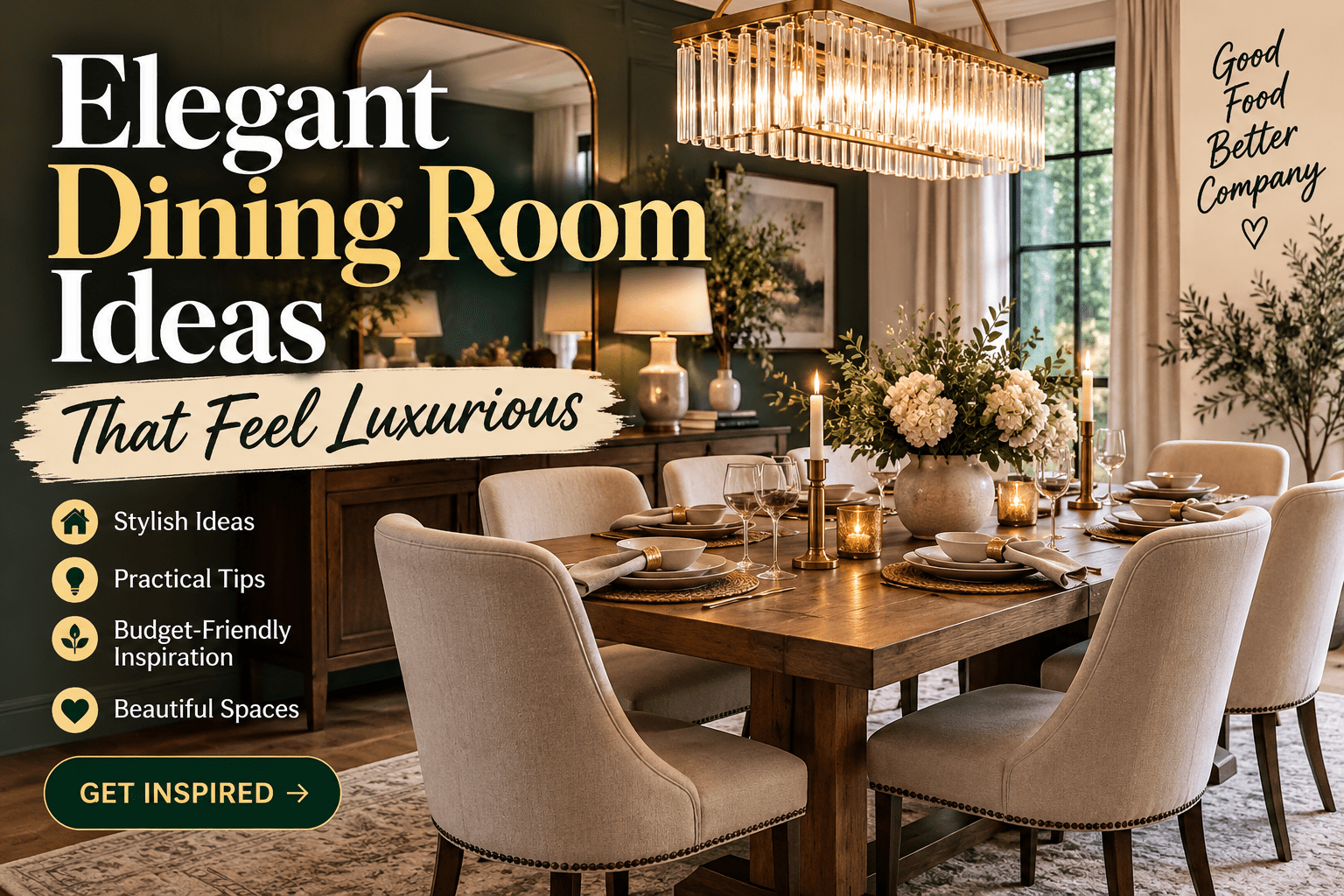
Dining Room Ideas: There’s a particular kind of dining room that makes you want to light a candle even on a random Tuesday. It’s not necessarily bigger than yours, and it almost certainly didn’t cost a fortune to pull together. What it has is intention — every piece earns its place, the lighting is warm instead of harsh, and nothing looks like it was grabbed off a big-box shelf in a hurry. If your dining room currently feels more “place where mail accumulates” than “place where you’d actually want to linger over dinner,” you’re not alone, and the fix is more approachable than you might think. Elegant doesn’t mean stiff, and luxurious doesn’t mean expensive. It means the room has been considered — the proportions feel right, the materials feel good to the touch, and the whole space has a quiet confidence to it. Here’s how to get there, piece by piece.
Elegant Dining Room Ideas
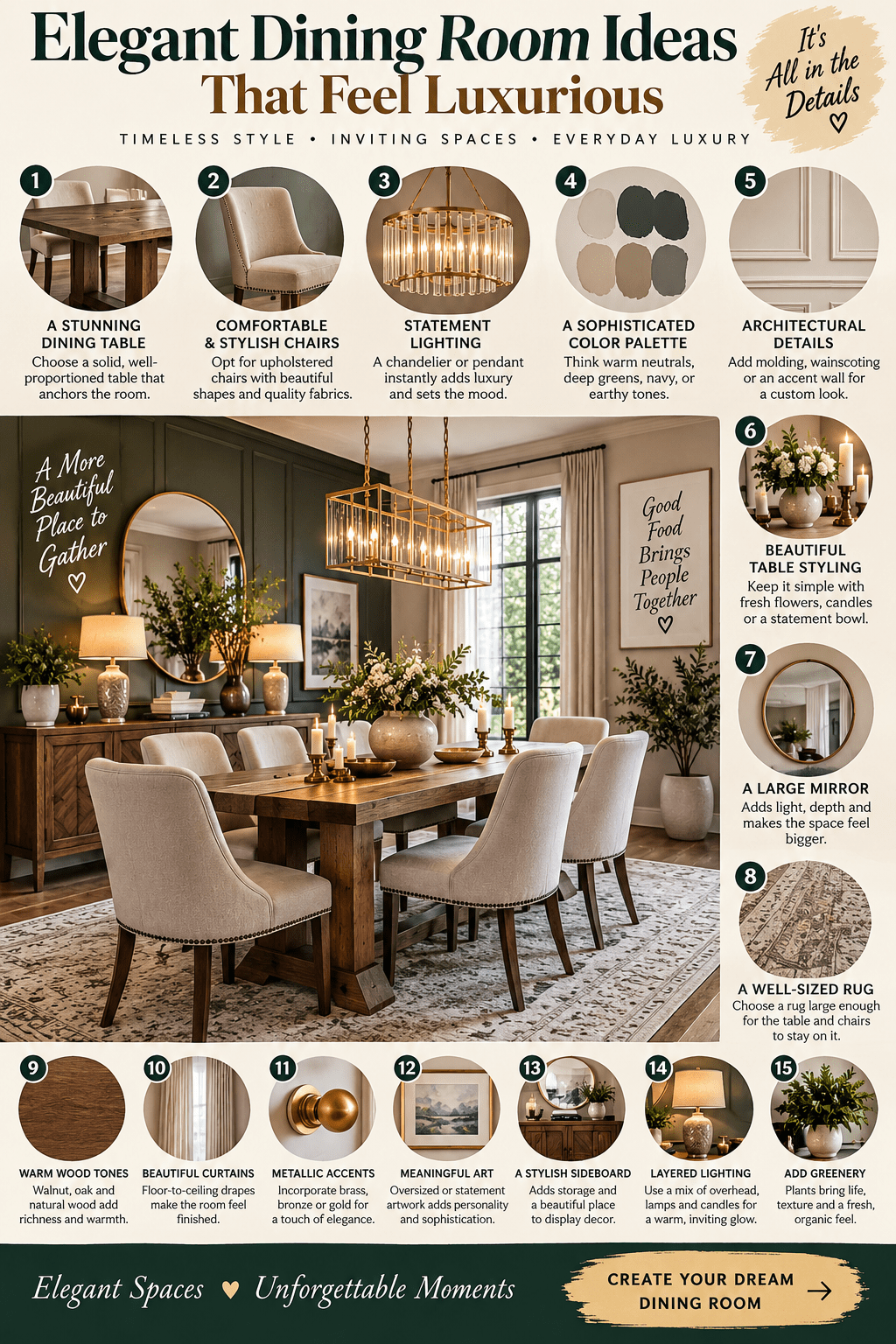
1. Start With a Dining Table That Feels Substantial
The table is the room. Everything else — the chairs, the rug, the light fixture — is built around it, so if the table feels flimsy or undersized, no amount of styling will fully rescue the space. A table with real presence sets the tone before you’ve added a single candlestick.
Solid wood is still the gold standard for a reason. Walnut, oak, and mahogany all carry weight both literally and visually, and they age beautifully instead of looking tired after a few years of dinners. A thick tabletop — somewhere around 1.5 to 2 inches — reads as substantial in a way that a thin, lightweight surface simply doesn’t, even if the two tables are the same width and length. If wood isn’t your style, a honed marble or stone-topped table paired with a sculptural wood or metal base brings a similar sense of weight with a cooler, more contemporary edge.
Shape matters more than people expect. Rectangular tables suit most American dining rooms and work especially well in spaces connected to open-concept kitchens, since they define a clear dining zone within a larger footprint. Round and oval tables soften a room’s lines and tend to feel more intimate, which is part of why designers love them for smaller dining rooms or spaces with a lot of traffic flow around the table. Whatever shape you land on, leave at least 36 inches of clearance between the table’s edge and the nearest wall or furniture piece — this is the single most common proportion mistake in American dining rooms, and it’s an easy one to fix.
2. Choose Dining Chairs With Beautiful Shape and Comfort
Chairs do a lot of quiet work in a dining room. They’re the pieces you interact with directly, so their comfort and their silhouette both matter — and honestly, this is where a lot of dining rooms lose their elegance without anyone quite knowing why.
Upholstered dining chairs are one of the fastest ways to soften a room and add a sense of comfort that hard wood chairs alone can’t provide. A curved back, a slightly tapered leg, or a subtle channel-tufted detail all read as intentional rather than trend-driven. Performance fabrics have gotten remarkably good in the last several years, so you can choose a plush-looking bouclé or a rich velvet without living in fear of every spilled glass of red wine — a real consideration for anyone who actually uses their dining room rather than just admiring it.
One detail designers often get right that homeowners sometimes miss: mixing chair styles at the head of the table. A pair of upholstered armchairs at either end, paired with simpler side chairs along the length of the table, adds visual rhythm without looking mismatched. It’s the kind of asymmetry that feels curated rather than accidental, and it also happens to be more comfortable for whoever’s sitting through a long holiday dinner.
If you’re set on wood chairs for durability or a more traditional look, look for ones with a curved crest rail or a woven cane back. Straight, boxy wood chairs are often what makes a dining room feel more like a conference room than a place for a dinner party.
3. Use a Statement Chandelier or Dining Room Light Fixture
If you only change one thing in your dining room, change the light fixture. Nothing dates a room faster than a builder-grade fixture, and nothing modernizes one faster than swapping it out for something with real character.
A chandelier with sculptural presence — whether that’s a classic crystal design, a linear fixture with a mix of brass and glass, or a series of oversized glass globes — becomes a piece of art hanging in the middle of the room. Scale is where a lot of people go wrong. A good rule of thumb is that your chandelier’s diameter should be roughly one-third the width of your table, and it should hang so the bottom of the fixture sits about 30 to 34 inches above the tabletop in a room with a standard 8-foot ceiling, adjusting up a few inches for every additional foot of ceiling height.
Warm lighting matters just as much as the fixture itself. Bulbs in the 2700K to 3000K range cast a golden, flattering glow that makes skin tones look good and food look appetizing — cooler bulbs tend to feel clinical, more like a dentist’s office than a dinner party. And always, always put your dining room lighting on a dimmer. A dimmer switch is one of the cheapest upgrades you can make, and it single-handedly lets one fixture do double duty for a casual Tuesday dinner and a candlelit Saturday gathering.
Wall sconces flanking a piece of artwork or a mirror add a secondary layer of light that a single overhead fixture can’t achieve on its own, which brings us to a bigger point about lighting layers a bit further down.
4. Create an Expensive-Looking Dining Room With Color
Color does more heavy lifting than most people give it credit for. A dining room can feel expensive simply because the palette feels cohesive and considered rather than because any single piece in it was costly.
Warm neutrals are the foundation of most elegant American dining rooms right now — think warm white, cream, soft greige, and taupe. These colors have enough depth to avoid looking flat or builder-basic, but they stay light enough to keep a room feeling airy rather than closed in. For homeowners who want more drama, deep colors like charcoal, forest green, or navy on the walls create an intimate, almost cocoon-like feeling that works particularly well in a dining room, since it’s typically a room you use in the evening. Dark walls paired with brass or warm wood tones and good ambient lighting can look genuinely luxurious rather than heavy, which is the opposite of what most people fear when they consider a dark paint color.
The trick to making any of these palettes look intentional is repetition. If your walls are a warm greige, echo that undertone somewhere else in the room — in the rug, in a piece of upholstery, or in the wood finish of the table. Rooms feel expensive when the colors talk to each other instead of existing as isolated decisions.
5. Add Architectural Interest to the Walls
Flat, featureless walls are one of the biggest reasons a dining room reads as builder-basic instead of custom-designed. Architectural detail is one of the most reliable ways to add that layer of sophistication, and it doesn’t require gutting the room.
Picture-frame molding — thin strips of trim applied directly to painted walls in a grid or rectangular pattern — is one of the most cost-effective upgrades available to a homeowner. It mimics the kind of custom millwork you’d see in a much older, more expensive home, and it can often be installed by a handy homeowner over a weekend. Wainscoting and board-and-batten treatments bring a similar effect with a slightly more traditional, tactile feel, especially when painted in a soft, warm white or the same color as the walls above for a monochromatic, high-end look.
Wallpaper deserves a mention here too, particularly in a dining room, which tends to be a lower-traffic, lower-mess room than a kitchen or entryway. A textured grasscloth, a subtle botanical print, or a rich, moody pattern on just one accent wall — often the wall behind a sideboard or the head of the table — adds depth without overwhelming the whole room.
6. Make the Dining Table Look Beautiful Without Overdecorating
Table styling is where a lot of otherwise elegant dining rooms fall apart, usually because there’s simply too much happening on the surface. The goal is a table that looks finished when it’s empty and effortless when it’s set for dinner.
A low, elongated centerpiece works better than a tall one for everyday styling, since it doesn’t block sightlines across the table. A wide, shallow bowl filled with lemons or a simple arrangement of greenery in a low vessel does more visual work than people expect. For a more elevated look, a pair of candlesticks in a warm metal finish, placed slightly off-center or in a loose cluster, adds height and a sense of occasion without permanently occupying the middle of the table.
A table runner in a natural material like linen adds texture and softens the hard edge of a wood or stone tabletop, and it gives you a built-in surface for styling smaller objects like a bud vase or a stack of linen napkins. The real key to elegant table styling is restraint — choose two or three elements, vary their height slightly, and stop there. A table with twelve small decorative objects on it doesn’t look luxurious; it looks like clutter that happens to be arranged on a nice piece of furniture.
7. Add a Large Mirror for Light and Depth
A well-placed mirror is one of the most underused tools in dining room design, and it’s a particularly good one for rooms that don’t get much natural light — which describes a surprising number of American dining rooms, especially in older homes or ones tucked between a kitchen and a hallway.
Position a mirror across from or adjacent to a window, or opposite the room’s main light source, so it bounces light back into the space rather than reflecting a wall. Size matters here too — a mirror that’s roughly two-thirds the width of a sideboard or console beneath it will look proportionate, while a small mirror on a large wall tends to look like an afterthought.
An arched or curved mirror in an antique brass or aged gold frame softens a room full of rectangular furniture, while a large, minimally framed mirror suits a more modern or transitional space. Either way, a mirror does double duty: it adds visual depth that makes the room feel larger than its actual square footage, and it reflects your chandelier or pendant light, essentially doubling the impact of your lighting investment.
8. Use a Large Rug to Ground the Dining Area
A properly sized rug does something subtle but important — it visually anchors the table and chairs together as a single, intentional grouping instead of a collection of furniture that happens to be sitting in the same room. Without one, especially on hardwood or tile, a dining set can feel like it’s floating.
The sizing rule that matters most: your rug needs to be large enough that all four chairs stay on it even when pulled out from the table. As a general guideline, add 24 to 30 inches of rug beyond each edge of the table. For a standard 6-foot rectangular table, that usually means an 8-by-10-foot rug at minimum, and a 9-by-12-foot rug will feel more generous and proportionate if your room allows for it.
Low-pile rugs are the practical choice for a dining room, since a plush, high-pile rug makes chairs difficult to slide in and out and tends to trap crumbs. Natural fiber rugs — wool, or a wool-and-jute blend — bring warmth and texture without competing with the rest of the room, while a traditional pattern in muted, tonal colors adds interest without looking busy underfoot. Washable rugs have also become a genuinely good option for families who use their dining room daily rather than saving it for special occasions.
9. Bring in Warm Wood Tones
Wood tone is one of those details that quietly determines whether a room feels warm and collected or cold and showroom-like. A dining room built entirely around cool grays and white surfaces can start to feel sterile, no matter how nice each individual piece is.
Walnut has become the wood tone most associated with elevated, modern interiors, thanks to its rich, chocolate-brown undertone that pairs beautifully with brass, black metal, and soft neutral textiles. Oak, particularly in a lighter, more natural finish, brings a slightly more relaxed, organic feeling that suits transitional and Scandinavian-influenced rooms. You don’t need every wood piece in the room to match exactly — in fact, a room where every wood tone matches perfectly can feel a little flat. A dining table in walnut alongside a sideboard in a lighter oak, connected by similar warm undertones, reads as collected over time rather than purchased as a matching set.
10. Add Curtains That Make the Room Feel Finished
An unfinished window is one of the quickest ways to make an otherwise beautiful dining room feel incomplete, even if everything else in the space is dialed in. Curtains add softness, sound absorption, and a sense of height that bare windows simply can’t provide.
Hang curtain rods as close to the ceiling as your window trim allows — ideally just a few inches below the crown molding or ceiling line — rather than directly above the window frame. This single adjustment makes ceilings look taller and rooms feel grander, and it’s one of the most common tricks used by professional designers. Curtains should graze the floor or break slightly, like a well-tailored pair of trousers; puddling too much reads as dated, while curtains that hover an inch above the floor look unfinished.
Linen, or a linen-blend, remains the most popular choice for elegant dining rooms because it has a natural, slightly textured drape that catches light beautifully without looking stiff. Stick to a fullness of about two to two-and-a-half times the width of your window for a rich, substantial look rather than a skimpy, flat panel that barely covers the glass.
11. Layer Metallic Accents Carefully
Metal finishes are where a lot of dining rooms either come together or fall apart. It’s tempting to mix chrome hardware with a brass chandelier and black iron chair frames, but that kind of scattered approach usually reads as unplanned rather than eclectic.
Choosing one dominant metal finish — aged brass, warm bronze, or brushed gold are the most popular choices for elegant dining rooms right now — and repeating it across your light fixture, drawer pulls, and picture frames creates a sense of cohesion that ties the whole room together. A second, secondary metal can absolutely make an appearance, particularly in something like a black iron chair frame or chrome candlesticks, but it should show up in smaller doses so it reads as an accent rather than competing for attention.
Aged and unlacquered finishes have an advantage over shiny, polished ones: they develop a soft patina over time instead of showing every fingerprint, which actually makes a fixture look more expensive as it ages rather than less.
12. Create a Luxurious Dining Room With Artwork
Artwork is one of the most personal ways to add sophistication to a dining room, and it’s also one of the places where scale really matters. A small piece of art centered on a large wall tends to look lost, while a single oversized piece — or a well-planned gallery wall — fills the space with intention.
For a dining room, artwork that relates to the room’s color palette without matching it exactly tends to look the most collected. If your walls are a warm greige, a piece with deep green or rust undertones will complement the space rather than blending into it or clashing with it. Abstract art suits modern and transitional dining rooms particularly well, since it adds color and texture without pulling focus away from conversation at the table. For a more traditional room, botanical prints, still-life paintings, or a mix of framed prints in coordinating (not matching) frames bring warmth without feeling overly formal.
A large mirror, discussed earlier, can also function as your statement piece if you’d rather not commit to a specific piece of art — and it has the added benefit of bouncing light around the room.
13. Add a Sideboard, Buffet, or Stylish Storage
A dining room without a sideboard or buffet often feels a little sparse, even when the table and chairs themselves are beautiful. Beyond the obvious practical benefit of extra storage for linens, china, and serving pieces, a sideboard adds visual weight along one wall that balances out the table in the center of the room.
A sideboard in a rich wood tone with simple, elegant hardware anchors a more traditional dining room, while a lacquered or fluted-front console suits a modern space. Leave enough room on top to style it the same restrained way you’d style the dining table — a lamp, a stack of books, a piece of art leaning against the wall, and maybe a small vase. This is also a natural spot to hang that large mirror we mentioned earlier, since the reflective surface plays beautifully off whatever you’ve placed on top of the sideboard.
14. Use Layered Lighting Instead of One Light Source
A single overhead chandelier, no matter how beautiful, can only do so much on its own. The dining rooms that feel most luxurious almost always have multiple light sources working together, each doing a slightly different job.
Ambient lighting — your chandelier or main overhead fixture — provides the overall glow for the room. Accent lighting, like wall sconces or picture lights above artwork, adds depth and highlights specific features rather than flooding the whole room evenly. And a small lamp on a sideboard or console brings a warm, low pool of light that’s especially useful for evenings when you don’t want the overhead fixture blasting at full brightness. Candles, of course, are the easiest and most affordable layer of all, and a cluster of varying heights on the table or sideboard adds a flickering warmth that no bulb can quite replicate.
The goal isn’t to use every one of these at once every night — it’s to have the option. A room with three or four light sources, each on its own switch or dimmer, gives you far more control over the mood than a single switch ever could.
15. Make a Small Dining Room Feel Luxurious
A small dining room can absolutely feel elegant — it just requires a slightly different set of decisions than a large, formal room would.
Round or oval tables are particularly well suited to tight footprints because they eliminate hard corners that people have to navigate around, and they allow chairs to be spaced more efficiently. A bench along one side of the table, tucked against a wall, can seat more people than chairs would in the same footprint, and it visually reads as less bulky. Mirrors do especially heavy lifting in small dining rooms — a large one is often the single best investment you can make in a tight space, since it genuinely makes the room feel like it extends beyond its actual walls.
Keep the color palette and materials relatively simple in a small room. This doesn’t mean boring — a moody, monochromatic dark room can look stunning in a small space — but it does mean avoiding too many competing patterns or finishes, which will make a small room feel busy and cramped rather than cozy and intentional. Scale down your lighting fixture appropriately too; a chandelier sized for a great room will overwhelm a small dining nook, while a smaller pendant or a pair of modest sconces will feel proportionate.
For dining spaces that share an open floor plan with the kitchen or living room, a rug is one of the best tools for defining the dining zone as its own distinct area without adding a single wall.
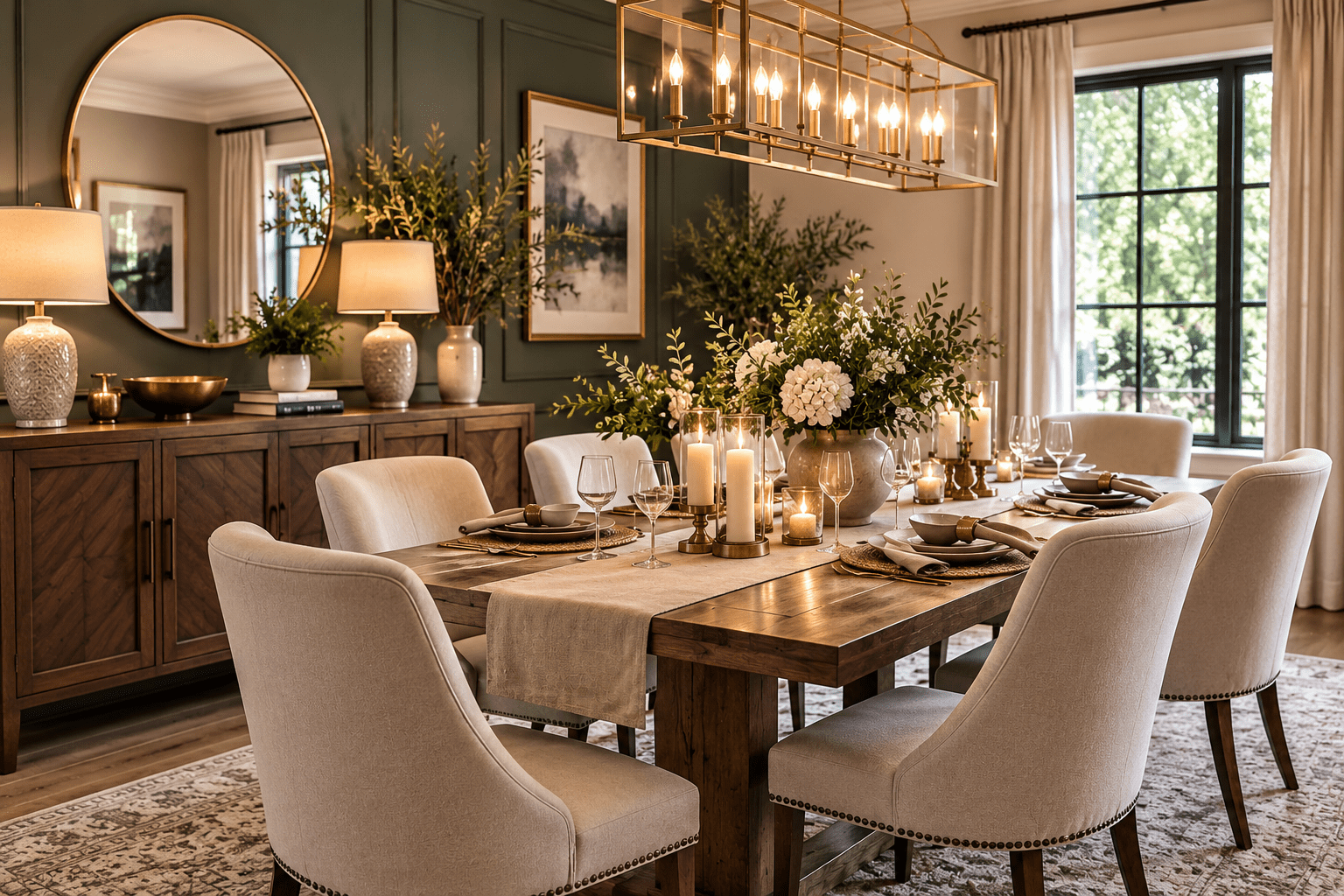
Elegant Dining Room Ideas on a Budget
Luxury and expense aren’t actually the same thing, and a dining room can look genuinely upscale without a designer-sized budget behind it. Here are some of the most effective, lower-cost changes:
- Repaint the walls in a warm, sophisticated neutral or a deep, moody color — paint remains the highest-impact, lowest-cost change available.
- Swap the light fixture. A secondhand chandelier from a vintage shop or online marketplace, cleaned up and rewired by an electrician, can look far more expensive than a brand-new budget fixture.
- Update hardware on a sideboard or buffet — new pulls in an aged brass finish cost very little and change the entire feel of an existing piece.
- Add picture-frame molding. A weekend project with trim from a hardware store can transform flat, boring walls for a fraction of what a full renovation would cost.
- Invest in one large piece of art rather than several small ones — it has more visual impact per dollar spent.
- Reupholster or slipcover existing chairs instead of replacing them entirely.
- Add curtains, even simple linen ones, to a bare window.
- Shop secondhand for a sideboard, mirror, or set of chairs — vintage pieces often have better proportions and materials than comparably priced new furniture.
- Style the table thoughtfully rather than buying more decor — a few well-chosen items arranged with care will always look more elegant than a table crowded with mismatched pieces.
- Bring in greenery. A simple arrangement of eucalyptus or a potted plant in the corner adds life and softness for very little money.
None of these require a full renovation, and most of them can be done gradually as your budget allows.
Elegant Dining Room Styles to Consider
Elegance isn’t one single look, and part of creating a dining room that feels authentically yours is identifying which version of “elegant” actually fits your home and your habits.
Modern elegant dining rooms lean on clean lines, a restrained color palette, and one or two statement pieces — often the light fixture or a sculptural table base — rather than heavy ornamentation. Transitional style blends traditional shapes, like a curved chair back or turned table leg, with more contemporary finishes and simpler silhouettes, making it one of the most broadly livable options for American homes. Traditional dining rooms lean into classic details like wainscoting, formal drapery, and symmetrical furniture arrangements, and they tend to suit older homes with more defined architectural character.
Modern organic style pairs natural materials — raw wood, stone, linen, rattan — with simple, uncluttered forms, creating a look that feels both current and warm. Quiet luxury and warm minimalist styles, which have become especially popular in the last few years, both emphasize high-quality materials and careful proportion over visible branding or obvious statement pieces; the luxury comes through in how things feel and how well they’re made, not in how loudly they announce themselves. Scandinavian-inspired and European-inspired dining rooms bring in lighter wood tones and a slightly more pared-back approach to styling, favoring function and comfort alongside beauty.
Most elegant dining rooms today actually borrow from two or three of these categories rather than committing fully to one, which is part of what makes them feel personal instead of like a showroom display.
Common Dining Room Decorating Mistakes to Avoid
A few recurring mistakes show up again and again in dining rooms that aren’t quite living up to their potential:
- Furniture that’s too small for the room makes the whole space feel underfurnished and awkward, with too much empty floor visible around the edges.
- Oversized furniture crammed into a small room has the opposite problem — it leaves no breathing room and makes movement around the table difficult.
- A chandelier that’s too small for the table below it is one of the most common scale mistakes, and it’s an easy one to avoid by measuring before you buy.
- Cold, overly bright lighting turns a dining room into something closer to a break room than a place you’d want to spend an evening.
- Too many decorative objects on the table or sideboard create visual noise instead of visual interest.
- A rug that’s too small leaves chair legs falling off the edges when pulled out, which undermines the polished look you’re going for.
- Curtains hung too low or too short make ceilings look shorter, and windows look smaller than they actually are.
- Excessive matching — a table, chairs, sideboard, and mirror all from the same collection — can flatten a room’s personality and make it feel more like a furniture showroom than a home.
- Too many competing metal finishes scattered throughout the room without any clear hierarchy.
- Ignoring the room’s actual proportions by choosing furniture based on what looks good in photos rather than what will actually fit and function in your specific space.
How to Put Everything Together?
If all of this feels like a lot to coordinate at once, here’s a simple sequence that mirrors how most designers actually approach a dining room from scratch:
- Choose your main color palette first, since it will guide nearly every other decision.
- Select the dining table — the anchor piece the rest of the room builds around.
- Choose chairs that balance comfort with the table’s scale and style.
- Install a properly scaled light fixture, and put it on a dimmer.
- Add a rug sized generously enough to keep every chair on it, even when pulled out.
- Add a wall treatment, whether that’s molding, wallpaper, or a piece of statement artwork.
- Add window treatments that reach close to the ceiling and graze the floor.
- Introduce a sideboard, buffet, or other storage piece to add visual weight.
- Style the table with a few restrained, well-chosen elements.
- Finish with a handful of carefully selected accessories rather than filling every surface.
Working in this order helps prevent the common trap of buying pieces individually and hoping they’ll come together — instead, each decision informs the next one.
Final Thoughts
None of this actually requires a bottomless budget or a total gut renovation. What separates a dining room that feels genuinely luxurious from one that just feels expensive is proportion, warm and layered lighting, quality-looking materials, and a bit of restraint in the styling. A room with fewer, better-chosen pieces will almost always outshine one that’s simply full of stuff. Start with whichever change feels most doable right now — a new light fixture, a coat of paint, a properly sized rug — and let the rest of the room build outward from there. Elegance, in the end, tends to come from a handful of good decisions made deliberately, rather than a long list of purchases made all at once.
Frequently Asked Questions (FAQ)
Question 1: How can I make my dining room look luxurious?
Answer: Focus on proportion and lighting first. A substantial table, chairs with a beautiful shape, and a properly scaled light fixture on a dimmer will do more for the room’s overall feel than any amount of small decorative accessories.
Question 2: What colors make a dining room look expensive?
Answer: Warm neutrals like cream, greige, and taupe tend to read as sophisticated and timeless, while deep colors like charcoal, navy, and forest green create a more dramatic, intimate feeling in the evening. The key is repeating undertones throughout the room rather than choosing colors in isolation.
Question 3: How do I decorate an elegant dining room on a budget?
Answer: Prioritize paint, lighting, and hardware updates before furniture purchases. A secondhand chandelier, a fresh coat of paint, and new drawer pulls on an existing sideboard can transform a room for a small fraction of what new furniture would cost.
Question 4: What type of lighting looks best in a dining room?
Answer: Warm-toned bulbs in the 2700K to 3000K range, layered across a main chandelier, wall sconces, and candles, create the most flattering and versatile lighting. A dimmer switch is essential for adjusting the mood between everyday meals and special occasions.
Question 5: What size rug should go under a dining table?
Choose a rug large enough that all chairs remain on it even when pulled away from the table — generally 24 to 30 inches of rug beyond each edge of the table. For a standard six-person table, that typically means an 8-by-10-foot rug at minimum.
Question 6: How can I make a small dining room look elegant?
Answer: Consider a round or oval table to soften corners, add a large mirror to expand the sense of space, and keep the color palette relatively simple. Scale your light fixture down appropriately so it doesn’t overwhelm the room.
Question 7: What should I put in the center of a dining table?
Answer: A low, elongated arrangement works best for everyday use, since it doesn’t block sightlines across the table. A shallow bowl of fruit or greenery, or a pair of candlesticks placed slightly off-center, adds interest without becoming a permanent obstacle at dinner.
Question 8: What makes a dining room look sophisticated?
Answer: A cohesive color palette, quality-looking materials like solid wood and natural fiber textiles, layered lighting, and restrained styling all contribute more to a sophisticated feeling than any single expensive purchase.