
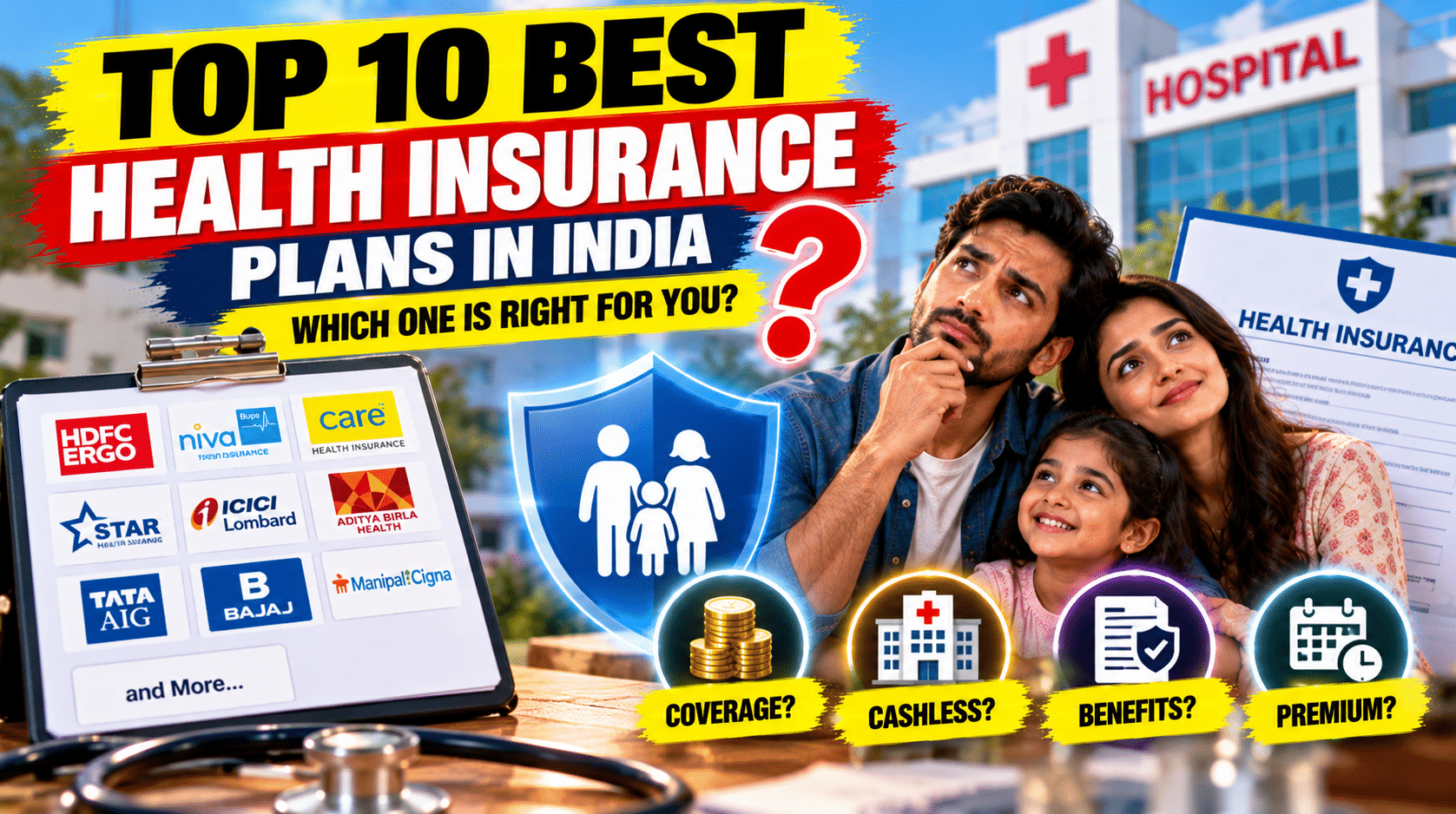
Top 10 Best Health Insurance Plans in India: One unexpected hospitalisation can put years of savings at risk. Even families with a steady income may find it difficult to manage a large medical bill, especially when treatment involves surgery, intensive care, or a long hospital stay.
That is why choosing the right health insurance policy has become an important part of financial planning. But with so many insurers, policy options, coverage limits, and additional benefits available, finding a suitable plan can feel confusing.
Some policies focus on comprehensive hospitalisation cover, while others offer benefits such as restoration of the sum insured, cumulative bonuses, senior-citizen coverage or additional protection through top-up plans.
The challenge is not simply finding the cheapest health insurance policy. It is finding one that provides useful protection when you actually need to make a claim.
In this guide, we compare 10 health insurance plans and options available in India, explain their key features, and discuss what buyers should check before making a decision. The features mentioned below are based on publicly available product information and may change according to the selected variant and policy wording. (ManipalCigna, IRDAI)
What Is Health Insurance and Why Do You Need It?
Health insurance is a financial arrangement in which an insurer covers eligible medical expenses according to the terms of your policy in exchange for a premium.
Depending on the plan, coverage may include hospitalisation, eligible day-care procedures, pre- and post-hospitalisation expenses, and other specified benefits.
A suitable policy can help protect your savings from unexpected medical expenses. However, it does not necessarily cover every treatment or every rupee spent at a hospital. Waiting periods, exclusions, deductibles, co-payments, and coverage limits can affect the amount payable.
IRDAI advises policyholders to review these conditions carefully and check the insurer’s network hospitals before purchasing a policy. (IRDAI)
Top 10 Health Insurance Plans in India
The following options provide a starting point for comparing comprehensive health insurance, family protection, customisable coverage and additional medical protection. They are not ranked from best to worst.
Important: Availability, benefits, premiums, sum insured and eligibility vary by policy variant, age, location and underwriting. Verify current product documents before purchasing.
1. HDFC ERGO Optima Secure
HDFC ERGO Optima Secure is worth considering for buyers looking for comprehensive health insurance with additional coverage-related benefits.
Before choosing it, review how the policy’s additional cover features work, the applicable limits, waiting periods, and exclusions. Also confirm whether the hospitals you would prefer are part of the insurer’s current network.
Consider it if: You want to compare a comprehensive health insurance option for yourself or your family.
2. Care Supreme
Care Supreme is another option to examine when comparing comprehensive health insurance policies.
Look closely at the available sum insured, cumulative bonus provisions, restoration benefits, room eligibility, and applicable co-payment conditions. Do not assume that every benefit is available under every variant.
Consider it if you want to compare plans offering broad hospitalisation protection and additional coverage features.
3. Niva Bupa ReAssure
Niva Bupa ReAssure is a health insurance product family that buyers may include in their comparison shortlist.
Review the current variant’s coverage structure, restoration provisions, renewal conditions, and waiting periods. The value of any restoration benefit depends on when and how it can be used under the policy.
Consider it if: You want to compare policies with features designed to provide additional protection after eligible claims.
4. Star Health Comprehensive
Star Health Comprehensive is an option for people comparing broader health insurance coverage.
Before purchasing, examine the policy’s room-rent conditions, co-payment clauses, waiting periods, and treatment-specific limits. Check the current hospital network in your city rather than relying only on the insurer’s total network count.
Consider it if: You want to compare a comprehensive plan from a specialist health insurer.
5. ICICI Lombard Complete Health
ICICI Lombard Complete Health is another product to consider when comparing health insurance policies.
Check the available coverage levels, hospitalisation benefits, exclusions, waiting periods, and optional benefits under the particular variant being offered. Premiums should be compared for the same age, location, and sum insured.
Consider it if you want to evaluate another comprehensive health insurance option alongside competing policies.
6. Aditya Birla Health Insurance Activ One
Activ One is a health insurance product range from Aditya Birla Health Insurance.
Depending on the variant, the product range may offer different combinations of hospitalisation coverage, wellness-related benefits, and other features. Read the specific brochure to understand which benefits are included and which require additional conditions.
Consider it if: You want to compare comprehensive cover with health and wellness-related features.
7. Tata AIG MediCare
Tata AIG MediCare is another option to include when comparing health insurance plans.
Review its current variant for sum insured options, room eligibility, pre- and post-hospitalisation cover, waiting periods, and exclusions. Also check whether its network includes hospitals you would realistically use.
Consider it if: You want to compare another established insurer’s health insurance offering.
8. Bajaj General Health Guard
Bajaj General Health Guard is an option worth reviewing for buyers looking for health insurance from Bajaj General Insurance.
Check the available variants, room-rent provisions, co-payment requirements, and coverage limits before comparing the premium with other plans.
Consider it if: You want to evaluate different coverage and pricing options for individual or family protection.
9. ManipalCigna ProHealth Prime
ManipalCigna ProHealth Prime is a comprehensive health insurance option with different coverage choices and benefits depending on the selected variant.
The insurer’s published information describes flexible coverage features, including options relating to room eligibility and additional benefits. Buyers should confirm the exact conditions in the current policy documents. (ManipalCigna)
Consider it if: You want to compare flexible health insurance options for yourself or your family.
10. ManipalCigna Sarvah
ManipalCigna Sarvah is another option for buyers seeking broader health insurance protection.
The insurer’s published product information describes different Sarvah variants, with features such as restoration benefits, cumulative coverage-related benefits, and options that can alter certain waiting periods, subject to the selected variant and terms. (ManipalCigna)
Consider it if: You want to compare a plan with higher sum insured options and additional coverage features.
Quick Comparison of the 10 Health Insurance Options
| Plan | Main comparison focus | Suitable buyer profile |
|---|---|---|
| HDFC ERGO Optima Secure | Comprehensive cover and additional benefits | Individuals and families |
| Care Supreme | Coverage structure and bonus features | Buyers comparing broad cover |
| Niva Bupa ReAssure | Restoration and policy benefits | Buyers seeking additional protection |
| Star Health Comprehensive | Hospitalisation coverage and conditions | Individuals and families |
| ICICI Lombard Complete Health | Coverage and policy variants | Buyers comparing comprehensive plans |
| Aditya Birla Activ One | Health cover and wellness-related features | Buyers who value wellness benefits |
| Tata AIG MediCare | Hospitalisation benefits and limits | Individual and family buyers |
| Bajaj General Health Guard | Coverage choices and premium | Buyers comparing different variants |
| ManipalCigna ProHealth Prime | Flexible cover options | Individuals and families |
| ManipalCigna Sarvah | Higher cover and additional benefits | Buyers seeking broader protection |
This table is a shortlist for research, not a claim that one plan is objectively superior to another. Premiums and benefits are not directly comparable without matching the buyer’s age, location, sum insured, and policy variant.
How to Choose the Best Health Insurance Plan for Your Needs
The plan name is only one part of the decision. These are the features that deserve closer attention before you pay the premium.
1. Choose an Appropriate Sum Insured
The sum insured is the maximum coverage available under the policy, subject to its terms and limits.
A low sum insured may be insufficient for expensive treatment, while a larger amount may cost more than your budget allows.
Consider your age, family size, city, medical history, existing coverage, and the likely cost of treatment at hospitals you may use.
2. Check the Cashless Hospital Network
A cashless facility can reduce the need to arrange the entire eligible hospital bill upfront.
However, cashless treatment is generally available through network hospitals and is subject to policy terms and pre-authorisation. Expenses outside the approved coverage may still be payable by you. (IRDAI)
Before purchasing, search for the hospitals near your home or workplace and confirm that they are currently part of the insurer’s network.
3. Understand Pre-Existing Disease Waiting Periods
If you already have a medical condition, check how the policy treats it.
Disclose your medical history accurately. If the insurer accepts a policy covering a disclosed pre-existing disease, the applicable waiting period and conditions will be set out in the policy. IRDAI states that the waiting period for covered pre-existing diseases cannot exceed 48 months under the relevant framework, subject to policy terms and applicable rules. (IRDAI)
4. Review Room-Rent Limits
Some policies restrict the category or cost of the hospital room you can choose.
A room-rent limit may also affect associated expenses depending on the policy wording. Check whether the policy has a room-category restriction, a monetary limit, or an option to remove or modify the restriction.
5. Check Co-Payment and Deductibles
A co-payment means that you must pay a specified portion of an eligible claim yourself.
A deductible is the amount you must bear before the insurer begins paying eligible expenses under the relevant coverage.
These features can reduce premiums in some circumstances, but they can also increase your out-of-pocket costs during treatment. Compare the savings against the potential expense you may have to bear.
6. Look at Restoration Benefits
A restoration benefit may replenish some or all of the sum insured after eligible claims, according to the policy terms.
However, restoration rules differ. Check whether the benefit applies to the same illness, a different illness, the same insured member, or subsequent claims—and whether any restrictions apply.
7. Understand No-Claim or Cumulative Bonuses
Some policies increase the available cover or provide another benefit when no claim is made, subject to the policy terms.
Check whether the benefit is guaranteed or conditional, how much it can grow, and what happens after a claim.
8. Review Exclusions
Every health insurance policy has conditions defining what is and is not covered.
Read the policy wording for exclusions, disease-specific limits, waiting periods, and restrictions on particular treatments. The insurer should also provide a Customer Information Sheet explaining key policy features in a simplified format. (IRDAI)
9. Compare Premiums on Equal Terms
Comparing a ₹5 lakh policy with a ₹15 lakh policy simply because one is cheaper does not provide a meaningful comparison.
Use the same age, location, sum insured, family composition, and similar coverage requirements when comparing quotes. Then assess the differences in benefits and conditions.
10. Consider Your Long-Term Needs
Your needs may change after marriage, having children, taking a home loan, or reaching retirement.
Choose a policy that fits your current circumstances while considering how your healthcare requirements could evolve. Also review renewal conditions and the insurer’s process for servicing the policy over time.
Individual Health Insurance vs Family Floater
Choosing between an individual plan and a family floater can be as important as choosing the insurer.
| Feature | Individual plan | Family floater |
|---|---|---|
| Who is covered? | One insured person per policy | Multiple eligible family members under one policy |
| How is the cover used? | The insured person’s own sum insured | Members generally share the sum insured |
| Premium considerations | Depends on the insured person’s profile and policy | Depends on the covered family and plan terms |
| Potential advantage | Dedicated cover for each insured person | One policy can simplify family management |
| Important limitation | Separate policies may be needed for each member | One major claim can use a large part of the shared cover |
For families with older members or people with significant medical needs, compare the cost and protection of separate individual policies against a family floater rather than automatically placing everyone under one policy.
Is a Higher Sum Insured Always Better?
Not necessarily.
A higher sum insured can provide more financial protection, but it may also increase the premium. More importantly, the policy must provide usable coverage rather than simply display a large number.
Check the coverage limits, exclusions, room eligibility, waiting periods, and cost-sharing clauses before deciding that a larger sum insured makes one policy better than another.
A policy with a lower headline sum insured but fewer restrictive conditions may be worth comparing with a higher-cover policy that has limits relevant to your needs. The final decision should depend on the actual policy wording and your financial situation.
Common Mistakes to Avoid When Buying Health Insurance
- Choosing a policy only because it has the lowest premium.
- Ignoring waiting periods and exclusions.
- Failing to disclose existing medical conditions.
- Assuming every hospital offers cashless treatment.
- Overlooking co-payments, deductibles, and room-rent limits.
- Assuming restoration benefits work in every situation.
- Buying a family floater without considering each member’s age and medical needs.
- Failing to read the Customer Information Sheet and policy wording.
- Comparing policies with different sum insured amounts as if they were identical.
- Forgetting to renew the policy on time.
Final Verdict
There is no single health insurance plan that is best for every Indian household.
HDFC ERGO Optima Secure, Care Supreme, Niva Bupa ReAssure, Star Health Comprehensive, ICICI Lombard Complete Health, Aditya Birla Activ One, Tata AIG MediCare, Bajaj General Health Guard, ManipalCigna ProHealth Prime and ManipalCigna Sarvah are options you can investigate when building a comparison shortlist.
But the smartest decision comes from comparing the actual policy benefits—not just the brand name or advertised premium.
Before buying, check the sum insured, cashless hospitals, waiting periods, exclusions, room-rent limits, co-payments, restoration rules, and renewal conditions. These details can matter far more when a claim arises than a headline feature in an advertisement.
Choose the policy that fits your medical needs, family circumstances and budget, and verify all current details in the insurer’s official policy documents.
Frequently Asked Questions (FAQs)
1. Which is the best health insurance plan in India?
There is no universally best plan. The right choice depends on your age, family size, medical history, location, budget, and preferred hospitals. Compare current policy wording and benefits before deciding.
2. What are the top health insurance plans to compare in India?
Options to research include HDFC ERGO Optima Secure, Care Supreme, Niva Bupa ReAssure, Star Health Comprehensive, ICICI Lombard Complete Health, Aditya Birla Activ One, Tata AIG MediCare, Bajaj General Health Guard, ManipalCigna ProHealth Prime and ManipalCigna Sarvah.
3. How much health insurance coverage should I buy?
Consider your family size, age, city, likely treatment costs, existing medical coverage, and financial capacity. There is no single sum insured that is appropriate for every household.
4. Is individual health insurance better than a family floater?
An individual plan provides separate cover for one person, while a family floater shares the sum insured among covered members. The better choice depends on family composition, age, medical needs, and premium.
5. What is a cashless health insurance claim?
A cashless claim allows eligible treatment expenses to be settled directly between the insurer or its administrator and a network hospital, subject to approval and policy terms. Expenses not covered by the policy may still be payable by the insured. (IRDAI)
6. What is a pre-existing disease waiting period?
It is the period specified by the policy during which coverage for a covered pre-existing condition is not yet available. The applicable duration and conditions depend on the policy and relevant regulations.
7. What is a restoration benefit in health insurance?
A restoration benefit can replenish the sum insured after eligible claims, according to the policy terms. The conditions differ between products, so check when restoration can be used and what restrictions apply.
8. Is a policy with no co-payment always better?
Not automatically. A no-co-payment policy may reduce your share of eligible expenses but could have a higher premium or different restrictions. Compare the total coverage and potential out-of-pocket costs.
9. Should I choose a policy based on claim settlement ratio alone?
No. Claim-related statistics can be one consideration, but you should also compare coverage, exclusions, waiting periods, hospital networks, service quality, and the policy’s actual conditions.
10. Can I buy health insurance if I already have a medical condition?
It may be possible, depending on the insurer’s underwriting decision and product terms. Disclose your condition accurately and review the applicable waiting periods, exclusions, and other conditions.
11. Are all hospital expenses covered under health insurance?
No. Coverage depends on the policy. Room-rent limits, co-payments, deductibles, exclusions, and non-payable expenses can affect the amount the insurer pays.
12. What should I check before purchasing health insurance online?
Compare the sum insured, premium, network hospitals, waiting periods, room-rent conditions, exclusions, co-payments, restoration benefits, and renewal terms. Read the policy wording and Customer Information Sheet before paying.
13. Can I change my health insurance plan later?
You may be able to renew, port, or migrate a policy subject to applicable rules and insurer requirements. Review the process carefully to understand how continuity benefits and waiting-period credits will be handled.
14. Does a higher premium mean better health insurance?
Not necessarily. A higher premium may reflect greater coverage or additional benefits, but suitability depends on the policy’s actual terms and how well it meets your needs.
15. Why should I compare health insurance plans before buying?
Comparing plans helps you identify differences in coverage, hospital networks, waiting periods, exclusions, and cost-sharing conditions. It also helps you judge premiums against the protection offered.