
Small Bedroom Ideas: A small bedroom can quickly feel crowded when the bed, storage, lighting, and everyday belongings all compete for the same limited floor space. You wake up and immediately bump into a dresser. You can’t open the closet door all the way because the bed frame is in the way. Even a tidy room can feel like it’s closing in on you. The good news is that you don’t need to knock down a wall or spend thousands of dollars to fix this. With the right layout, furniture choices, and a few smart visual tricks, almost any small bedroom can feel noticeably more open, calmer, and easier to live in. Below are 25 small bedroom ideas that actually work in real homes — apartments, rentals, starter homes, and guest rooms alike — organized so you can pick the changes that make the most sense for your space and your budget.
Key Takeaways
- Furniture placement and “visual weight” matter as much as the actual square footage of your room.
- Light, reflective surfaces and a few well-placed mirrors do more for a small bedroom than most people expect.
- Vertical space (walls, the area above doorways, tall narrow shelving) is often the most underused storage in a small bedroom.
- You don’t need to paint your walls white — several light, warm, and even muted colors can make a small bedroom look bigger.
- Multifunctional and space-saving furniture reduces clutter without sacrificing what the room needs to do.
- Small, consistent changes (decluttering, better lighting, a well-placed rug) often make a bigger visual difference than one expensive purchase.
- Renters can apply almost every idea here without violating a lease, using removable and non-permanent solutions.
Quick Answer: What Makes a Small Bedroom Look Bigger?
A small bedroom looks bigger when the eye can move through it without interruption. That means keeping the floor as clear as possible, choosing furniture that’s scaled to the room instead of oversized for it, and using light, letting in as much natural light as you can. Mirrors, low-profile furniture, and a limited, cohesive color palette all help create a sense of continuous space rather than a room chopped up into small, cluttered zones. Vertical storage — shelves, hooks, and tall narrow pieces — keeps belongings off the floor and out of sightlines. In short: reduce visual clutter, open up sightlines, and let the room breathe.
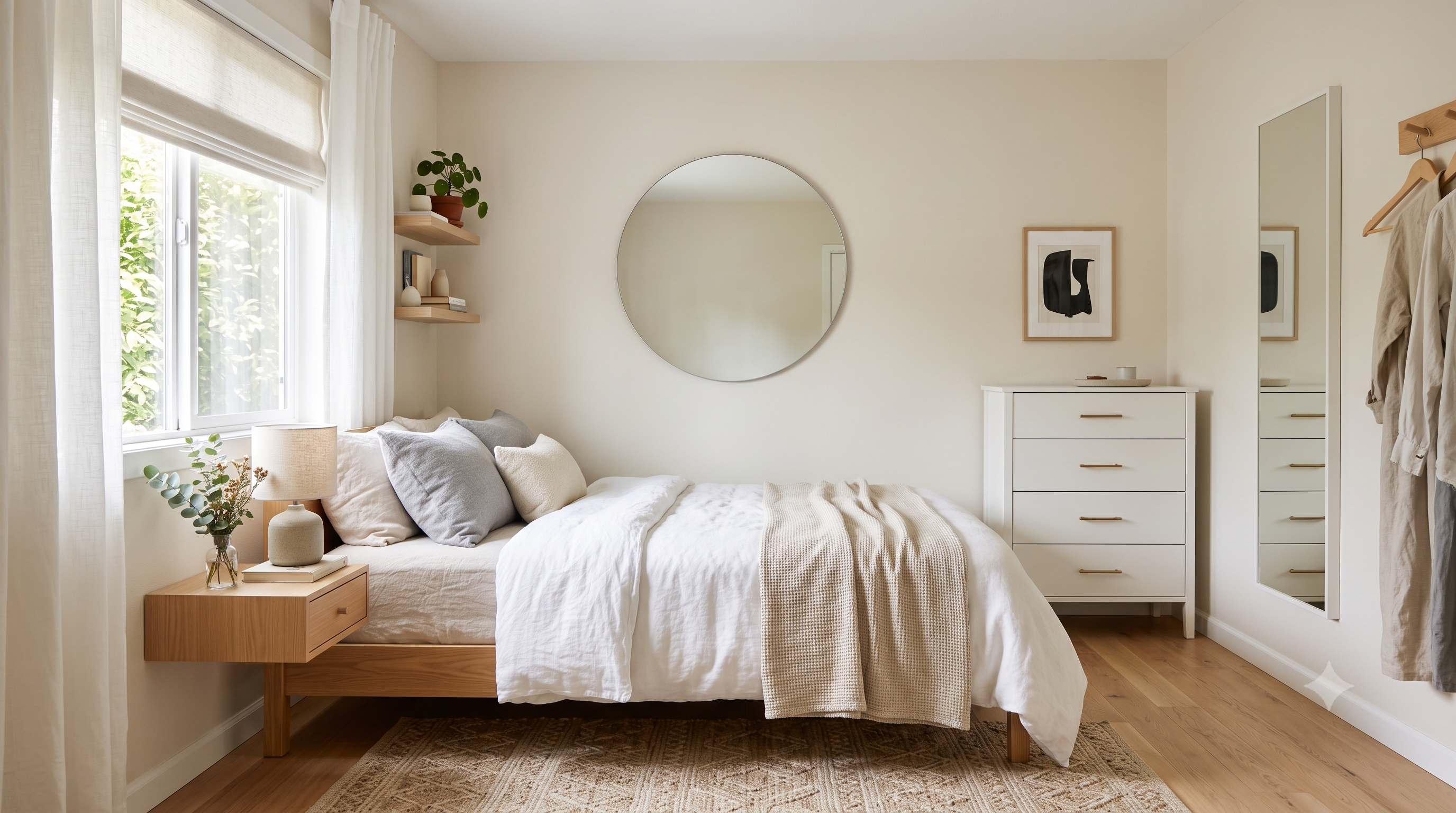
25 Small Bedroom Ideas To Make a Room Look Bigger
1. Push the Bed Against the Wall That Makes the Most Sense, Not the Prettiest One
It’s tempting to center your bed under a window because it looks nice in photos, but in a small room, that placement often eats up your best walking path. Instead, walk the room and figure out which wall placement leaves the widest, most uninterrupted path from the door to the closet. In a lot of small bedrooms, that means pushing the bed into a corner or against the longest wall, even if it’s not the wall you’d instinctively choose. This single decision often does more for how open a room feels than any decor purchase.
2. Choose a Low-Profile Bed Frame
A tall, bulky bed frame with a thick headboard visually eats up a huge portion of a small room. A platform bed or a frame with a low profile lets more of the wall and ceiling show above it, which reads as more open space. If you’re shopping, look for frames under about 14 inches off the floor. This is especially useful in a small master bedroom where the bed is unavoidably the largest piece of furniture in the room.
3. Consider a Storage Bed Instead of a Separate Dresser
A storage bed with drawers built into the base can replace some or all of a standalone dresser, freeing up floor space you’d otherwise need for a separate piece of furniture. This works particularly well in a small apartment bedroom where every square foot of floor is doing double duty. The tradeoff is that storage beds are heavier to move, so they’re a better fit if you’re not relocating often.
4. Hang Floating Nightstands Instead of Using Legged Ones
A wall-mounted nightstand doesn’t touch the floor, which means the floor underneath it stays visually open. Even a small floating shelf on either side of the bed can hold a lamp, a phone, and a book, without the bulk of a traditional nightstand with legs and drawers. This is a simple swap that works in almost any small bedroom layout and is easy to install with basic wall anchors.
5. Use a Slim, Narrow Nightstand If You Need Drawers
If floating shelves don’t give you enough storage, look for a narrow nightstand — something 12 to 16 inches wide instead of the standard 20-plus inches. The extra few inches you save on each side of the bed add up, especially in a room where the bed nearly touches both walls.
6. Go Vertical With Storage Instead of Wide
Tall, narrow bookcases and shelving units take up a small footprint on the floor while offering plenty of storage above eye level. Instead of a low, wide dresser that eats up a big chunk of wall, look for tall units that are 12 to 18 inches deep. This is one of the most effective small bedroom storage ideas because it uses space that would otherwise sit empty — the upper third of your walls.
7. Add Wall-Mounted or Floating Shelves Above the Bed or Desk
Floating shelves installed above a headboard or desk give you display and storage space without taking up any floor area at all. Use them for books, small plants, or framed photos instead of piling those items on a dresser top. Keep the styling light — three or four objects per shelf, with breathing room between them, looks intentional rather than cluttered.
8. Maximize Under-Bed Storage
The space under your bed is often completely wasted. Clear, stackable under-bed bins or a set of rolling drawers can hold off-season clothing, extra linens, or shoes, all hidden from view. If your bed frame has legs, look for one with at least 7 to 8 inches of clearance so the bins actually fit and slide easily. This is one of the simplest storage solutions for small bedrooms because it uses space you’re already paying for in square footage but not using.
9. Use a Large Mirror to Bounce Light and Create Depth
A large mirror reflects both natural and artificial light back into the room and creates the illusion of a second “window” or additional depth. Where you put a mirror in a small bedroom actually matters: placing it across from or near a window will reflect the most light, while placing it directly opposite the bed can feel disorienting to some people, so test the placement before committing. A leaning floor mirror is a good renter-friendly option since it doesn’t require mounting hardware.
10. Add a Second, Smaller Mirror as an Accent
Beyond one large mirror, a smaller decorative mirror on an adjacent wall can add another layer of reflected light without overwhelming the room. This works well above a dresser or beside a closet door, giving you a practical spot to check your appearance while adding another light-bouncing surface.
11. Choose Light, Warm Wall Colors — But Know You Have Options
Light neutrals, warm whites, soft beige, and pale gray are reliable choices for making a small bedroom feel open, because they reflect more light than dark colors and don’t visually “advance” toward you the way deep, saturated colors can. That said, white isn’t the only option. Muted blues and soft sage greens can also read as spacious, especially in rooms with good natural light, because they’re still light in value even though they carry more color than a true neutral. The common thread among all of these choices isn’t the specific hue — it’s that they’re light in value and low in contrast with the trim and ceiling.
12. Don’t Be Afraid of a Darker Accent Wall, Used Carefully
A single darker wall — behind the headboard, for example — can actually add depth and coziness without making the whole room feel smaller, as long as the other three walls stay light and the room has decent lighting. This works especially well in a small guest bedroom or a room you want to feel intentionally cozy rather than strictly “bigger.” The key is contrast: one deep wall against three light ones reads as a design choice, while four dark walls in a small room will feel closed in.
13. Keep Trim and Ceiling Lighter Than or Matching the Walls
A ceiling that’s noticeably darker or more saturated than the walls will visually “lower” in a small room, making it feel more cramped. Painting the ceiling the same white or off-white as the trim, or a very slightly lighter version of the wall color, keeps the eye moving upward instead of stopping short. This is an easy, budget-friendly small bedroom makeover project if your ceiling hasn’t been touched in years.
14. Hang Curtains High and Wide
One of the most common small bedroom window mistakes is hanging curtains directly on top of the window frame. Instead, mount the curtain rod several inches above the frame and extend it a few inches past the window on each side. This tricks the eye into perceiving a taller, wider window than what’s actually there, and it lets in more light when the curtains are open. Choose lightweight, light-colored fabric so the window still feels bright even when covered.
15. Layer in a Few Different Light Sources
Relying on a single overhead fixture creates flat, harsh lighting that can make a small room feel more clinical than cozy. Add a floor lamp in a corner, a small table lamp on your nightstand, or plug-in wall sconces to create layered light at different heights. This is a small bedroom lighting idea that costs very little — even swapping in warmer-toned bulbs (around 2700K to 3000K) makes a noticeable difference in how inviting the room feels.
16. Maximize Natural Light
Keep windows unobstructed by furniture, trim back any plants blocking the glass, and clean the windows themselves — it sounds basic, but grime and dust genuinely cut down on how much light gets through. If privacy allows, swap heavy blackout curtains for sheer or light-filtering ones during the day and save the blackout layer for nighttime only, using a double curtain rod if needed.
17. Choose a Rug That’s Sized Correctly for the Room
A rug that’s too small will visually chop the floor into disconnected sections, which makes a small bedroom feel choppier and smaller than it is. As a general guideline, aim for a rug that extends at least a foot beyond the sides of the bed, or one large enough that the front two legs of any furniture sit on it. A rug that’s too big for the space, on the other hand, can overwhelm a small room, so measure the space before you buy rather than guessing.
18. Keep Flooring Visible Around the Perimeter of the Room
Even with a properly sized rug, try to leave a visible border of flooring around the edges of the room rather than covering wall to wall with furniture and rugs. Seeing the actual floor near the walls gives the brain a visual cue about how much open space exists, which subtly reinforces the sense that the room is larger than it is.
19. Limit Wall Decor to a Few Intentional Pieces
A wall covered in many small frames, posters, and knick-knacks can make a small bedroom feel busy and closed in, even if the floor itself is clear. Instead, choose one or two larger pieces of art, or a tightly curated gallery wall with consistent frame colors, rather than a scattered mix of many small items. Negative space on the walls is doing real work in a small room — it gives the eye somewhere to rest.
20. Use Multifunctional Furniture Wherever Possible
A bench with hidden storage at the foot of the bed, an ottoman that opens up, or a desk that folds against the wall when not in use all let one piece of furniture do the job of two. This is especially useful in a small apartment bedroom that also needs to function as a home office or reading nook. Before buying any new furniture for a small room, ask whether it could serve more than one purpose.
21. Consider a Murphy Bed for a True Multi-Use Room
If your bedroom regularly needs to double as an office, guest space, or workout area, a wall-mounted Murphy bed folds up and out of the way entirely during the day. This is a bigger investment — professionally installed Murphy beds often run from $1,500 to $4,000+ depending on the size and features — but for a room that genuinely needs to serve two functions, it can be transformative in a way that smaller changes can’t match.
22. Declutter Before You Decorate
It’s tempting to jump straight to buying new furniture or shelving, but decluttering a small bedroom first often reveals that you need less storage than you thought. Go through closets, under the bed, and every surface, and be honest about what you actually use. A smaller amount of stuff, stored well, will always look better in a small room than a large amount of stuff, no matter how organized the containers are.
23. Give Everything a Home — Especially on Surfaces
Clutter on visible surfaces (dressers, nightstands, the floor near the closet) is one of the fastest ways to make a small bedroom feel chaotic. Small bedroom organization comes down to giving every category of item — jewelry, chargers, loose papers — a specific drawer, tray, or bin, so things have somewhere to go besides “wherever there’s space.” A simple tray on the dresser for daily items you actually use keeps small clutter contained instead of spreading across the whole surface.
24. Edit Your Closet the Way You’d Edit Your Wardrobe
Small bedroom closet ideas don’t have to involve an expensive built-in system. Start by removing anything you haven’t worn in the last year, then add an over-the-door shoe organizer, slim velvet hangers (which take up noticeably less rod space than plastic ones), and a hanging closet organizer with shelves for folded items. This alone can make a shared or single closet feel like it holds far more than it did before, without adding a single piece of furniture to the room itself.
25. Stick to a Cohesive, Limited Color Palette in Your Styling
Beyond wall paint, the bedding, curtains, rug, and decor you choose all contribute to how “busy” a room feels. Sticking to two or three colors throughout the room — rather than a different color for every textile — creates visual continuity that makes the whole space read as calmer and larger. This doesn’t mean everything has to match exactly; it means choosing a simple palette and staying disciplined about it, which is one of the most overlooked cozy small bedroom ideas for renters who are decorating with soft goods rather than paint or built-ins.
Small Bedroom Problem-and-Solution Table
| Small Bedroom Problem | Smart Solution | Why It Works |
|---|---|---|
| Bed takes up nearly the whole room | Choose a low-profile platform bed and consider a full instead of a queen if the room can’t comfortably fit one | Reduces visual bulk and leaves more walkable floor space |
| No room for a dresser | Use a storage bed base or wall-mounted shelving instead | Moves storage off the floor or eliminates a separate piece entirely |
| Room feels dark | Layer lighting, hang curtains high and wide, add a large mirror near the window | Increases both natural and artificial light without renovation |
| Floor is always cluttered | Add under-bed bins, a closet organizer system, and daily “homes” for loose items | Gives every item a designated spot instead of the nearest flat surface |
| Room feels choppy or cramped | Size the rug correctly and leave visible flooring at the room’s edges | Creates a sense of continuous, unbroken floor space |
| Walls feel busy | Limit wall decor to one or two intentional pieces | Gives the eye a place to rest instead of scanning constant detail |
| No space for a desk or extra function | Use a fold-down desk or Murphy bed setup | Lets one room serve two purposes without permanent furniture |
| Closet feels impossibly small | Declutter, add slim hangers, and use an over-the-door organizer | Increases usable storage without adding furniture to the room |
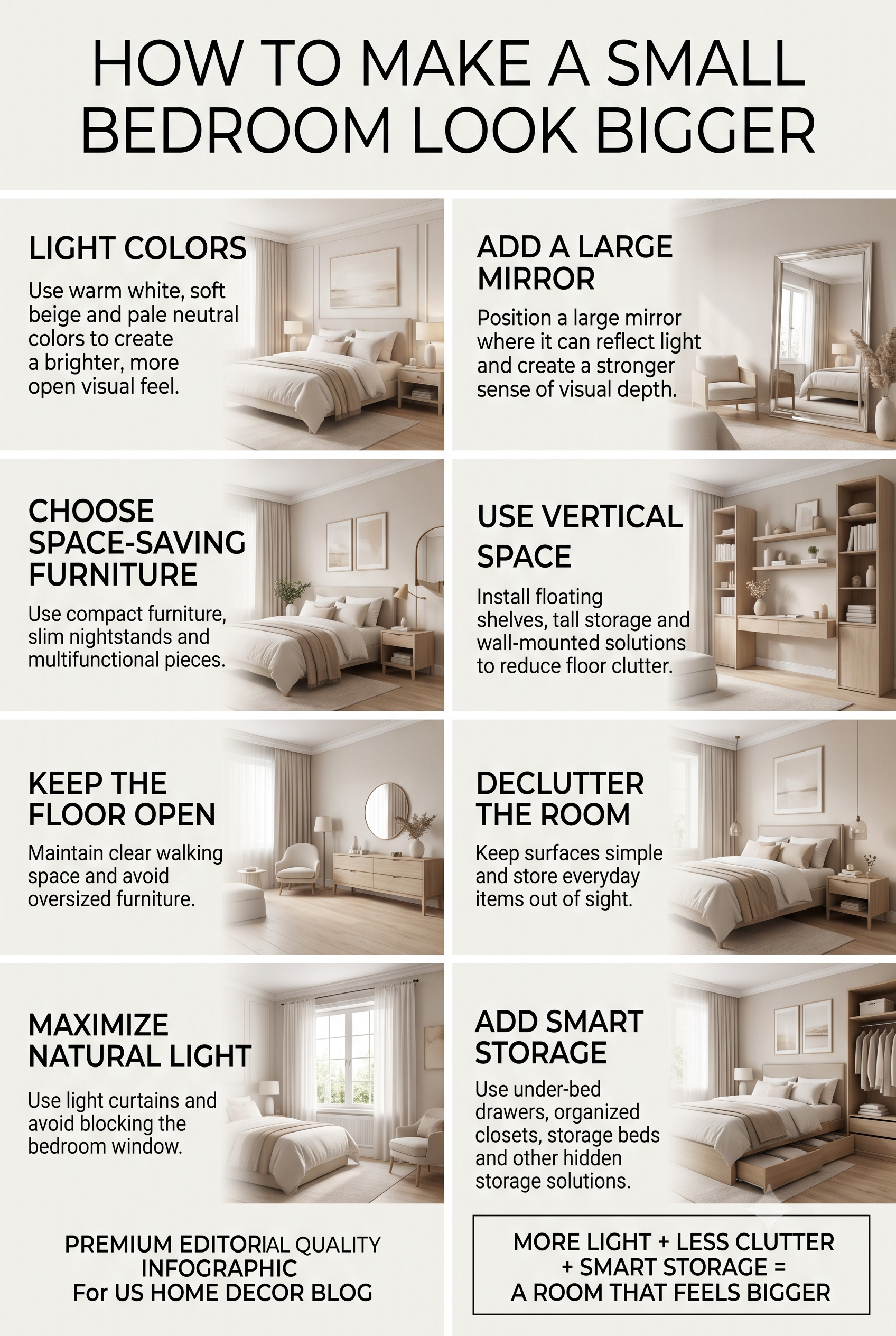
Small Bedroom Mistakes That Make a Room Feel Smaller
1. Buying furniture sized for a bigger room. An oversized dresser or a bed frame with a tall, thick headboard might look great in a showroom, but in a small bedroom it dominates the space. Measure your room carefully and look for furniture scaled to fit it, not furniture you simply like the look of.
2. Pushing every piece of furniture against the walls. It seems logical to maximize the center of the room, but if every wall is lined with furniture, the room can end up feeling boxed in with no visual breathing room. Sometimes leaving one wall mostly clear does more than filling every available inch.
3. Using heavy, dark curtains in a room that needs light. Dark, thick curtains block light even when partially open and visually shrink the window. Save heavier blackout fabric for actual bedtime use, and choose something lighter for daytime.
4. Skipping a rug because the room is small. Bare floor isn’t automatically better — an oddly proportioned or missing rug can make a room feel unfinished and choppy. Choose the right size rather than skipping it entirely.
5. Letting the closet door stay open with visible clutter. An overstuffed, visibly messy closet with the door left open adds clutter to the room’s sightline even if the rest of the space is tidy. Keep the door closed, or invest a little time in organizing what’s inside.
6. Mounting curtains right above the window frame. As mentioned earlier, this shrinks the perceived size of the window and the light it lets in. A higher, wider rod placement is a nearly free fix.
7. Overdecorating every wall and surface. Filling every wall with frames and every surface with objects adds visual noise that makes a small room feel busier and smaller than it is, even when it’s technically clean.
8. Ignoring vertical space. Many small bedrooms have a lot of unused wall space above furniture and doorways. Failing to use shelving or tall storage there means missing one of the easiest ways to add function without taking up floor area.
Best Colors for a Small Bedroom
Light neutrals remain a dependable choice for small bedroom paint colors because they reflect light and keep contrast low between walls, trim, and ceiling. Warm whites (rather than stark, cool whites) tend to feel more inviting and less clinical in a small space. Soft beige works well in rooms with a lot of wood tones or warm-toned furniture, while pale gray suits a more modern, minimalist bedroom aesthetic.
That said, muted blues and soft sage greens can also make a small bedroom look bigger, particularly in rooms that get good natural light throughout the day. What matters more than the specific hue is the value — how light or dark the color is — and the contrast between the wall color and everything around it. A pale, dusty blue with white trim will read as open and airy in much the same way a warm white does.
Darker colors aren’t automatically off-limits, either. A single deep-toned accent wall, used behind a headboard with the remaining walls kept light, can add richness and coziness to a small room without making it feel smaller overall — as long as the lighting in the room is strong enough to keep the space from feeling dim.
Small Bedroom Layout Tips
Start by mapping your room’s actual walking paths before you decide where furniture goes. In most small bedrooms, you want at least 24 to 30 inches of clearance around the bed for comfortable movement, though this isn’t always possible in very tight layouts — prioritize the side you’ll use most and the path to the door and closet.
Position the bed on the wall that leaves the widest continuous path, even if that means it isn’t centered under a window. If you’re deciding between a queen and a full-size bed for a small master bedroom, measure your actual floor space rather than assuming a queen will fit just because it fits in most bedrooms — a full-size frame can sometimes make the difference between a room that feels workable and one that feels wall-to-wall bed.
Use the walls, not just the floor, for as much function as possible: wall-mounted lighting instead of floor or table lamps, floating shelves instead of a bookcase, hooks instead of a valet stand. Every item you can get off the floor adds to the sense of open, walkable space, which is often what separates a small bedroom that feels “cozy” from one that feels “cramped.”
Budget-Friendly Small Bedroom Makeover
- Under $50: Declutter and reorganize what you already have, add slim velvet hangers to your closet, install a set of inexpensive floating shelves, switch to warmer LED bulbs in your existing lamps, and rehang your curtain rod higher and wider using the existing curtains.
- $50–$150: Add a properly sized area rug from a budget retailer, buy a large leaning floor mirror, pick up a few matching storage bins for under-bed use, or invest in a small set of wall sconces with plug-in cords (no electrical work required).
- $150–$500: Replace a bulky dresser with a slim, tall storage unit, buy a platform bed frame if you’re due for a new one anyway, add a wall-mounted or floating desk for a multi-use setup, or hire a handyperson for an afternoon to install floating shelves and a properly mounted curtain rod.
These ranges are rough examples based on typical retail pricing, not universal guarantees — actual costs will vary by retailer, region, and materials.
Small Bedroom Ideas for Renters and Apartments
If you’re renting, most of the ideas above still apply without any permanent changes. A tension curtain rod avoids the need for drilling into the wall above your window. Leaning mirrors and floor lamps require no installation at all. Removable, damage-free hooks can hold floating-style shelving in some cases, or you can use furniture risers to gain a few extra inches of under-bed storage without touching the walls. Command-strip-mounted lightweight shelves are another apartment-friendly option, though always check the weight limits before loading them with anything heavier than light decor. When in doubt, check your lease for what’s allowed before installing anything that involves drilling or adhesive.
Frequently Asked Questions (FAQs)
Question 1: How can I make my small bedroom look bigger?
Answer: Focus on furniture placement first — a bed positioned to leave the widest walking path makes the biggest visual difference. From there, add a large mirror, use light colors on the walls, and get as much storage off the floor and onto the walls as possible.
Question 2: What colors make a small bedroom look bigger?
Answer: Light neutrals like warm white, soft beige, and pale gray are dependable choices, but muted blues and soft greens can work just as well if they’re light in value and the room gets good natural light.
Question 3: Where should I put a mirror in a small bedroom?
Answer: Near or across from a window is usually most effective, since it reflects natural light back into the room. Test placement before mounting anything permanently, since some people find a mirror directly facing the bed distracting.
Question 4: What type of bed is best for a small bedroom?
Answer: A low-profile platform bed, ideally with built-in storage underneath, works well in most small bedrooms. Consider whether a full-size mattress makes more sense than a queen based on your actual floor dimensions, not just personal preference.
Question 5: How do I add storage without making a small bedroom feel crowded?
Answer: Prioritize vertical storage — tall narrow shelving, wall-mounted units, and under-bed bins — over wide, floor-level furniture. Getting storage up and off the floor keeps sightlines open even as your storage capacity increases.
Question 6: How can I make a small bedroom cozy without clutter?
Answer: Layer your lighting instead of relying on one overhead fixture, choose a couple of soft textiles like a throw blanket or accent pillow, and stick to a limited color palette. Coziness comes from warmth and texture, not from the number of objects in the room.
Question 7: What furniture should I avoid in a small bedroom?
Answer: Oversized dressers, bulky headboards, and any furniture with a wide, heavy visual footprint tend to overwhelm a small room. Look for pieces that are appropriately scaled, with legs or a raised base where possible so some floor remains visible underneath.
Question 8: How can renters decorate a small bedroom?
Answer: Focus on non-permanent solutions: tension curtain rods, leaning mirrors, furniture risers, removable adhesive hooks (checked for proper weight limits), and rugs or lighting that don’t require any installation. Nearly every idea in this guide can be adapted for a rental.
Final Thoughts
Making a small bedroom look and feel bigger isn’t about one dramatic renovation — it’s usually a combination of smaller decisions: where the bed sits, how much floor stays visible, how much light the room gets, and how disciplined you are about what actually lives in the space. If the list above feels like a lot, don’t try to do everything at once. Pick two or three changes that address your biggest frustration first — maybe that’s rehanging your curtains and adding a mirror, or clearing out the closet and adding under-bed storage — and build from there. Small, deliberate changes add up, and most of these small bedroom ideas cost far less than people expect for how much difference they make in daily life.
1 thought on “25 Small Bedroom Ideas To Make Your Room Look Bigger”
Comments are closed.