
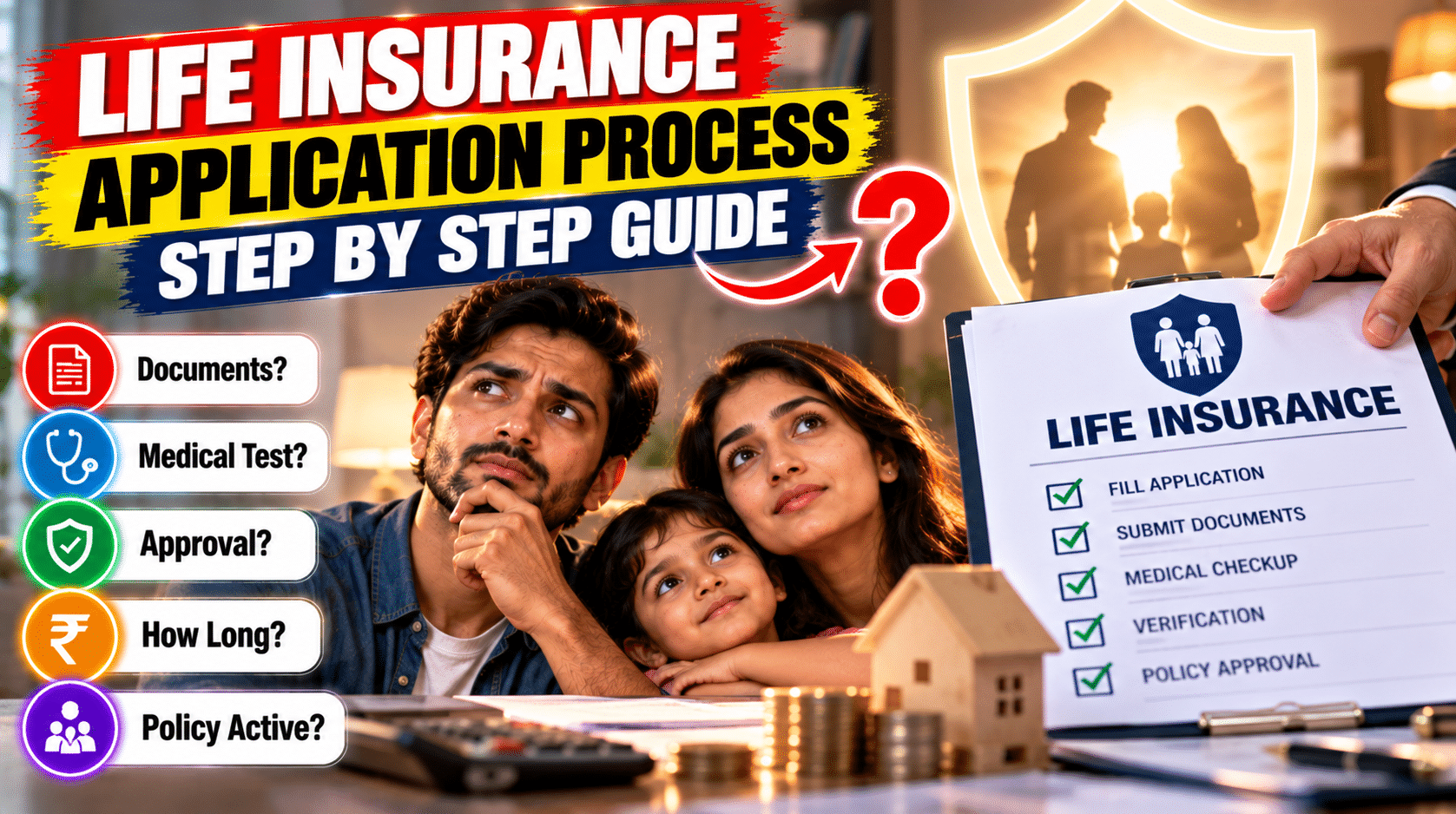
How to Apply for Life Insurance: Buying a life insurance policy may look like a simple online process. You choose a plan, enter your details, upload documents, and make the payment. But behind the scenes, the insurer goes through several important steps before deciding whether to issue the policy and on what terms.
The proposal form, health disclosures, financial information, documents, and medical evaluation can all play a role in the underwriting process. Most importantly, paying the first premium does not by itself mean that your life insurance cover has started. The insurer’s acceptance and the policy’s stated commencement date should be confirmed.
So, how does the life insurance application process actually work in India?
Here is a complete step-by-step guide covering the application form, documents, medical tests, underwriting, policy issuance, and the important checks you should make after receiving your policy.
What Is the Life Insurance Application Process?
The life insurance application process is the journey through which an applicant provides personal, financial, and health information to an insurer so that the company can evaluate the risk and decide whether to issue life insurance.
A typical application journey can look like this:
Choose your coverage → Select a suitable policy → Fill the proposal form → Submit documents → Medical evaluation if required → Underwriting → Insurer’s decision → Policy issuance → Review the policy
The exact procedure can differ depending on the insurer, policy type, age, coverage amount, health profile, occupation, and other factors.
Step 1: Decide Why You Need Life Insurance
Before filling out any application form, first understand the purpose of buying life insurance.
For most people, life insurance is primarily about protecting their family financially if something happens to the earning member.
Your coverage may be intended to help with:
- Family’s regular living expenses
- Home or personal loans
- Children’s education
- Spouse’s financial security
- Dependent parents
- Long-term financial obligations
- Other major family responsibilities
Once you understand the purpose, you can estimate how much life cover may be appropriate for your situation.
There is no single coverage amount that is right for everyone. Your income, liabilities, savings, investments, and number of dependants should all be considered before selecting the sum assured.
Step 2: Choose the Right Type of Life Insurance
The next step is selecting the type of life insurance policy.
Term insurance, savings-oriented life insurance and ULIP products can serve different financial objectives. A term plan is generally focused on providing life protection for a specified period, while other products may combine insurance with savings or market-linked investment features.
Don’t choose a policy simply because its premium looks cheap.
Instead, ask yourself:
What financial need am I trying to solve with this policy?
Read the policy features, benefits, exclusions, charges, and conditions carefully before making your final decision.
Step 3: Keep Your Information Ready
The proposal form asks for important information about you and the insurance you are applying for.
Depending on the insurer and product, you may need to provide details such as:
- Full name
- Date of birth
- Residential address
- Mobile number
- Email address
- Occupation
- Income
- Existing life insurance policies
- Nominee information
- Policy term
- Desired sum assured
- Health history
- Smoking or tobacco habits
- Alcohol consumption
- Relevant medical treatment or medication
The exact information requested can vary from one insurer to another.
Having the relevant documents and information ready before starting the application can make the process much smoother.
Step 4: Fill the Proposal Form Carefully
The proposal form is one of the most important documents in the entire life insurance process.
It is used by the insurer to collect information about the applicant and forms an important part of the underwriting process. The information generally covers personal details, policy requirements, health and lifestyle information, and declarations.
This is why you should never rush through the form.
Answer questions honestly and accurately, particularly those relating to:
- Existing medical conditions
- Previous surgeries
- Hospitalisation
- Ongoing treatment
- Prescription medicines
- Smoking or tobacco use
- Alcohol consumption
- Occupation
- Hazardous activities
- Existing insurance cover
- Other information specifically requested by the insurer
Why Is Correct Disclosure So Important?
Some applicants may be tempted to hide a medical condition because they believe it could increase the premium or make the policy difficult to obtain.
That can create serious problems later.
The insurer’s current guidance emphasises that the proposal should contain factual and complete information. Material suppression or incorrect information can potentially create complications during claim assessment.
The simple rule is:
If the proposal form asks for it, disclose it accurately.
Step 5: Submit the Required Documents
Once the proposal form is completed, you may need to submit supporting documents.
The exact list depends on the insurer, product, and applicant, but commonly requested documents may include:
| Document | Purpose |
|---|---|
| Aadhaar/PAN/Passport/Voter ID/Driving Licence | Identity verification |
| Age proof | Verification of date of birth |
| Address proof | Residential verification |
| Salary slips | Income verification for salaried applicants |
| Form 16/ITR | Income and financial assessment |
| Bank statements | Financial verification where required |
| Medical reports | Health and underwriting assessment |
| Photographs | Applicant verification |
| Existing policy details | Understanding existing insurance coverage |
| Proposal form | Application and risk information |
Aditya Birla Sun Life’s current term-insurance documentation guidance lists identity, age, address, income, and medical documents among the commonly required categories.
Not every applicant will be asked for every document.
Step 6: Do You Need a Medical Test?
This is one of the most common questions people have when applying for life insurance.
The answer is: not necessarily.
Medical requirements can depend on several factors, including:
- Your age
- Amount of cover requested
- Policy duration
- Declared health conditions
- Medical history
- Tobacco or nicotine use
- Alcohol consumption
- Occupation
- Existing insurance coverage
- Insurer’s underwriting requirements
Depending on the application, the insurer may ask for a tele-medical assessment, medical examination, laboratory tests, diagnostic investigations, or medical records.
A medical test should not be treated as a reason to hide information. Even when no physical examination is requested, you should still answer every health-related question in the proposal form correctly.
Step 7: The Insurer Performs Underwriting
After receiving your proposal and documents, the insurer evaluates the application through underwriting.
Underwriting is essentially the insurer’s risk assessment process.
The company may consider:
- Age
- Health profile
- Medical history
- Lifestyle habits
- Occupation
- Income
- Requested sum assured
- Policy term
- Existing life insurance
- Medical reports
- Other relevant information
After reviewing the application, the insurer may:
- Accept the proposal on standard terms
- Request additional documents or information
- Offer cover with different terms or conditions
- Decline the proposal
There is no single universal underwriting timeline for every application. Straightforward applications can move faster, while cases requiring additional medical or financial information may take longer.
Step 8: Additional Information May Be Requested
Sometimes the insurer may contact you after the initial submission and ask for clarification or additional documents.
For example, it may request:
- Previous medical reports
- Recent medical tests
- Income documents
- Existing insurance details
- Clarification regarding a medical condition
- Additional KYC documents
- Information about occupation or lifestyle
Don’t ignore such requests.
Responding promptly and providing accurate information can help prevent unnecessary delays in processing your application.
Step 9: Does Paying the First Premium Mean Your Cover Has Started?
No, not automatically.
This is an important point that many buyers misunderstand.
Submitting an application and making the first payment should not be treated as automatic confirmation that the policy is already active.
The insurer needs to accept the proposal, and the policy documents should state the applicable commencement or risk commencement date.
Aditya Birla Sun Life specifically advises applicants to confirm acceptance and the policy commencement date rather than assuming that payment alone means the cover has started.
So, always check the final policy document.
Step 10: Policy Issuance
If the insurer accepts your proposal, the policy is issued.
The policy document contains the contractual details of your insurance arrangement.
It can include information such as:
- Policy number
- Policyholder details
- Life assured
- Sum assured
- Policy term
- Premium amount
- Premium payment term
- Nominee details
- Benefits
- Exclusions
- Riders
- Policy commencement date
- Other applicable conditions
Once the policy is issued, don’t simply save the PDF and forget about it.
Read it carefully.
What Should You Check After Receiving the Policy?
Compare the issued policy with what you originally applied for.
Pay particular attention to:
- Your name and personal details
- Date of birth
- Sum assured
- Policy term
- Premium
- Premium payment frequency
- Nominee information
- Riders
- Benefits
- Exclusions
- Special conditions
- Commencement date
If you find an important discrepancy, contact the insurer through an official channel as soon as possible.
The insurer’s current guidance also recommends promptly reporting discrepancies and checking the applicable free-look period if you are considering cancellation.
What Is the Free-Look Period?
The free-look period gives eligible policyholders an opportunity to review the policy after receiving the policy document.
Under the current IRDAI life insurance framework, the applicable free-look period is generally 30 days, subject to the relevant regulatory conditions and policy provisions.
This makes it important to actually read the policy instead of keeping it unopened.
If the policy terms are materially different from what you expected, contact the insurer promptly and understand the applicable cancellation procedure.
What If You Make a Mistake in the Application Form?
If you discover that you entered incorrect information after submitting the proposal, don’t ignore it.
Contact the insurer through an official channel, explain the correction, and provide the correct information.
It is also sensible to keep written proof of the communication.
The insurer’s current guidance recommends promptly informing the company about corrections and retaining its written response.
Never Deliberately Hide Information
A common mistake is assuming that a small omission will never matter.
That’s not a good strategy.
If the insurer asks about a particular medical condition, treatment, medication, tobacco use, or another relevant fact, answer according to the question rather than deciding yourself that the information is “not important.”
How to Make the Life Insurance Application Process Easier
A little preparation before applying can save considerable time later.
Before starting the application:
- Keep your KYC documents ready
- Keep income documents available
- Collect relevant medical reports
- Make a list of current medicines
- Check details of existing insurance policies
- Keep nominee information ready
- Read every proposal question carefully
- Review the completed form before submitting it
- Save the submitted proposal and payment receipt
For applicants with medical histories, keeping previous prescriptions, reports and discharge summaries organised can also make the underwriting process easier if the insurer requests them.
Common Mistakes to Avoid When Applying for Life Insurance
Choosing a policy only because the premium is low
The cheapest policy isn’t necessarily the right policy for your family’s financial needs.
Hiding health information
Incomplete disclosure can create complications later.
Guessing information
If you don’t remember an important medical or financial detail, check your records rather than guessing.
Not checking existing insurance
The insurer may ask about your existing life insurance coverage as part of its assessment.
Letting someone else fill the form without checking it
An agent or adviser may help with the application, but you should carefully review the completed form before signing or confirming it.
Assuming the first premium means immediate coverage
Always confirm the acceptance and commencement date.
Ignoring nominee details
Incorrect nominee information can create unnecessary administrative difficulties later.
Not keeping your policy documents safe
Your family should know that the policy exists and where its documents are stored.
Life Insurance Application Process at a Glance
| Stage | What Happens |
|---|---|
| 1 | Decide your financial protection requirement |
| 2 | Choose an appropriate policy |
| 3 | Fill out the proposal form |
| 4 | Submit KYC and supporting documents |
| 5 | Complete medical evaluation if required |
| 6 | Insurer conducts underwriting |
| 7 | Additional information may be requested |
| 8 | Insurer makes its decision |
| 9 | Premium/payment is processed as applicable |
| 10 | Policy is issued |
| 11 | Review the policy document |
| 12 | Store the documents safely |
What Happens If the Insurer Declines Your Application?
An insurer may decline a proposal after assessing the information provided.
This does not necessarily mean that you can never obtain life insurance elsewhere.
Different insurers can have different underwriting approaches and product eligibility criteria.
If your proposal is declined, understand the reason provided by the insurer and avoid hiding the same information in another application.
If you apply elsewhere, provide accurate and complete information again.
Should Your Family Know About Your Life Insurance Policy?
Yes.
A life insurance policy is purchased primarily for financial protection, so your family or nominee should know that the policy exists.
Ideally, keep the following information accessible:
- Policy number
- Insurer name
- Policy document
- Premium details
- Nominee details
- Customer service information
- Important correspondence
This can make the claim process much easier for your family in the future.
Final Verdict
The life insurance application process is much more than filling out an online form and paying a premium.
The insurer uses the information in your proposal, supporting documents, and, where required, medical evaluation to assess the risk before issuing the policy.
The smartest approach is simple: choose the coverage according to your family’s needs, answer every question honestly, submit genuine documents, respond quickly to additional requirements, and carefully review the final policy document.
And remember one crucial point: don’t assume that paying the first premium automatically means your life cover is active. Confirm the insurer’s acceptance and the policy’s stated commencement date.
A few extra minutes spent checking your application today can prevent much bigger problems when the policy is actually needed.
Frequently Asked Questions (FAQs)
Can I apply for life insurance online?
Yes. Many insurers provide online application facilities. However, depending on your profile and the policy, additional documentation, verification, or medical evaluation may be required.
Does paying the first premium activate my life insurance?
Not necessarily. You should confirm that the insurer has accepted the proposal and check the policy’s stated commencement date.
Can I buy life insurance if I have a medical condition?
Yes, you can submit an application. You should disclose the condition accurately and provide medical records if requested. The insurer will decide whether and on what terms the policy can be issued.
Are medical tests compulsory for every life insurance applicant?
No. Medical requirements vary depending on factors such as age, coverage amount, health information, lifestyle, and the insurer’s underwriting rules.
What documents are generally required for life insurance?
Common requirements can include identity proof, age proof, address proof, income documents, photographs, medical records, and the completed proposal form. The exact requirements depend on the policy and insurer.
How long does life insurance underwriting take?
There is no single timeline applicable to every applicant. Applications requiring additional documents, medical tests, or clarification can take longer.
Can I correct an incorrect answer after submitting the proposal?
Yes, if you notice an error, contact the insurer promptly through an official channel, provide the correct information, and keep a record of the communication.
What if an insurance agent fills out the proposal form for me?
You can take assistance, but you should review every answer before signing or confirming the application. The final proposal should accurately reflect the information you provided.
What should I check after receiving my life insurance policy?
Check your name, sum assured, premium, policy term, nominee details, riders, benefits, exclusions, and commencement date.
What is the free-look period in life insurance?
The applicable free-look period generally allows a policyholder to review the policy after receiving the document. Under the current framework, it is generally 30 days, subject to applicable regulatory conditions.
Can I cancel my policy during the free-look period?
Eligible policyholders can use the free-look facility according to the applicable regulations and policy terms. Contact the insurer promptly if you are considering cancellation.
What happens if the insurer asks for additional documents?
Submit the requested information as soon as possible through the insurer’s official channel. Additional requirements can arise during underwriting.
Should I disclose an old surgery?
If the proposal asks about previous surgery or relevant medical history, disclose it according to the wording and time period mentioned in the form. If you’re unsure, ask the insurer rather than assuming it doesn’t need to be mentioned.
Should I disclose occasional tobacco or nicotine use?
Yes, answer according to the definition and questions provided in the proposal form. If the available options don’t accurately describe your situation, ask the insurer for clarification.
Can an existing health condition automatically lead to rejection?
Not necessarily. The insurer evaluates the overall risk based on the information provided and then decides whether cover can be offered and on what terms.
Should my family know about my life insurance?
Yes. Your nominee or a trusted family member should know that the policy exists and where the documents are stored. This can make future servicing and claim procedures easier.