
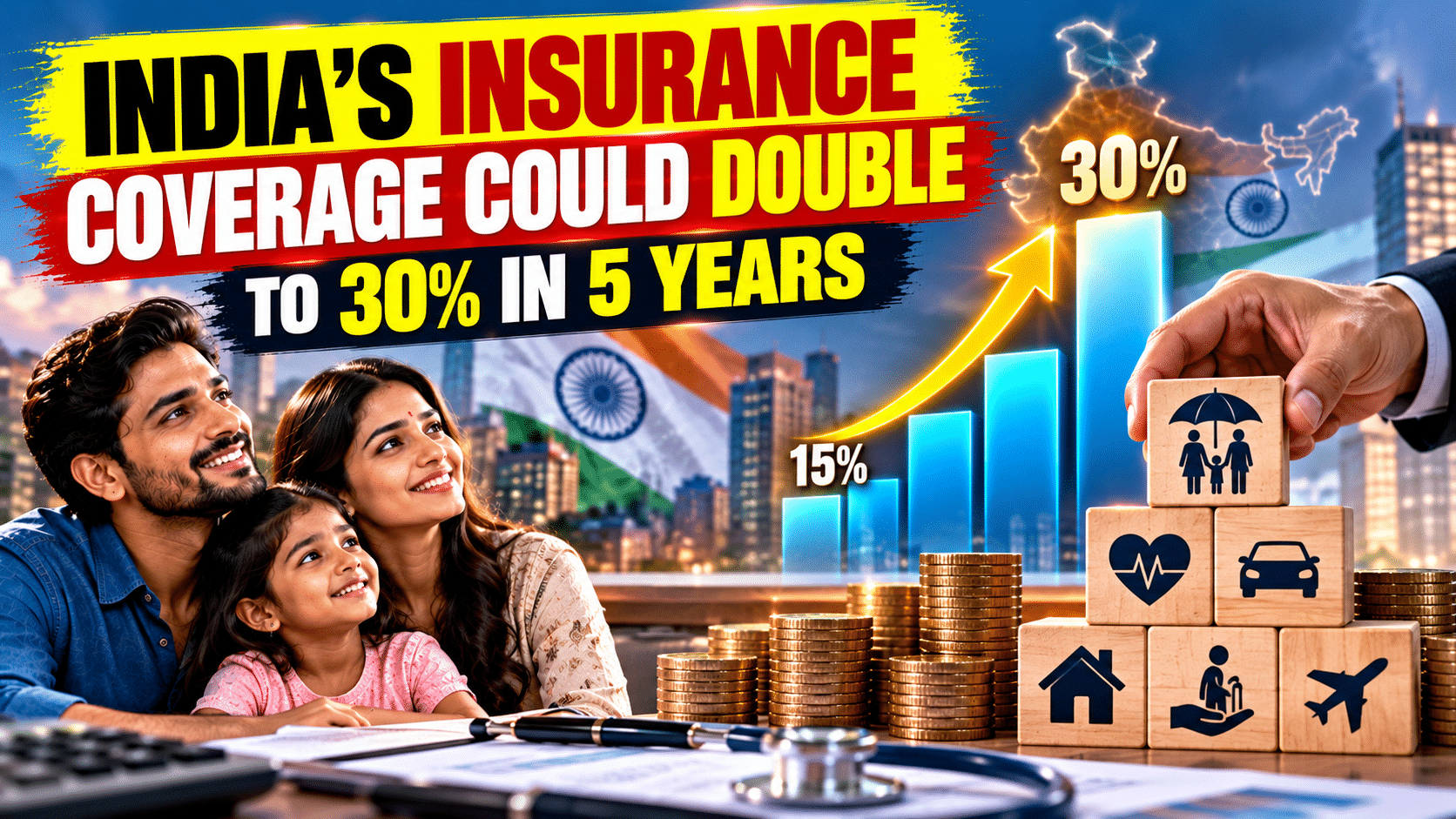
Insurance Coverage in India: India’s insurance sector could be heading towards a major transformation, with the country’s insurance regulator highlighting the possibility of doubling effective insurance coverage over the next five years. The development could have important implications for households, small businesses and millions of people who remain financially vulnerable to unexpected medical expenses, accidents or loss of income.
Ajay Seth, Chairman of the Insurance Regulatory and Development Authority of India (IRDAI), said that effective insurance coverage for India’s population and economic enterprises is estimated to be around 15%. He suggested that the proportion could potentially reach 30% over the next five years if the industry can make insurance more affordable and expand access through digital services.
The remarks were made at the SamvAAd 2026 India Open Finance Summit in Mumbai on October 15, 2026. However, the proposed increase is an outlook rather than a confirmed government target or a guaranteed outcome.
For ordinary consumers, the bigger question is what this potential expansion could mean for the way insurance is purchased, priced, and accessed across India.
India Insurance Coverage Could Reach 30% by 2031
India’s insurance market has expanded over the years, but a substantial protection gap remains. Many households and businesses still lack insurance that adequately protects them against major financial risks.
According to Seth’s assessment, effective coverage currently extends to around 15% of India’s population and economic enterprises. He indicated that doubling this proportion to at least 30% over five years could be achievable.
| Key detail | What has been indicated |
|---|---|
| Current estimated effective coverage | Around 15% |
| Potential coverage level | Around 30% |
| Suggested timeframe | Five years |
| Key areas of focus | Affordability, digital services and wider access |
| Status | A possibility expressed by the IRDAI chairman, not a guaranteed outcome |
The distinction between insurance sales and effective coverage is important. Selling more policies does not automatically mean that more people have adequate financial protection.
A person may have insurance but still be underinsured, while a small business may hold a policy that does not sufficiently cover its financial exposure. Increasing meaningful coverage will require the industry to focus on whether insurance actually meets customers’ needs.
Why Is India’s Insurance Protection Gap a Concern?
Insurance is designed to protect people and businesses from financial shocks that may otherwise be difficult to absorb from savings or regular income.
For a family, an unexpected hospital bill can disrupt household finances. For a small business, a fire, accident, or other insured event can create expenses that are difficult to manage without adequate protection.
Despite these risks, insurance may remain out of reach for some consumers because of cost, limited awareness, complicated products, or difficulty understanding policy conditions.
Several factors can contribute to the protection gap:
- Affordability concerns: Some households may struggle to fit insurance premiums into their monthly budgets.
- Limited awareness: Consumers may not fully understand the difference between life, health and general insurance.
- Product suitability: A policy may not match a customer’s income, responsibilities or specific risks.
- Complex buying processes: Lengthy paperwork and confusing terms can discourage potential customers.
- Limited access to advice: People in smaller towns and underserved areas may have fewer opportunities to receive suitable guidance.
- Insufficient coverage: Buying a policy with inadequate benefits can leave important financial risks unprotected.
Closing this gap will require more than increasing policy sales. Insurers will need to offer products that people understand, can afford, and can maintain over the long term.
How Digital Insurance Could Help Expand Coverage
One of the key areas highlighted by the IRDAI chairman was the potential role of digital financial infrastructure in making insurance more accessible and affordable.
India has already seen how digital systems can transform financial services. The widespread use of the Unified Payments Interface (UPI), for example, has made digital payments easier for individuals and businesses.
The insurance industry could benefit from a similar shift towards convenient digital services, although insurance requires additional steps involving risk assessment, product suitability, disclosures, and claims.
Digital platforms may help consumers compare policies, complete applications, access documents, and manage their coverage with fewer administrative hurdles.
Potential benefits include:
1. Easier access to insurance products
Online platforms can help consumers explore policies without depending entirely on physical offices or in-person transactions. This could be particularly useful for people living in smaller cities and remote areas.
2. Lower administrative costs
Digital processes may reduce paperwork and make some insurance services more efficient. If these improvements translate into lower distribution and servicing costs, they could support more affordable products.
However, lower operating costs do not automatically guarantee lower premiums. Pricing also depends on the insured risk, claims experience, product benefits and other expenses.
3. Faster and simpler customer journeys
Digital applications, electronic documents and streamlined servicing may make it easier to buy and maintain insurance.
A simpler process could also help customers understand their coverage and complete essential formalities more conveniently.
4. Better use of financial information
Consent-based financial data sharing may help insurers assess eligible information more efficiently when designing or providing services.
The Account Aggregator framework is one part of India’s digital financial infrastructure that could support this development. Its use must follow applicable consent and data-protection requirements.
Digital tools will be most useful when they improve the customer experience without compromising privacy, transparency, or the quality of insurance advice.
What Is the Account Aggregator Framework, and Why Does It Matter?
The Account Aggregator framework enables individuals and businesses to share eligible financial information between participating institutions through a consent-based system.
In the insurance sector, such infrastructure could help simplify certain information-sharing processes and reduce some of the friction involved in providing financial services.
The broader opportunity is to make insurance services more accessible while helping providers develop products and processes around customers’ actual needs.
For example, a small business seeking suitable insurance may benefit from a simpler way to share relevant financial information with an authorised service provider, where the required institutions and services support that process.
However, an Account Aggregator is not an insurance policy, and using the framework does not guarantee approval, lower premiums or better coverage. Its practical value will depend on adoption, suitable use cases, customer consent, and how effectively insurers integrate it into their operations.
The insurance industry will also need to ensure that customers understand what information they are sharing and why it is required.
Why Affordable Insurance Products Will Be Crucial
Digital access alone cannot solve India’s insurance protection gap. Products must also be suitable for the people they are intended to protect.
A policy that is easy to purchase but too expensive to renew may provide only temporary protection. Similarly, a low-premium product with restrictive benefits may not offer sufficient financial support when a covered event occurs.
Insurers may need to pay greater attention to the needs of different income groups, including salaried households, self-employed individuals, small business owners and people with irregular earnings.
Useful improvements could include:
- Clearer policy terms and simpler explanations of exclusions.
- Coverage options suited to different budgets and life stages.
- Transparent information about premiums, limits and out-of-pocket costs.
- Convenient renewal and customer-support services.
- Better guidance to help customers select appropriate protection.
- Products that address the specific risks faced by individuals and small businesses.
Affordability should not mean removing important benefits without making the limitations clear. Customers need to understand what they are buying and what financial risks remain their responsibility.
Will Insurance Become Cheaper for Indian Consumers?
The possibility of wider insurance coverage raises an important question: could premiums become more affordable in the coming years?
Digital services and more efficient distribution may help reduce some costs associated with selling and servicing policies. Greater competition and better-designed products could also influence the range of options available to consumers.
Nevertheless, there is no guarantee that insurance premiums will fall simply because digital adoption increases.
Premiums depend on several factors, including the type of insurance, the insured person’s risk profile, coverage limits, claims costs, exclusions, and the insurer’s pricing structure.
Consumers should therefore avoid assuming that the projected increase in coverage will automatically lead to cheaper policies.
Instead, compare the total cost of insurance with the actual protection offered. Check the sum insured, exclusions, waiting periods where applicable, deductibles, co-payments, and renewal conditions before making a purchase.
A policy that costs less but leaves significant risks uncovered may not be the best financial decision.
Insurance Agents Will Still Have an Important Role
Although digital insurance services are expected to become more important, human guidance will continue to matter.
Insurance products can involve technical terms, complicated exclusions, and decisions that have long-term financial consequences. Some customers may prefer buying online, while others may feel more comfortable speaking to an agent or adviser.
A suitable adviser can help explain the differences between products, identify relevant benefits and clarify policy conditions. However, consumers should still review the documents themselves and avoid relying solely on sales claims.
The industry will need to balance convenient digital access with trustworthy guidance, particularly for customers who are unfamiliar with insurance.
Better customer education can also help reduce the risk of buying unsuitable policies or abandoning coverage because the benefits were misunderstood.
What Does This Development Mean for Families and Small Businesses?
If effective insurance coverage expands significantly over the next five years, more households and enterprises could gain access to financial protection. The actual impact will depend on how the industry delivers on affordability, product suitability and service quality.
For families, adequate health and life insurance can help manage certain medical expenses and protect dependants against specified financial risks. Depending on their circumstances, other forms of insurance may help protect homes, vehicles or other assets.
For small businesses, suitable insurance may help manage covered risks associated with property damage, liability or business operations.
Consumers can take practical steps today rather than waiting for the market to change:
- Review the insurance policies you already hold.
- Identify major financial risks that remain uninsured or inadequately covered.
- Compare products from authorised insurers using the actual policy documents.
- Check exclusions, claim conditions, limits and renewal requirements.
- Choose premiums that fit your budget over the long term.
- Keep your policy information and claim instructions accessible.
The aim should be to obtain protection that remains useful when it is needed, not simply to increase the number of policies held.
What Challenges Could Prevent Insurance Coverage From Doubling?
The five-year outlook is ambitious, and several challenges could affect how quickly coverage expands.
- Affordability: Insurance must remain financially manageable for households and businesses with different income levels.
- Customer trust: Clear disclosures, fair sales practices, and reliable servicing are essential if consumers are to maintain their policies.
- Product suitability: Policies must address real financial risks instead of focusing only on sales volume.
- Digital adoption: Technology needs to be accessible, secure, and simple enough for customers with different levels of digital familiarity.
- Long-term policy retention: Buying a policy is only the beginning. Consumers must be able to understand, afford, and renew their coverage.
- Measuring effective protection: The industry needs better ways to understand how many people and businesses are adequately insured, rather than relying only on the number of policies sold and premiums collected.
These challenges underline why the projected rise should be viewed as an opportunity rather than a certainty.
Why Measuring Actual Insurance Coverage Matters
One of the most important points raised by the IRDAI chairman concerns the way the industry measures its progress.
Insurance companies and the wider market commonly track indicators such as policies sold and premiums collected. These figures help describe business activity, but they do not necessarily reveal how many unique individuals or businesses have adequate protection.
For example, one person may hold several policies, while another person may have no coverage at all. Similarly, a business may own an insurance policy but still face significant uninsured risks.
A stronger understanding of effective coverage would help policymakers and industry participants assess whether insurance is reaching underserved groups and whether the protection being purchased is sufficient.
Better measurement could also help identify gaps between policy ownership and the actual financial needs of households and enterprises.
Conclusion: A Bigger Insurance Market Must Also Mean Better Protection
India’s insurance sector has an opportunity to reach more people and businesses over the coming years. IRDAI Chairman Ajay Seth’s suggestion that effective insurance coverage could rise from around 15% to 30% within five years highlights the scale of that opportunity.
Digital services, consent-based financial data sharing and more affordable, suitable products may help support the expansion. But success will depend on whether consumers can obtain meaningful protection, understand their policies and maintain coverage when they need it.
For individuals and businesses, the most useful step is to review existing protection and identify the financial risks that remain uncovered. For insurers, the challenge is to make insurance easier to access without compromising suitability, transparency or customer trust.
The real measure of progress will not simply be how many policies are sold. It will be whether more Indian households and businesses are genuinely better protected against financial uncertainty.
Frequently Asked Questions (FAQs)
1. Could insurance coverage in India double to 30% in five years?
IRDAI Chairman Ajay Seth said that effective insurance coverage, estimated at around 15%, could potentially reach 30% over the next five years. This is an expressed possibility, not a guaranteed outcome.
2. Who announced the possibility of higher insurance coverage in India?
Ajay Seth, Chairman of the Insurance Regulatory and Development Authority of India (IRDAI), discussed the possibility at the SamvAAd 2026 India Open Finance Summit in Mumbai on October 15, 2026.
3. What does effective insurance coverage mean?
Effective coverage refers to meaningful financial protection against specified risks. It goes beyond simply counting policies and considers whether individuals or businesses are adequately protected.
4. How could digital technology help increase insurance coverage?
Digital platforms may simplify applications, policy servicing, information sharing, and access to insurance products. These improvements could reduce some administrative barriers, although they do not guarantee lower premiums or wider coverage by themselves.
5. What is the Account Aggregator framework?
It is a consent-based financial data-sharing framework that allows individuals and businesses to share eligible financial information between participating institutions. It may support more efficient financial services, including certain insurance-related processes.
6. Will health and life insurance premiums become cheaper?
Not necessarily. Digital efficiency and competition may influence costs, but premiums also depend on risk, coverage, claims, and other pricing factors. Consumers should compare actual policy benefits and costs rather than assume prices will fall.
7. Why is India’s insurance protection gap important?
Without adequate insurance, a major medical expense, accident, or business loss can place significant pressure on savings and income. Suitable coverage can help manage specified risks, subject to policy terms.
8. Will insurance agents become unnecessary as digital services grow?
Not necessarily. Digital platforms can make purchasing and servicing more convenient, but many customers still need guidance to understand policy terms and choose appropriate coverage. Both digital and assisted services may continue to play a role.
9. Does having more insurance policies mean a person is adequately covered?
No. A person may hold several policies and still have gaps in protection. The suitability of the coverage, its limits and the risks it addresses are more important than policy count alone.
10. What should consumers do while the insurance sector expands?
Review existing policies, identify coverage gaps, compare authorised providers, read policy exclusions and choose coverage that fits both financial needs and long-term affordability. Do not buy a policy based only on a headline or a sales promise.