
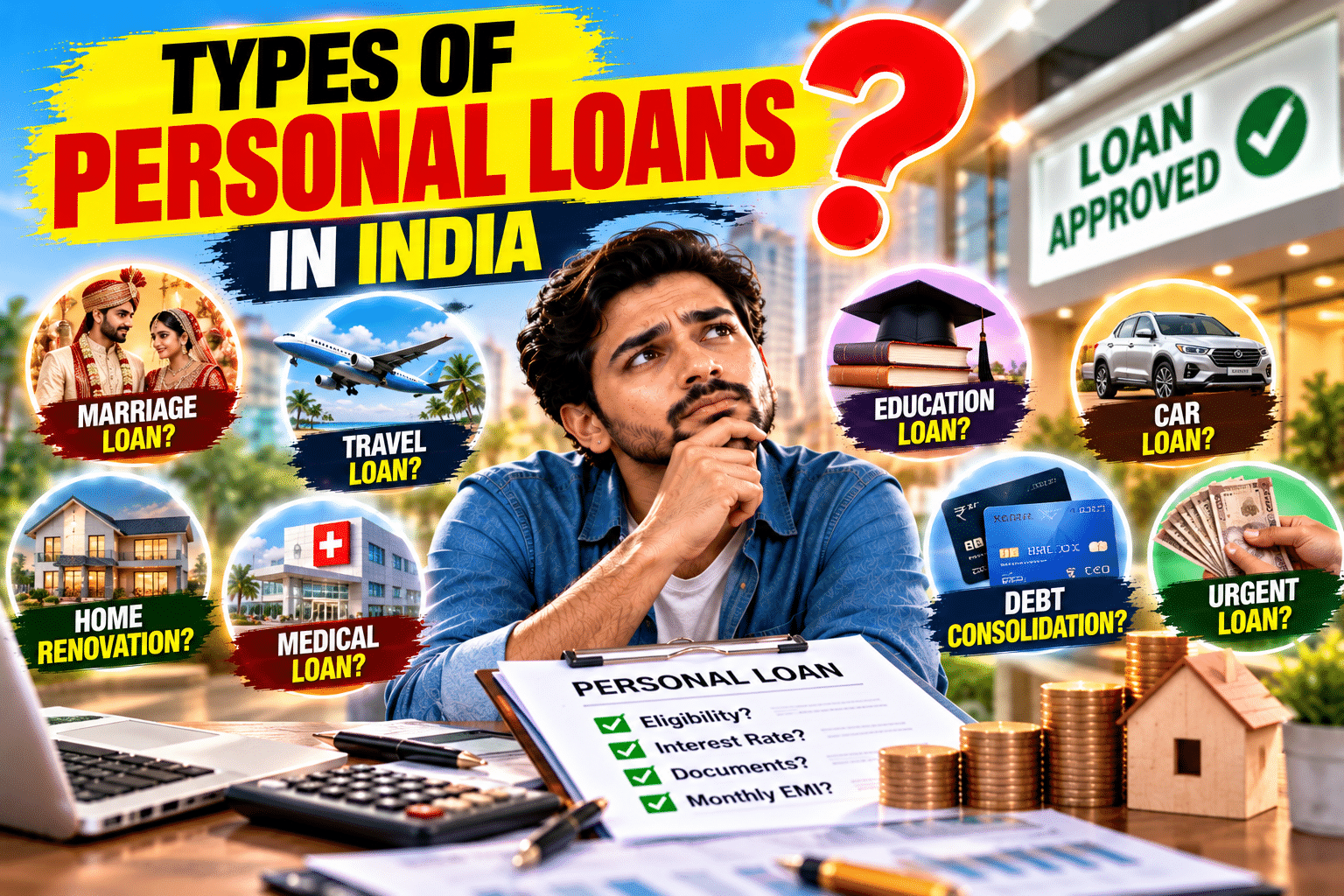
12 Types of Personal Loans in India: A financial need can arise when you least expect it. You might be planning a wedding, preparing for an important trip, renovating your home, or dealing with a medical emergency. Sometimes, even a carefully managed budget is not enough to cover a large expense at once.
A personal loan can help bridge that gap by providing funds that you repay over an agreed period through monthly instalments. Since most personal loans are unsecured, borrowers generally do not need to pledge property, gold or another asset as collateral.
But not every personal loan serves the same purpose. Some are marketed for specific needs, such as travel, education or home improvement, while others offer flexible access to funds for eligible personal expenses. Borrowers may also encounter options such as top-up loans, small loans, and overdraft-style credit facilities.
The important thing is to choose financing that fits your actual need and repayment capacity—not simply the loan with the fastest approval.
In this guide, Insurance & Finance Review explains 12 common personal loan categories in India, how they work, what to compare before applying, and how to avoid unnecessary borrowing costs.
What Is a Personal Loan?
A personal loan is a form of credit that allows an eligible borrower to receive funds from a bank or other lender and repay the amount over an agreed period, usually through equated monthly instalments (EMIs).
Most conventional personal loans are unsecured. This means the borrower does not normally need to pledge a specific asset as security. Instead, the lender assesses factors such as income, employment stability, credit history, existing financial commitments, and repayment capacity.
Personal loans may be used for a wide range of eligible expenses, depending on the lender’s terms. These can include medical bills, wedding expenses, home renovation, travel, education-related costs and debt consolidation.
The interest rate, loan amount, tenure, fees, and eligibility criteria vary between lenders and borrowers. Approval is not guaranteed, even when an applicant meets the basic published requirements.
12 Types of Personal Loans in India
Here is a quick overview of common personal-loan categories and the situations in which they may be useful.
| Personal loan type | Common purpose | What to consider |
|---|---|---|
| 1. Marriage loan | Wedding and related expenses | Keep the loan within a realistic wedding budget |
| 2. Travel loan | Holiday and travel costs | Avoid borrowing more than you can repay after the trip |
| 3. Home renovation loan | Repairs, upgrades, and interior work | Estimate the complete project cost before applying |
| 4. Debt consolidation loan | Combining eligible existing debts | Compare the total cost, not just the new EMI |
| 5. Medical emergency loan | Eligible healthcare expenses | Check insurance coverage and repayment affordability |
| 6. Education loan for personal expenses | Certain education-related costs | Compare with dedicated education-loan options |
| 7. Personal loan for women | Eligible personal expenses | Check actual eligibility and pricing; the label alone does not guarantee special terms |
| 8. Personal loan for government employees | Eligible personal expenses for qualifying employees | Review the lender’s employment and income criteria |
| 9. Top-up personal loan | Additional borrowing for an eligible existing borrower | Check the combined repayment burden |
| 10. Urgent personal loan | Time-sensitive eligible expenses | Verify fees, interest, and disbursal conditions |
| 11. Small personal loan | Relatively modest financial requirements | Avoid taking a larger amount than necessary |
| 12. Overdraft or flexible credit facility | Expenses that arise at different times | Understand interest calculation, fees and repayment rules |
These categories are not necessarily 12 separate regulated loan products. Some describe the intended use of a conventional personal loan, while others may have different eligibility, repayment or credit-facility structures.
1. Personal Loan for Marriage
Weddings can involve substantial expenses, from venue bookings and catering to clothing, photography, travel and accommodation for guests. When savings are insufficient, some families consider a personal loan to cover part of the cost.
A marriage loan is generally a personal loan marketed for wedding-related expenses. The lender may not require the borrower to pledge an asset, but approval depends on eligibility and the lender’s terms.
Potential Benefits
- Helps cover eligible wedding expenses when savings fall short.
- Allows repayment over an agreed period rather than paying the entire amount upfront.
- May be available through a relatively straightforward application process for eligible borrowers.
What Should You Consider?
Wedding expenses can increase quickly. Borrowing too much for a one-time celebration may leave you paying EMIs long after the event is over.
Prepare a realistic budget, separate essential expenses from optional upgrades, and borrow only the amount you genuinely need. Ensure the monthly instalment remains affordable after accounting for rent, household expenses, insurance and existing loans.
2. Personal Loan for Travel
A travel loan can help cover eligible expenses associated with a holiday, family trip or international journey. Depending on the lender and product, the funds may be used for costs such as flights, accommodation, transport and other travel-related requirements.
For people who want to spread a large expense over several months, this option may appear convenient.
Potential Benefits
- Helps manage the upfront cost of a planned trip.
- Provides a structured repayment schedule.
- May offer flexibility in how eligible funds are used.
What Should You Consider?
Travel is generally a discretionary expense. Borrowing for a holiday means that the trip may end well before the repayments do.
Before taking a loan, calculate the complete travel budget and consider whether saving in advance would be more economical. If you decide to borrow, compare the total repayment amount with the actual cost of the trip.
3. Personal Loan for Home Renovation
Home renovation can involve expenses that are difficult to cover from monthly income alone. Repairs, painting, plumbing, electrical upgrades, flooring, and interior improvements can all add up.
A personal loan for home renovation can provide funds for eligible improvements without necessarily requiring the borrower to mortgage the property.
Potential Benefits
- Helps fund repairs or upgrades when immediate payment is required.
- May suit smaller projects that do not justify a property-secured loan.
- Offers a predetermined repayment schedule.
What Should You Consider?
Prepare a detailed estimate before applying. Include materials, labour, transport, installation, and a reasonable allowance for unexpected expenses.
For a major renovation, compare a personal loan with other suitable financing options. A personal loan may be unsecured, but its interest rate and repayment period may differ from those of secured home-improvement financing.
Choose the option that provides a manageable total cost rather than focusing only on the EMI.
4. Personal Loan for Debt Consolidation
Managing several loans and credit card balances can make monthly finances complicated. Different payment dates, interest rates, and minimum dues can also increase the risk of missed payments.
Debt consolidation involves combining eligible existing debts into a single borrowing arrangement. Some borrowers use a personal loan to repay high-cost debt and replace multiple payments with one EMI.
Potential Benefits
- May simplify monthly repayment management.
- Could reduce borrowing costs if the new loan offers a genuinely lower overall cost.
- Provides a clearer repayment schedule.
What Should You Consider?
Debt consolidation does not automatically reduce debt. A lower EMI may simply reflect a longer repayment period, which can increase the total interest paid.
Before consolidating, compare:
- The interest rates on your existing debts.
- The new loan’s interest rate and processing fee.
- Any foreclosure or prepayment charges on existing loans.
- The total amount payable over the new repayment period.
- Whether you can avoid accumulating fresh credit card debt afterward.
Debt consolidation is most useful when it forms part of a plan to control spending and repay outstanding balances—not when it simply creates room for more borrowing.
5. Personal Loan for Medical Emergencies
Unexpected medical expenses can put significant pressure on a household budget. Treatment, hospitalisation, diagnostic tests, medicines and related travel may require funds before a family has time to arrange them.
A personal loan may help eligible borrowers cover certain healthcare expenses when savings and available insurance are insufficient.
Potential Benefits
- Provides another funding option for urgent eligible expenses.
- May help manage costs that are not fully covered by health insurance.
- Can spread repayment over an agreed period.
What Should You Consider?
First, check whether your health insurance policy covers the treatment and whether any reimbursement or cashless facility is available. A personal loan should not automatically be the first option if other suitable funding is available.
If borrowing is necessary, compare lenders and ensure that the EMI remains manageable during the recovery period. Medical expenses can be unpredictable, so avoid committing to a repayment schedule that leaves no room for other essential costs.
6. Personal Loan for Education-Related Expenses
Education can involve tuition fees, examination costs, accommodation, travel, learning materials, and professional development. Some borrowers consider a personal loan when they need funds for eligible education-related expenses.
However, a personal loan should not be confused with a dedicated education loan. Education loans may have different repayment structures, eligibility conditions, and other features designed specifically for educational funding.
Potential Benefits
- May help cover certain expenses when funds are required quickly.
- Can be considered for eligible costs not covered by another suitable financing arrangement.
- May offer flexibility in the use of funds, subject to the lender’s terms.
What Should You Consider?
Compare a personal loan with education-specific financing before making a decision. Consider the course duration, future income prospects, repayment start date, interest rate, and total cost.
If the education is expected to improve future earning capacity, estimate whether the likely income will support the repayments without placing excessive pressure on your finances.
7. Personal Loan for Women
Some lenders market personal loans specifically to women or offer eligibility-based financial products for women borrowers. Such loans may be used for eligible personal needs, including education, home improvements, family expenses, or professional development.
However, a personal loan labelled “for women” is not necessarily a separate loan category with universally different terms.
What Should You Check?
- Whether the lender has specific eligibility criteria for women applicants.
- Whether the interest rate or fees differ from its standard offering.
- The required income and employment documentation.
- The repayment tenure and any special conditions.
- Whether another loan product would be more suitable.
Do not assume that a product offers a lower interest rate simply because it is marketed to a particular group. Compare the written offer with other available options.
8. Personal Loan for Government Employees
Government employees may find personal loans useful for eligible expenses such as family requirements, education, home improvements, or unexpected bills.
Some lenders have products or eligibility criteria designed for applicants with particular employment profiles. Stable employment and regular income may support a lender’s assessment, but approval and pricing still depend on the individual application.
Potential Benefits
- May provide access to unsecured credit for eligible applicants.
- Offers a defined repayment schedule.
- Can be used for approved personal expenses.
What Should You Consider?
Government employment does not guarantee loan approval or the lowest interest rate. Lenders may also assess credit history, net monthly income, existing EMIs, and other financial commitments.
Compare offers based on the actual interest rate, fees, and total repayment amount. Borrow only what is needed and keep the EMI within a comfortable share of your take-home income.
9. Top-Up Personal Loan
A top-up personal loan provides additional borrowing to an eligible customer who already has a personal loan or qualifies under a lender’s top-up facility.
For example, an existing borrower may need extra funds for an unexpected expense while continuing to repay the original loan. Depending on the lender, a top-up may be available after reviewing repayment history and current eligibility.
Potential Benefits
- May offer additional funds without requiring an entirely unrelated financing arrangement.
- Could simplify borrowing for an eligible existing customer.
- May involve a streamlined process when the lender already holds relevant financial information.
What Should You Consider?
A top-up increases your total debt. Before accepting one, check the new loan amount, interest rate, revised EMI, remaining tenure and total repayment cost.
Also confirm whether the top-up replaces or adds to the existing loan. The structure matters because the total outstanding amount and repayment obligations may change significantly.
10. Urgent Personal Loan
An urgent personal loan is generally a personal loan marketed for situations in which funds are needed quickly. The underlying product may be a conventional unsecured loan with an expedited application or disbursal process.
It may be considered for a time-sensitive expense that cannot reasonably be postponed.
Potential Benefits
- May offer a faster application process for eligible borrowers.
- Can provide funds for approved urgent expenses.
- May require less paperwork when the lender already has verified customer information.
What Should You Consider?
“Instant” or “urgent” does not mean approval is guaranteed. Lenders may still need to verify identity, income, credit history, and other details.
Check the actual interest rate, processing fee, repayment schedule, and expected disbursal time. Avoid accepting expensive credit under pressure without reading the terms.
If you receive an unexpected loan offer through a message or phone call, verify it through the lender’s official website or customer-service channel before sharing personal or banking information.
11. Small Personal Loan
A small personal loan is intended for borrowers who need a relatively modest amount rather than a large loan. It may help cover a limited expense, such as an essential repair, a short-term financial gap, or another eligible personal requirement.
The minimum loan amount and repayment period depend on the lender’s product.
Potential Benefits
- May limit borrowing to the amount actually required.
- Can provide a structured way to repay a smaller expense.
- May be available through an online application process for eligible borrowers.
What Should You Consider?
A smaller loan is not necessarily a cheaper loan. Processing fees and other charges can represent a larger proportion of a small borrowing amount.
Compare the total cost, minimum tenure, and early-repayment conditions. If you can comfortably cover the expense from savings without undermining your emergency fund, borrowing may not be necessary.
12. Personal Loan Overdraft or Flexible Credit Facility
An overdraft-style personal credit facility may allow an eligible borrower to access funds from an approved limit as needed, rather than receiving and using the entire amount at once.
The structure varies by lender. Interest may be calculated on the amount utilised, while fees and repayment conditions depend on the agreement.
Potential Benefits
- Offers flexibility when the exact amount needed is uncertain.
- May suit expenses that arise at different times.
- Can allow the borrower to use only part of an approved limit.
What Should You Consider?
An overdraft facility is not identical to a standard personal loan. It may have different interest calculations, renewal conditions, fees and repayment requirements.
Ask the lender how interest is charged, whether there are commitment or maintenance fees, how repayments work, and what happens when the facility reaches its review or expiry date.
Use flexible credit carefully. Having access to an approved limit does not mean the entire amount should be treated as available income.
How to Choose the Right Personal Loan?
The best personal loan depends on your financial requirements, income, existing obligations, and ability to repay. Before applying, follow these steps.
1. Identify the Actual Expense
Start by determining exactly why you need the money. A medical expense, home renovation, and debt consolidation may require different financial approaches.
Avoid borrowing more simply because a lender offers a higher amount.
2. Compare Interest Rates and Fees
Review the interest rate, processing fee, applicable taxes, late-payment charges, and prepayment conditions. The lowest advertised rate may not be the rate offered to your profile.
Ask for the complete cost of the loan before accepting the offer.
3. Calculate Your EMI
Use an EMI calculator to estimate your monthly repayment. Enter the proposed loan amount, annual interest rate, and tenure, then compare different options.
Make sure the EMI remains affordable after accounting for rent, household expenses, insurance, savings, and existing EMIs.
4. Check Eligibility and Credit History
Lenders generally consider income, employment, credit history, and outstanding financial commitments. Review your credit report for errors and make timely payments on existing debts before applying.
Meeting the basic eligibility requirements does not guarantee approval.
5. Choose a Suitable Repayment Tenure
A longer tenure generally reduces the EMI but can increase the total interest paid. A shorter tenure may lower the overall interest cost but requires larger monthly payments.
Choose a period that balances affordability and total borrowing cost.
6. Read the Loan Agreement
Check the sanctioned amount, interest rate, repayment schedule, fees, default conditions, and early-repayment rules.
If any condition is unclear, ask the lender to explain it before you sign.
Documents Commonly Required for a Personal Loan
Documentation varies by lender and applicant profile. Commonly requested documents include:
| Document category | Examples |
|---|---|
| Identity proof | PAN, Aadhaar or another accepted identity document |
| Address proof | An accepted address document, such as a passport or eligible utility bill |
| Income proof | Recent salary slips, Form 16 or other income records requested by the lender |
| Bank statements | Recent statements showing income and financial activity |
| Employment details | Employer information or other proof of employment, where required |
| Application documents | Completed application form, photographs or other requested details |
Existing customers with eligible pre-approved offers may have a simpler application process, but the exact requirements depend on the lender and the specific offer.
Never share your OTP, PIN, or banking password with an agent claiming to guarantee loan approval.
Common Personal Loan Mistakes to Avoid
Even a legitimate personal loan can create financial pressure if it is poorly planned.
- Borrowing more than necessary: A larger loan means more principal to repay and potentially more interest.
- Choosing only by EMI: A low EMI may result from a longer tenure, increasing the total repayment amount.
- Ignoring processing fees: Charges and applicable taxes can make a loan more expensive than the advertised rate suggests.
- Taking a new loan to cover every expense: Repeated borrowing can lead to a debt cycle, especially when existing EMIs already consume a large share of income.
- Missing repayment dates: Late payments may result in charges and can negatively affect your credit history.
- Ignoring early-closure conditions: Some loans have specific prepayment or foreclosure terms. Check them before planning to repay early.
- Accepting an unverified offer: Apply only through a lender’s official channels and review the agreement before sharing sensitive information or making payments.
Final Verdict: Which Personal Loan Is Right for You?
Personal loans can help finance a variety of needs, from medical expenses and home renovation to weddings, travel and debt consolidation. Top-up loans, small loans and flexible credit facilities may also be useful for eligible borrowers under the right circumstances.
But the purpose of the loan is only one part of the decision. Interest rates, processing fees, tenure, repayment flexibility and your ability to manage the EMI matter just as much.
Before applying, compare suitable products, calculate the total borrowing cost, and make sure repayment will not compromise essential expenses or emergency savings.
Insurance & Finance Review takeaway: The right personal loan is not simply the one that gives you money fastest. It is the one that meets a genuine need while keeping your long-term finances manageable.
Frequently Asked Questions (FAQs)
1. What are the different types of personal loans in India?
Common categories include marriage loans, travel loans, home renovation loans, debt consolidation loans, medical emergency loans, education-related personal loans, loans marketed to women or government employees, top-up loans, urgent loans, small personal loans, and overdraft-style facilities.
2. Are all types of personal loans different products?
No. Many categories describe the intended use of a conventional personal loan. Other options, such as top-up loans and overdraft facilities, may have different structures or eligibility conditions. Always check the specific product terms.
3. Which personal loan is best for emergencies?
A personal loan may be suitable for an eligible emergency if you need funds quickly and can afford the repayments. Compare the interest rate, fees, and disbursal timeline, and consider available savings or insurance coverage first.
4. Can I use a personal loan for a wedding?
A personal loan may be used for eligible wedding-related expenses, subject to the lender’s terms. Prepare a budget and borrow only the amount you can comfortably repay.
5. Is a personal loan for travel a good idea?
It depends on your financial situation. Borrowing can spread the cost of a trip over time, but interest and fees increase the final expense. Saving in advance may be more economical if the trip is not urgent.
6. Can a personal loan help me consolidate debt?
Yes, an eligible personal loan may be used to repay certain existing debts. Compare the new loan’s total cost with your existing obligations and avoid accumulating new debt after consolidation.
7. What is a top-up personal loan?
A top-up personal loan is additional borrowing offered to eligible existing customers, subject to lender rules. It increases your total debt, so check the revised EMI, tenure, interest rate, and total repayment amount.
8. Can I get a personal loan without collateral?
Many conventional personal loans are unsecured, so applicants generally do not need to pledge property or another asset. Approval still depends on the lender’s eligibility and credit assessment.
9. Does a high credit score guarantee personal loan approval?
No. A strong credit history may support your application, but lenders also assess income, employment, existing debt, documentation, and other criteria.
10. How can I reduce the cost of a personal loan?
Compare lenders, select a suitable tenure, maintain a healthy credit profile, and borrow only what you need. Check all fees and consider early repayment only after reviewing the agreement and maintaining sufficient emergency savings.
11. Can I repay a personal loan early?
Early repayment may be possible, depending on the lender’s terms and applicable rules. Check for prepayment or foreclosure charges and calculate whether early closure would be financially beneficial.
12. What should I check before accepting a personal loan offer?
Confirm the interest rate, sanctioned amount, EMI, tenure, processing fees, total repayment amount, late-payment conditions, and early-repayment terms. Read the loan agreement carefully before accepting the offer.