
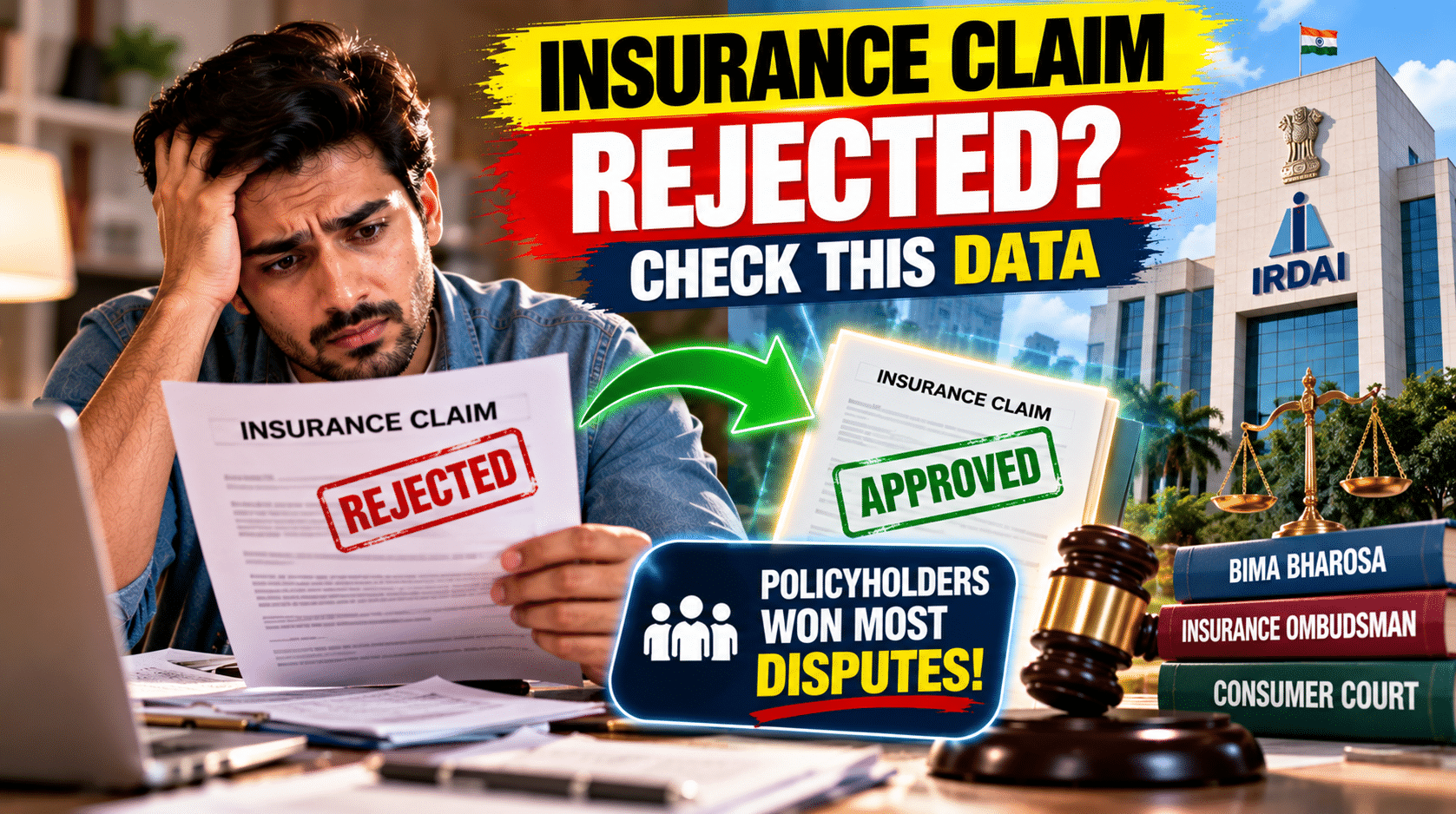
Insurance Claim Complaints in India: Buying insurance is supposed to provide financial protection when life takes an unexpected turn. Yet, for many policyholders, the real challenge begins when they file a claim and receive a rejection, a reduced settlement, or a response that does not adequately explain the insurer’s decision.
Newly reported figures from India’s insurance regulator, the Insurance Regulatory and Development Authority of India (IRDAI), offer an important insight into this problem. According to data discussed in a recent consultation paper, policyholders were successful in a significant proportion of complaints handled through different grievance-resolution channels during FY2025–26.
The reported figures show that policyholders won 63% of complaints resolved through Bima Bharosa, 75% at the insurance ombudsman level, and 54% of cases decided by consumer forums and courts. These numbers suggest that escalating a genuine dispute can make a meaningful difference. However, they do not guarantee that every rejected claim will be reversed.
For insurance customers, the bigger question is why so many disputes arise in the first place—and what they can do if their insurer refuses to pay.
IRDAI Data: How Often Do Policyholders Win Insurance Disputes?
The figures highlighted in the recent report show that customers were successful at every major stage of the complaint-resolution process covered by the data.
| Complaint resolution channel | Complaints decided in the policyholder’s favour |
|---|---|
| Bima Bharosa portal | 63% |
| Insurance ombudsman | 75% |
| Consumer forums and courts | 54% |
Source: Figures reported by Value Research Online from an IRDAI consultation paper. These percentages refer to reported complaint outcomes, not the overall percentage of all insurance claims paid.
The results challenge the assumption that challenging an insurer’s decision is unlikely to produce a favourable outcome.
The ombudsman channel recorded the highest reported success rate among the three. Consumer forums and courts also decided more than half of the cases covered by the reported figures in favour of policyholders.
However, the percentages should be interpreted carefully. The cases reaching each stage may differ in their facts, evidence, and eligibility. These figures do not establish that the same policyholder has a fixed probability of winning at every stage, nor do they measure the overall claim settlement rate of insurance companies.
Even with these limitations, the data underline an important lesson: a claim rejection should be examined against the policy terms and the evidence before the customer decides to give up.
Why Are Insurance Companies Facing So Many Complaints?
Insurance disputes can arise for several reasons. Some involve genuine disagreements over policy exclusions or incomplete documentation. Others may involve unclear communication, disputed interpretations of policy conditions, or decisions that customers believe are unfair.
The latest figures also point to a persistent problem with general insurance grievances.
According to the figures discussed in the report, complaints involving general insurance increased from 78,347 in FY2022–23 to 1,37,361 in FY2024–25. Approximately 68% of these complaints were related to claims, according to the article’s analysis.
That increase is concerning because insurance is purchased primarily to manage financial risks. When customers encounter difficulties at the time of a claim, the practical value of the protection they bought can come into question.
Several issues may contribute to disputes:
- Claim rejection: An insurer may decline a claim by citing a policy exclusion, a breach of conditions, or another reason that the customer disputes.
- Lower-than-expected settlement: The amount offered may be less than the policyholder believes is payable under the contract.
- Documentation disputes: Customers and insurers may disagree over whether the required records have been submitted or whether additional documents are relevant.
- Misunderstood policy terms: Customers may not fully understand waiting periods, exclusions, deductibles, co-payments, or other conditions when purchasing a policy.
- Delays and poor communication: A lack of clear explanations or prolonged correspondence can leave policyholders uncertain about the status of their claims.
Not every complaint indicates wrongdoing by an insurer. Some claims may legitimately fall outside the cover purchased. The important issue is whether the decision is consistent with the contract, supported by the relevant facts, and communicated fairly.
Why Are Policyholders Winning These Complaints?
There is no single explanation for the reported success rates. Each complaint depends on its own facts, documents, policy wording, and applicable rules.
Nevertheless, the results raise important questions about how some claims are assessed and how effectively insurers explain their decisions.
1. The insurer’s decision may not be adequately supported
A claim decision should be assessed against the policy terms and the evidence available. If an insurer relies on a reason that is not properly supported by the contract or the facts, a grievance authority may find grounds to disagree with that decision.
For example, a general assumption about a person’s health or lifestyle does not, by itself, establish that a particular insurance claim should be rejected. The relevant medical evidence, policy conditions, and circumstances of the claim must be considered.
2. Policyholders may have evidence that was overlooked
A customer may possess hospital records, bills, investigation reports, payment receipts, policy documents, or correspondence that supports their position.
Organising these records and presenting them clearly can help a grievance authority understand what happened and assess whether the insurer’s decision was justified.
3. Independent review can change the outcome
When a dispute moves beyond the insurer’s internal grievance team, another authority may examine the available evidence and the applicable policy conditions.
That independent review can identify problems that were not resolved during the initial exchange between the customer and the insurance company. It does not mean that every escalation will succeed, but it gives eligible policyholders a formal route to challenge a disputed decision.
4. The complaint may reveal a genuine service deficiency
A disagreement about coverage is not necessarily proof of misconduct. However, if an insurer fails to follow applicable requirements, gives an inadequately supported explanation, or handles a claim improperly, the complaint process can provide a way to seek redress.
The reported outcomes are a reminder that policyholders should understand their rights and use the available mechanisms when they believe a decision is wrong.
Rising Complaints Raise Questions About Accountability
A particularly important concern is whether the existing complaint-resolution system is doing enough to prevent disputes from arising.
If customers continue to win a substantial share of complaints after escalation, it is reasonable to ask whether some disputes could have been resolved earlier through better claim assessment, clearer explanations, and more effective internal grievance handling.
There is also a broader question about incentives. If resolving a complaint in favour of a customer does not lead to meaningful improvements in the practices that caused the dispute, the same types of grievances may continue.
The increase in reported general insurance complaints between FY2022–23 and FY2024–25 adds to that concern. The figures alone do not establish why complaints rose or prove that insurers routinely reject valid claims. However, they highlight the need for transparent decision-making and stronger attention to recurring customer problems.
For insurers, fair claim handling is not merely a regulatory obligation. It is central to customer trust and the credibility of the insurance product itself.
For regulators, complaint outcomes can help identify patterns that deserve closer scrutiny. For customers, the message is to retain records, ask for clear reasons, and understand the available options for challenging a decision.
What Should You Do If Your Insurance Claim Is Rejected?
If your health, life, motor, or other insurance claim has been rejected—or you believe the settlement is incorrect—avoid relying only on verbal discussions. A written record of the dispute can make it easier to explain your case.
Step 1: Read the rejection letter carefully
Identify the exact reason given by the insurer. Check whether it refers to a policy exclusion, a waiting period, missing documentation, non-disclosure, or another condition.
Compare the stated reason with the wording of your policy. Keep a copy of the rejection letter and any related claim assessment.
Step 2: Collect the relevant documents
The documents you need will depend on the type of insurance and the dispute. These may include:
- Your policy schedule and full policy wording
- The claim form and claim reference number
- Bills, receipts, medical records, or repair estimates, where applicable
- Copies of documents already submitted to the insurer
- The insurer’s written explanations and all relevant correspondence
Arrange the records in chronological order so that the sequence of events is easy to understand.
Step 3: File a written complaint with the insurer
Approach the insurer’s grievance redressal officer or designated grievance channel. Explain why you disagree with the decision and refer to the specific policy terms and documents supporting your position.
Ask for a written response. Keep the complaint acknowledgement and reference number for future follow-up.
Step 4: Escalate through Bima Bharosa if necessary
If the insurer does not resolve the issue satisfactorily, you can consider using IRDAI’s Bima Bharosa grievance management system.
The platform helps policyholders register and track grievances and enables IRDAI to monitor complaints against insurers. The regulator advises customers to approach the insurer’s grievance channel first, where possible.
Official resource: IRDAI Bima Bharosa and complaint channels.
Step 5: Consider the insurance ombudsman or another appropriate forum
Depending on the nature of the dispute, eligibility requirements, and the applicable procedure, you may be able to approach the Insurance Ombudsman or a consumer dispute redressal forum.
Check the current rules, monetary limits, filing requirements, and applicable deadlines before proceeding. Keep your complaint history and supporting documents ready.
A well-documented complaint is more useful than a general allegation. Explain what the insurer decided, why you believe that decision was incorrect, what evidence supports your position, and what resolution you are requesting.
Does a Rejected Insurance Claim Mean You Cannot Get Your Money?
No. A rejection is the insurer’s decision, but it does not necessarily mean that the dispute cannot be challenged.
Whether you can obtain a reversal or compensation depends on the facts, the policy wording, the reason for rejection, and the relevant legal and regulatory requirements.
For example, if you believe the insurer has misunderstood a policy condition or overlooked important evidence, you can ask for a review and provide supporting documents. If the matter remains unresolved, the appropriate grievance mechanism may examine the dispute.
At the same time, a claim may be declined legitimately when the loss is excluded from cover or the applicable policy requirements have not been met. The reported complaint-success figures should therefore be treated as an indication that escalation can be worthwhile—not as a promise of payment.
What This Means for Insurance Buyers in India?
The reported IRDAI figures offer a useful reminder that buying an insurance policy is only one part of financial protection. Understanding the contract and knowing how to raise a complaint are also important.
Before purchasing a policy, read the exclusions, waiting periods, claim requirements, deductibles, and co-payment provisions. Disclose relevant information accurately and retain copies of the documents submitted during the application process.
After purchasing a policy, keep the policy schedule, customer-care details, and claim procedure accessible. If you ever need to make a claim, submit the required information promptly and save all communication.
Most importantly, do not assume that an insurer’s first decision is beyond question. If you believe your claim has been wrongly rejected or underpaid, examine the reasons, gather evidence, and use the appropriate grievance process.
The latest complaint-outcome figures do not prove that every insurer behaves unfairly. They do show why a policyholder should know how to challenge a decision rather than automatically accepting an outcome they believe is unjustified.
Frequently Asked Questions (FAQs)
1. What percentage of insurance complaints did policyholders win in 2026?
According to the figures reported by Value Research Online from an IRDAI consultation paper, policyholders won 63% of complaints disposed of through Bima Bharosa, 75% at the insurance ombudsman level, and 54% of cases decided by consumer forums and courts during FY2025–26.
These figures relate to reported complaint outcomes, not the percentage of all insurance claims paid.
2. What is the Bima Bharosa portal?
Bima Bharosa is IRDAI’s grievance management system for insurance policyholders. It provides a channel for registering and tracking grievances and helps the regulator monitor complaints involving insurance companies.
Official website and information: IRDAI policyholder complaint channels.
3. What should I do first if my insurance claim is rejected?
Read the rejection letter, review the relevant policy conditions, gather supporting documents, and submit a written complaint through the insurer’s grievance redressal channel. Retain the acknowledgement and request a clear written response.
4. Can I complain to IRDAI if my insurance company does not resolve my issue?
Yes. If the insurer’s grievance process does not resolve your complaint satisfactorily, you can consider escalating it through Bima Bharosa or the relevant IRDAI grievance channel, following the applicable procedure.
5. Can the insurance ombudsman help with a rejected claim?
The Insurance Ombudsman can consider eligible insurance disputes under the applicable rules. Whether your complaint qualifies depends on the nature of the dispute and the relevant procedural requirements.
Check the current eligibility criteria and filing conditions before submitting a complaint.
6. Does a high complaint-success rate mean insurance companies reject most genuine claims?
No. Complaint-success rates and overall claim settlement rates measure different things. The reported figures cover complaints that reached and were resolved through particular channels. They do not establish that most genuine insurance claims are rejected.
7. What documents should I keep when disputing an insurance claim?
Keep your policy wording, policy schedule, claim form, rejection letter, supporting bills or medical records where relevant, copies of submitted documents, and all correspondence with the insurer. The precise documents required depend on the type of insurance and the issue being disputed.
8. Is it worth challenging a rejected insurance claim?
It may be worth challenging a decision if you have reasonable grounds to believe the insurer has misapplied the policy terms, overlooked evidence, or handled the claim improperly. The outcome is never guaranteed, so review the facts carefully and follow the appropriate complaint procedure.
Final Takeaway
India’s latest reported insurance complaint figures offer a reason for policyholders to pay closer attention to their rights. With substantial proportions of complaints reportedly decided in customers’ favour across multiple resolution channels, a rejected claim should not automatically be treated as the end of the process.
The practical approach is straightforward: understand your policy, keep your documents, request a clear explanation, and escalate a genuine dispute through the appropriate channel when necessary.
Disclaimer: This article is for general information and consumer awareness. Complaint outcomes depend on the facts, policy terms, and applicable rules. Verify current procedures and eligibility requirements through official IRDAI resources before filing a grievance.